
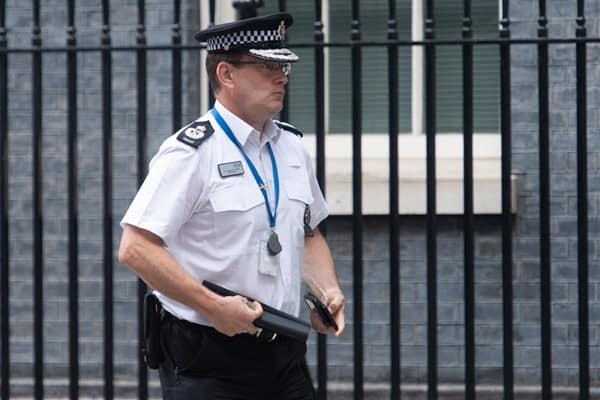
Police chiefs have been accused of compromising the principle of equality before the law after issuing guidance advising female officers to consider religious sensitivities when interacting with Muslim men.
Reform UK leader Nigel Farage condemned the National Police Chiefs’ Council (NPCC) recommendations as evidence of what he called “institutional two-tier policing”, demanding that the document be withdrawn and those responsible dismissed.
The guidance, contained in a national Faith Toolkit developed by the NPCC and the College of Policing, tells officers that “cultural factors should be considered when interacting with the opposite sex”. It says this applies to both physical contact and verbal communication, adding that in some circumstances an officer of the same sex may be better placed to deal with a Muslim individual.
Officers are also advised to avoid entering areas of mosques and Muslim homes designated for members of the opposite sex, dress modestly when visiting such premises and “avoid the use of dogs” when carrying out police work in Muslim spaces.
Read more related news:
‘Released, recalled, repeat’ as Police chief delivers brutal assessment of Labour’s prison experiment
Labour’s 13,000-officer promise in tatters as police ‘retreat from the streets’ as forces run out of money
Met Police still institutionally racist, misogynistic, homophobic and fear the press damning review finds
The recommendations have provoked a political row over whether forces are going too far in accommodating religious practices, and whether such advice risks placing cultural considerations above the equal treatment of citizens.
Mr Farage told The Telegraph: “This is outrageous and yet more proof of institutional two-tier policing. The police should not be bending over backwards to placate sexist and outdated cultures. If the police actually believed in equality before the law, the NPCC would remove this immediately and those responsible would be fired.”
Shadow Home Secretary Chris Philp also demanded that the toolkit be scrapped, accusing police chiefs of adopting an approach that could damage public confidence in policing.
He said: “This is precisely the kind of guidance that is harming policing. The police should treat everyone the same, whatever their faith or the colour of their skin, and any document telling officers otherwise is plainly wrong.
“My pleas to the NPCC and two Labour home secretaries to scrap guidance like this were ignored until the Henry Nowak murder. Much like the Police Race Action Plan, this toolkit should be withdrawn. The dangerous ideology behind this belongs in the bin.
“We cannot continue to treat people differently because of their faith or skin colour, in policing or anywhere else, is morally wrong and ends in disaster.”
The Faith Toolkit covers 23 religions and belief systems, including Christianity, Judaism, Islam, Buddhism, Sikhism and paganism. It is intended to help officers understand religious practices, places of worship, cultural sensitivities and requirements surrounding the treatment of the dead.
However, the section dealing with Islam is considerably longer and more detailed than those covering other faiths. It also contains additional advice on reporting anti-Muslim hate, with no equivalent instruction specifically addressing hate crimes against other religious communities.
The document identifies terrorist attacks and international developments, including elections, as periods when Muslim communities may be particularly vulnerable.
It also recommends that forensic examinations of deceased Muslim women should ideally be carried out by female officers of the same faith.
Other sections contain their own religious considerations. Women are advised to dress modestly when visiting Buddhist temples, while officers entering Orthodox synagogues are told to respect the separation of male and female areas. Male officers should not enter female galleries, while female officers should stay out of male areas.
The toolkit was developed with contributions from organisations representing police staff and religious communities, including the National Association of Muslim Police and the British Association for Women in Policing.
Its introduction, written by Rachel Kearton, the NPCC’s chair for race, inclusion, religion and belief, stresses the importance of understanding the cultural and religious circumstances in which officers operate.
But the recommendations have renewed questions about the boundary between respectful engagement with communities and the operational independence of police officers.
The NPCC defended the document, insisting that its purpose was to help officers work effectively across Britain’s increasingly diverse communities, rather than to create different standards of policing.
A spokesman said: “Policing serves and protects everyone regardless of faith, background or belief. The law applies equally to all.
“Policing operates within increasingly diverse communities. This guidance is a practical toolkit to help officers and staff to understand and engage effectively with different communities. Religious and cultural considerations do not override the law or the operational duties of police officers.”
The spokesman added that the same process had been followed for every faith group and that the toolkit covered broadly the same areas across all 23 religions and beliefs.
That defence has not silenced critics, who argue that the greater detail devoted to Islam and the absence of equivalent hate-crime reporting advice for other faiths demand closer examination.
The dispute now places police chiefs under pressure to explain how the guidance was drawn up, why its recommendations differ in detail between religions and how they will ensure officers can carry out their duties without religious sensitivities compromising operational decisions.


Leave a Comment