
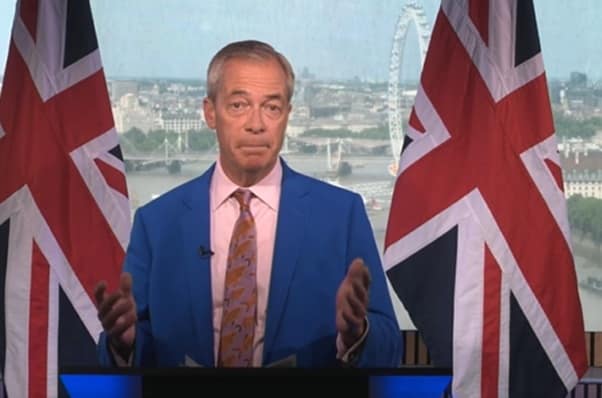
Nigel Farage has warned that Britain faces its most dangerous international security environment in 80 years, accusing successive Conservative and Labour governments of hollowing out the armed forces and promising a sweeping military overhaul if Reform UK wins power.
Addressing a packed press conference on Thursday, the Reform leader said defence had been pushed to the margins of political debate since the end of the Cold War, leaving Britain dangerously exposed as international tensions intensify.
The party used the announcement to introduce former military officer Angus MacIntyre as its new armed forces spokesman, with Farage presenting his appointment as part of a wider effort to bring experienced figures from outside Westminster into government.
Farage said: “The world is a more dangerous, unstable place than it’s been at any point, I would suggest, for the last 80 years.”
He argued that the collapse of the Berlin Wall had encouraged politicians to treat military readiness as a secondary concern, allowing defence budgets and armed forces capabilities to decline while the public debate moved elsewhere.
“You could argue that ever since the fall of the Berlin Wall, as we have cut our defence capability, that somehow defence, armed forces, veterans have been pushed out of public debate,” he said.
“But it is now vital that these issues and these people are put back at the centre of debate.”
Read more related news:
‘More experience than the entire government defence team’ as Farage recruits Ukraine war veteran
Badenoch warns ‘we’re at war now’ and ‘three days of tinned food won’t save us’ as UK is unprepared
Burnham faces devastating warning from Lord Dannatt over Britain’s defences as he’s ‘squandering 365 days’
The intervention comes as European governments face mounting pressure to strengthen military capabilities amid Russia’s war against Ukraine and growing concerns about the security of Nato’s eastern flank.
Farage also launched an attack on what he described as the narrow recruitment culture of British politics, arguing that government departments were too often run by ministers lacking experience beyond Westminster.
He said: “If you want to run health or defence or any other big department, the qualifications are you must have gone to Oxford University, you must have worked in a research department, you must have become an MP very, very young, and God forbid you’ve had any experience of a real job or a proper job in the real world.”
Over 14 years, the Tories destroyed our armed forces. They left them with 50,000 fewer personnel than they started with.
Our army hasn’t been this small since the 1790s. It’s underfunded and those who serve are treated as an afterthought.
Wing Commander (Retd) Angus MacIntyre,… pic.twitter.com/WKNVG2iFXq
— Nigel Farage (@Nigel_Farage) November 5, 2026
He criticised the frequent movement of ministers between departments, arguing that officials were often transferred before they had developed a proper understanding of their responsibilities.
“You wouldn’t run a company like this. You wouldn’t run the Army like this. And we should not run the country with people with no experience of real life in any way at all,” he said.
Farage reserved particular criticism for the established parties over their handling of defence expenditure. He argued that Conservative governments had cut military spending more aggressively than Labour administrations since the Cold War, although he insisted both political traditions bore responsibility.
“We’ve run defence down. And now I think really, since the fall of the Berlin Wall, it has been Conservative governments that have cut defence more than Labour governments – a point people need to understand and need to remember. But they’ve both been guilty.”
The Reform leader also sought to frame military spending as a question of national priorities, contrasting the amount Britain spends on welfare with its defence budget.
“Just think about this: we as a country this year will spend £330 billion on benefits, but will only spend £60 billion on defence,” he said.
“But without defence against potential threats, there’ll be no community, there’ll be no society, there’ll be no benefits. We have got our priorities wrong, we’ve got things back to front.”
His comments reflect Reform’s intention to make defence spending a central dividing line in the next general election, alongside its broader proposals to reduce welfare expenditure and redirect public money towards national security.
Farage warned that the decline in military resources was also damaging recruitment, claiming that young people no longer viewed service in the armed forces as an attractive or respected career.
“We are not getting many of the brightest and best young people now wanting to come into our military,” he said.
He argued that repeated cuts and the treatment of military veterans had contributed to a wider loss of confidence in the services, particularly among potential recruits.
MacIntyre, who served in the armed forces for four decades, offered a stark comparison between the military he joined and the one he was leaving.
“Forty years ago, I joined a military that numbered 330,000 troops. The Army had three armoured divisions, eight armoured brigades. The Navy had a surface fleet numbering nearly 50 frigates and destroyers. And the Royal Air Force had over 500 fast jets, fighter jets.
“Last week, I left a military that has less than half as many men and women under arms than when I joined.”
The former Royal Air Force officer said he had answered Farage’s call for people with practical experience to help the party prepare for government.
“I’m proud to have answered that call. I can think of no better way to continue my service to our great nation than by standing before you, and alongside Nigel and the Reform team, and explaining, despite the current state of our country and our armed forces, our best days still lie ahead.”
MacIntyre also blamed Britain’s industrial decline on government policy, placing particular emphasis on net zero measures, energy costs and immigration.
“Net zero policies have collapsed our industrial base, and they put our energy sovereignty at risk, giving us the most expensive energy in Europe,” he said.
He further claimed that uncontrolled illegal migration had brought “hundreds of thousands of undocumented fighting-age males, many with combat experience and operatives from hostile states, into the heart of our community”. He did not provide supporting evidence for those allegations during the press conference.
He argued that Britain’s ability to sustain a modern military ultimately depended on rebuilding domestic manufacturing capacity.
“A nation’s military strength depends on its ability to manufacture, to build things from its industrial base. That industrial base has been collapsed by our political class.”
The new spokesman also made veterans’ prosecutions a central part of his initial policy programme, pledging legislation within Reform’s first 100 days in government to prevent what he described as unjustified legal action against former soldiers.
“State-backed lawfare against our veterans has become a serious threat to Britain’s ability to defend itself,” he said.
He argued that military personnel needed certainty that they would be protected when carrying out lawful duties on behalf of the country.
“Reform UK will end this, giving our armed forces the certainty they need to carry out their duties, and our veterans the peace of mind they deserve.”
MacIntyre concluded with a personal commitment to deliver the policy, saying: “That’s why I will end the unjust prosecutions of our veterans in my first 100 days in office, or I will resign.”
The pledge adds a significant element to Reform’s attempt to establish its defence credentials, although its proposed legal protections and wider spending ambitions will face questions over implementation, cost and the safeguards needed to preserve accountability.
MacIntyre insisted Britain could reverse its military decline, declaring: “I am not a defeatist. I believe we can reverse the decline.”
For Farage, the challenge will be turning that confidence into a credible programme capable of addressing the armed forces’ manpower, equipment and industrial weaknesses. The party has made clear that it wants defence restored to the heart of national politics. Whether it can deliver the resources and structural reforms to match its rhetoric will be a central test of its preparations for government.


Leave a Comment