
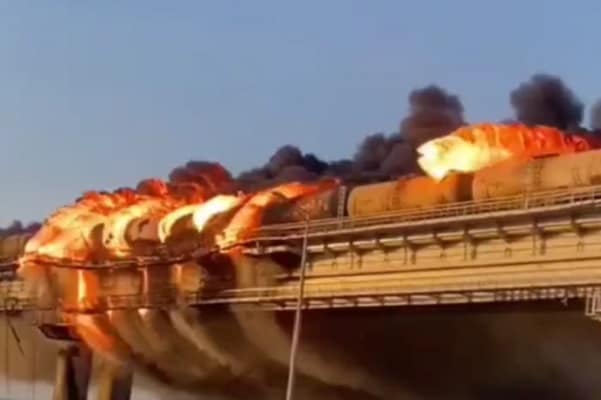
Volodymyr Zelensky has ordered the complete destruction of Vladimir Putin’s prized Crimean Bridge, with Ukrainian forces preparing further attacks to bring down the remaining sections of the strategically vital crossing, according to a report.
“The president wants it demolished completely,” a military source told The Telegraph, adding that fresh strikes against the surviving structure were already being prepared.
Destroying the entire bridge would deliver a major political and military victory for Kyiv, severing one of Moscow’s principal supply routes into occupied Crimea and striking at a key symbol of Russia’s control over the peninsula.
The revelations provide new details of Ukraine’s successive attacks on the Kerch Strait crossing between November 17 and 19, which caused a main metal arch and section of roadway to collapse into the sea before damaging adjacent railway tracks.
According to The Telegraph, the operation involved 11 different weapons systems and was the culmination of a seven-stage campaign to weaken Russian air and coastal defences before the bridge itself was targeted.
Read more related news:
‘Unknown sources’: Kremlin adviser raises prospect of attacks on British drone factories
Britain’s military masterplan: Call up 100,000 veterans, then try to find them
Putin bombs Ukraine into darkness whilst Trump’s envoy has the temerity to call it restraint
‘Everything from Tallinn to London’: Kremlin hardliner threatens nuclear strikes across Europe
Unmanned aerial vehicles launched the initial waves before Ukrainian Navy coastal defence units unleashed a major salvo of domestically manufactured Neptune cruise missiles. The units then rapidly relocated to avoid Russian counter-battery fire.
At around 2am local time, the missile brigade received confirmation that part of the roadway and its supporting arch had fallen into the water.
“Obviously, we had some beer,” one of the operation’s organisers recalled.
The following night, the brigade returned to launch a second strike, damaging and weakening the railway span. Those involved only discovered afterwards that the mission had been carried out on Zelensky’s direct orders.
The attacks could also influence Ukraine’s future weapons production. The Telegraph suggested that Zelensky might redirect defence funding from Flamingo missiles towards expanding production of Neptune cruise missiles.
Military sources said the shift could allow Ukraine to conduct “hundreds more missions”.
One Ukrainian military official questioned why Moscow believed it could repeatedly strike Ukrainian infrastructure without facing equivalent retaliation.
“I don’t get the Russians. They should have been aware that we possess such weapons. So why should they engage our bridges without realising we wouldn’t do the same with their bridges? The same logic applies to our power stations. Are the Russians ready to face the imminent consequences when we fire back?” the official told the newspaper.
The revelations follow Zelensky’s disclosure at a November 21 meeting with British Defence Secretary Wes Streeting that Russian forces had carried out 109 separate missile and drone attacks against Ukrainian bridges before Kyiv’s retaliation.
The Crimean crossing is a crucial military supply route, carrying tanks, armoured vehicles and artillery into Russian-occupied territory.
Ukraine’s Defence Minister Yevhenii Khmara has estimated that Russian engineering teams will need several months simply to lift and tow away the collapsed road arch and span. Divers have already been deployed to inspect the submerged wreckage.
Although Russian Deputy Prime Minister Marat Khusnullin claimed some road sections could reopen within one to two months, Moscow has begun preparing alternative routes.
The Kremlin has moved to release 20 billion rubles (£244million) ahead of schedule from its reserve fund to accelerate construction of a bypass around occupied Mariupol and widen the R-280 highway through occupied southern Ukraine.
But with Kyiv preparing further attacks, Russia faces the prospect of its damaged bridge becoming an even greater strategic liability.


Leave a Comment