
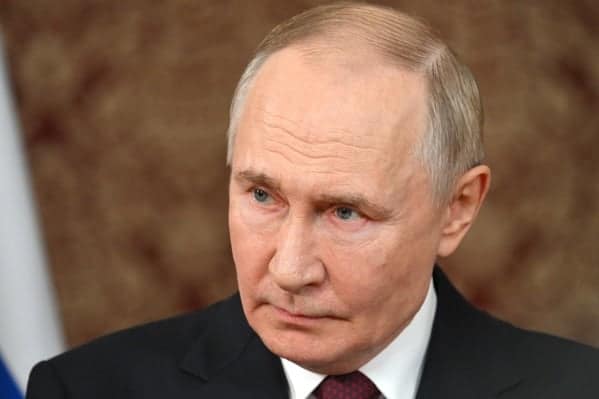
The latest round of peace negotiations in Abu Dhabi has brought Ukraine, Russia and the United States back to the negotiating table for the first time since February.
Washington describes the discussions as productive, but from where I sit in Ukraine, I see very little evidence that Vladimir Putin has fundamentally changed his position.
The American delegation, led by Jared Kushner and Steve Witkoff, arrived talking about progress, compromise and a new European security framework.
Kushner even claimed Washington had narrowed the gaps between the two sides, suggesting the negotiations could produce something far bigger than simply ending Russia’s invasion.
But narrowed what gaps, exactly?
The reality on the ground tells a very different story from the diplomatic optimism emerging from Abu Dhabi.
Russia continues targeting Ukraine’s power stations and energy infrastructure, even after UN investigators concluded that its systematic attacks on civilian energy infrastructure constitute crimes against humanity. These are not isolated incidents, but part of a sustained campaign against Ukraine’s civilian population.
Read more related news:
‘Putin lives in a different reality’: Ukraine sets Russian oil port ablaze as fireball lights up NATO skies
‘There’s not a snowball’s chance in hell of Putin just going away’ as Brits face chilling war warning
Civilian casualties have also risen sharply, returning to levels not seen since 2022. In September alone, the UN recorded 328 civilians killed and 2,105 injured, an 85% increase on September 2025.
On 2 November, Russian guided bombs struck the Dzherelo Gymnasium in Komyshuvakha, Zaporizhzhia Oblast, where civilians had gathered for a publicly announced humanitarian aid distribution. The school served as a regular aid distribution centre and civilian shelter, with the reported death toll subsequently rising to at least 55, including emergency responders. Subsequent Russian strikes reportedly hit the shelter where civilians had sought refuge, while drones targeted rescue workers searching the rubble.
Meanwhile, Russia’s intensified ballistic missile campaign against Ukrainian cities, supported by North Korean-supplied missiles, demonstrates the scale of military pressure being applied while Moscow discusses peace.
These are the measurable realities against which Moscow’s commitment to any peace agreement must be judged, so I ask again, what gap has actually been narrowed?
A lame-duck president is exactly that, and this one’s got a third-rate chief of staff and a bunch of fourth- and fifth-rate staffers playing diplomats… https://t.co/hQOy5HmDSG
— Shaun Pinner (@ShaunPinnerUA) November 10, 2026
Across the table sits a Russian delegation led by Vladimir Medinsky, joined by senior officials including Sergei Ryabkov, Mikhail Galuzin and military intelligence c
hief Igor Kostyukov. These are experienced representatives of the Kremlin’s political, diplomatic and military establishment, not individuals empowered to abandon Putin’s strategic objectives, objectives that remain remarkably familiar. Russia wants Ukraine weakened, territorially diminished and prevented from determining its own security arrangements. Moscow now wants those demands incorporated into a wider discussion about Europe’s future.
Kushner’s opening remarks were particularly revealing, he proposed creating a new framework, building on previous institutions and agreements, supposedly capable of delivering peace for decades, perhaps centuries.
But why are we discussing another European security framework when Russia deliberately violated the existing one?
The Helsinki Final Act, the UN Charter and the principles underpinning European security already established the foundations for sovereignty, territorial integrity and the peaceful settlement of disputes.
Then there is the 1994 Budapest Memorandum, under which Ukraine agreed to surrender the nuclear arsenal it inherited following the collapse of the Soviet Union, in exchange for security assurances from Russia, the United States and the United Kingdom, including commitments to respect Ukraine’s independence, sovereignty and existing borders.
Ukraine fulfilled its obligations, transferring its nuclear weapons to Russia and joining the Nuclear Non-Proliferation Treaty as a non-nuclear-weapon state. Russia subsequently violated too, breaking assurances when it invaded and annexed Crimea in 2014, followed by its full-scale invasion in 2022.
So what exactly makes another agreement more credible than the one Moscow has already disregarded?, creating another framework without consequences for violating previous agreements risks rewarding precisely the behaviour those arrangements were designed to prevent.
Even more concerning is the growing impression that Washington is moving away from the position of a neutral mediator and towards accommodating Moscow’s preferred negotiating agenda.
Russian Foreign Minister Sergei Lavrov has welcomed the broader security discussions, while Moscow has resisted direct European participation, that should concern every European capital.
When I received the second report from our negotiating team after their meetings in Abu Dhabi, they told me that the Russians think and say they have already occupied half of Donbas, which remains under our control. These were military officers, Russian intelligence, and they… pic.twitter.com/bs1c7blV1p
— Volodymyr Zelenskyy / Володимир Зеленський (@ZelenskyyUa) November 10, 2026
While President Volodymyr Zelenskyy has taken a more cautiously optimistic position, describing the discussions as constructive and highlighting progress on humanitarian matters, prisoner exchanges and security guarantees. In his latest public comments, he emphasised the importance of guarantees that can actually be implemented, and that’s understandable, any opportunity to bring prisoners home or recover Ukrainian children deserves serious consideration, but diplomacy must also confront Russia’s manufactured battlefield reality.
Moscow repeatedly presents territorial claims, exaggerated military successes and political demands as established facts, expecting everyone else to negotiate around them, while the reality on the battlefield is considerably less favourable to Putin than his propaganda suggests. Russia has spent years attempting to capture the remaining Ukrainian-held areas of Donetsk, suffering enormous losses without achieving its objectives, while on 8 November alone, Ukraine’s General Staff reported 2,980 Russian soldiers killed or seriously wounded, the highest single-day losses recorded since the full-scale invasion began.
Yet despite these staggering losses, Moscow continues demanding territory its military has been unable to capture, expecting Ukraine to surrender at the negotiating table what Russia has failed to take on the battlefield, yet, Washington continues discussing territorial compromises involving land Russia cannot take militarily, and why should Ukraine surrender strategically vital defensive positions, including the Fortress Belt in Donetsk, simply because Putin demands them?
We must also consider the changing political landscape in Washington. Donald Trump is now a lame-duck president in political terms, having lost considerable domestic momentum following a catastrophic midterm election result. Although the new Congress will not take its seats until January, the political consequences are already being felt, and the administration faces the prospect of far greater congressional scrutiny and opposition to its policies.
Yet rather than reconsidering its approach, Trump appears to be doubling down on an increasingly pro-Russian negotiating agenda, with Kushner and Witkoff continuing to pursue concessions from Ukraine while Moscow offers little, in return.
I believe this significantly undermines the prospects of any meaningful breakthrough in Abu Dhabi. Putin knows the political clock is ticking in Washington, and with Trump’s domestic authority weakened, Moscow has even less incentive to make genuine concessions, why compromise now when delaying might produce a more favourable outcome?
For these reasons, I remain deeply sceptical that these talks will achieve anything substantial. Until continuing this war costs Putin more than ending it, another diplomatic framework, however grand its title, changes very little.
And peace without accountability risks becoming nothing more than the foundations of Russia’s next war.


Leave a Comment