
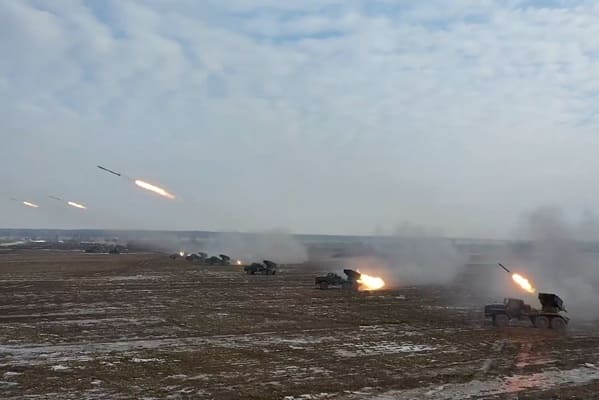
Russia and four allied countries have launched military exercises in Belarus involving more than 1,500 troops, 300 pieces of military equipment and around 80 drones, as growing concern over Moscow’s military partnership with Minsk puts one of NATO’s most strategically sensitive corridors under renewed scrutiny.
The drills, which began on October 12 and run until October 16, are taking place at two training grounds in Belarus. They bring together military contingents from Russia, Belarus, Kazakhstan, Kyrgyzstan and Tajikistan under the Russian-led Collective Security Treaty Organisation (CSTO).
The alliance said the exercises were designed to train its “peacekeeping forces” and included scenarios involving responses to biological threats.
Mirlan Turgunbekov, the CSTO’s deputy secretary-general, described the manoeuvres as “particularly relevant given the escalating military and political situation”.
The exercises come as Belarus deepens its military cooperation with Moscow, having allowed Russian forces to use its territory as a staging ground for the full-scale invasion of Ukraine in February 2022.
Read more related news:
Streeting warns Britain faces unprecedented risk of war with Russia
Bunker rat does not want peace and rejects 60-day ceasefire offering Ukraine just 24 hours to vote
Kremlin warns of assassinations on European defence chiefs for ‘doing business with Ukraine’
Expert fears UK and Europe ‘will wake up only after capitals are hit’ then ‘it’s too late’
NATO chief warns Russia we are ‘ready to fight tonight’ as ex-general raises conscription alarm
Although Belarus has not officially deployed its own troops to fight in Ukraine, President Alexander Lukashenko has repeatedly reaffirmed his commitment to Russia’s war strategy, underlining the extent to which Moscow can rely on its neighbour without formally involving Belarusian combat units.
In remarks reported by Belarusian state news agency BelTA, Lukashenko acknowledged that the two leaders sometimes joked about which of them was the greater “co-aggressor”.
“In the end, we are ‘co-aggressors’ with him. We have one question, which we sometimes discuss jokingly: who is more of an ‘aggressor’ – me or him?” he said.
Lukashenko added that Belarus would remain aligned with the Kremlin even where he disagreed with Moscow’s assessment of the conflict.
“I have my own understanding of individual aspects of the conflict in Ukraine, but we will always be committed to our common course,” he said.
“If you, the leadership of Russia, make a decision, we will always be with you, despite our particular understanding of what is happening there. We have never been traitors.”
He also declared that Belarus would “never allow anyone to shoot Russia in the back”, describing the relationship between the two countries as an indivisible geopolitical space stretching “from Brest to Vladivostok”.
For Kyiv and its western allies, the statements reinforce concerns that Belarus remains an important component of Russia’s military posture, even without sending its own soldiers into Ukraine.
The wider security implications extend to NATO’s eastern flank, particularly the Suwałki Gap, the narrow corridor between Poland and Lithuania that connects the Baltic states to the rest of the alliance by land.
Belarus has deployed tanks, artillery and drone units near the area during military exercises focused on border defence and countering simulated sabotage teams. The corridor is strategically sensitive because of its proximity to Belarus and Russia’s Kaliningrad exclave.
Britain has indicated that high-readiness forces could be deployed under NATO defence plans if Russia and Belarus attempted to close the corridor.
Defence Minister Louise Sandher-Jones said the UK remained committed to the alliance’s collective defence arrangements.
“NATO has the capability and commitment to defend every inch of Alliance territory,” she said.
“The UK remains staunchly committed to NATO’s collective defence obligation, offering almost all of our Armed Forces to NATO including high-readiness forces, which can be deployed as part of NATO’s collective defence plans if necessary.”
The prospect of a confrontation over the Suwałki Gap carries particular significance given Russia’s military build-up before its 2022 invasion of Ukraine. However, the current exercises do not in themselves establish that Moscow or Minsk intends to launch an attack.
Established in 2002, the CSTO comprises Russia, Belarus, Kazakhstan, Kyrgyzstan, Tajikistan and Armenia, although Armenia is not participating in the latest drills.
Russia remains the alliance’s dominant military power, with the exercises demonstrating continued cooperation between Moscow and four partners at a time of heightened tensions with the West.
For NATO, the challenge is to deter any attempt to test the alliance’s eastern defences while avoiding assumptions that every Russian-led exercise signals an imminent escalation.
But Lukashenko’s declaration that Belarus will stand with Putin regardless of disagreements over the war leaves little doubt about the political alignment underpinning the military partnership.
As troops, armoured vehicles and drones operate across Belarus, the country’s role in Russia’s wider confrontation with the West remains a central concern for European security planners.


Leave a Comment