
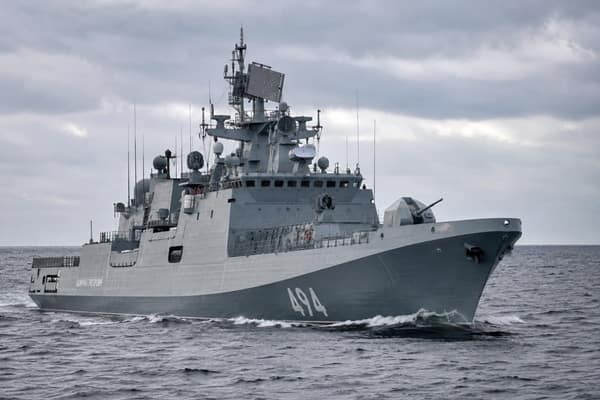
Vladimir Putin has raised tensions in the Baltic with the deployment of the Russian frigate Admiral Kasatonov near Germany, adding a military dimension to an increasingly bitter dispute over Moscow’s maritime trade and Western sanctions.
The warship, reported near the German island of Fehmarn, is equipped with long-range strike weapons including Zircon hypersonic missiles. Tracking data cited by The Telegraph indicated that the frigate was operating with its automatic identification system switched off, making its movements less visible to commercial shipping and maritime authorities.
The deployment comes as Moscow has issued increasingly explicit warnings over Western efforts to intercept vessels associated with Russia’s so-called shadow fleet, a network of ships used to transport Russian oil and circumvent sanctions.
In June, British forces reportedly boarded and seized the Smyrtos, a tanker linked to the shadow-fleet network. France has also intercepted Russian-linked vessels, prompting Putin to accuse Western governments of “piracy” and threaten retaliation.
The resulting confrontation illustrates a widening gap between economic sanctions and military risk. European governments are attempting to enforce restrictions on Russian trade while avoiding actions that could trigger a direct confrontation with Moscow. Russia, meanwhile, has sought to make the enforcement of those sanctions progressively more costly.
The Baltic is particularly sensitive. Much of the sea is now surrounded by Nato members, leaving Russian naval movements under close surveillance while increasing the possibility of encounters involving military and commercial vessels.
The deployment also comes against a broader deterioration in European security. Russia has expanded its use of drones and missiles in Ukraine and is developing infrastructure capable of supporting larger-scale long-range strikes.
For European capitals, the immediate concern is therefore less whether the Kasatonov represents preparation for an attack than whether Moscow is testing how far it can push Nato without provoking a military response.
That calculation is becoming increasingly important as European governments reinforce the alliance’s eastern flank and seek to protect shipping, energy infrastructure and critical trade routes.
The Baltic is no longer merely a commercial corridor. It is becoming one of the clearest arenas in which Russia and Europe are testing the limits of confrontation without crossing the threshold into war.


Leave a Comment