
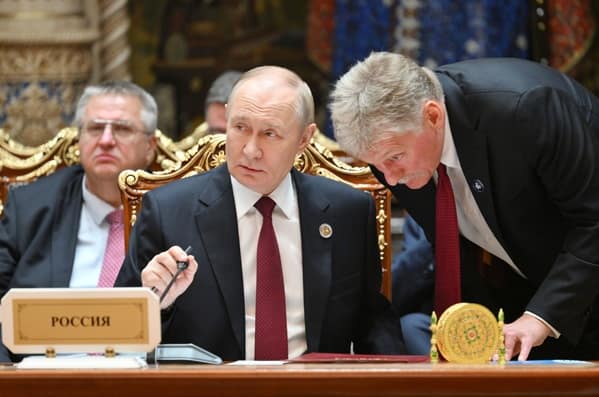
Vladimir Putin has reaffirmed Russia’s nuclear cooperation with Iran, delivering a pointed geopolitical message to Donald Trump as Moscow and Tehran strengthen economic and strategic ties amid escalating Middle East tensions.
The Russian president confirmed that construction of Iran’s Bushehr Nuclear Power Plant would continue and that Moscow remained committed to its joint obligations with Tehran, following high-level talks with Iranian President Masoud Pezeshkian at the Kremlin.
The meeting underlines the limits of Washington’s ability to isolate Iran diplomatically as Russia presses ahead with a partnership that spans nuclear energy, trade, education and political cooperation.
Putin met Pezeshkian on Tuesday evening on the sidelines of the eighth summit of the Gas Exporting Countries Forum. Before their wider delegations joined the discussions, the two leaders held private talks on the deteriorating situation in the Middle East.
Senior Russian officials attending the subsequent discussions included Foreign Minister Sergei Lavrov, Rosatom chief Alexei Likhachev and Dmitry Shugaev, who oversees military-technical cooperation.
Read more related news:
‘A stronger Europe in a stronger NATO’: Britain and Poland forge new missile alliance against Russian threat
Assassination ‘plots have reached advanced stages’ as US intelligence sounds alarm over Iran
‘The scariest thing was to fall asleep’: UN exposes the human cost of Russia’s winter war on Ukraine
Fears of all-out war ‘within days’: Netanyahu issues chilling threat as US prepares new Iran attacks
Putin’s message was unequivocal: Russia intends to honour its commitments to Iran despite mounting international tensions.
“For our part, we are fulfilling all the obligations we have assumed under our joint projects,” he said, confirming that construction of the Bushehr nuclear power plant was continuing.
The Russian president also pointed to expanding commercial links between the two countries, saying bilateral trade had increased by 10.4 per cent during the first eight months of the year.
The figure offered a further indication of Moscow and Tehran’s determination to deepen economic cooperation despite pressure from the United States and the wider geopolitical consequences of the conflict in the Middle East.
Putin’s Iran nuclear deal sends a message to Trump
Putin’s reaffirmation of nuclear cooperation is significant because it demonstrates that Russia is not prepared to abandon a strategically important relationship with Tehran in response to Washington’s pressure.
Although the Kremlin’s statement did not explicitly frame the Bushehr project as a challenge to Trump, its timing gives the commitment wider geopolitical significance.
For the US president, the meeting highlights a persistent obstacle to efforts to contain Iran’s influence: Moscow has its own economic, diplomatic and strategic interests in maintaining close relations with the Islamic Republic.
Russia’s cooperation with Iran also forms part of a broader effort by both governments to promote a multipolar international order in which American influence is less dominant.
The nuclear project is civilian in purpose, and continued construction does not by itself establish that Russia is assisting an Iranian nuclear weapons programme. Nevertheless, nuclear cooperation remains politically sensitive given the wider international dispute over Iran’s nuclear activities and regional security.
Putin presented the relationship as a long-term partnership built around shared interests rather than a temporary alignment.
He also highlighted humanitarian links between the countries, noting that approximately 10,000 Iranian students were studying at Russian universities.
The combination of energy investment, expanding trade and educational ties illustrates the breadth of the relationship Moscow is seeking to preserve.
Iran’s President calls for a Middle East without US security dependence
Pezeshkian used the Kremlin meeting to deliver a direct criticism of Washington’s regional military posture, arguing that countries in the Middle East should be capable of addressing their security challenges without American assistance.
He thanked Putin for Russia’s political and economic support before turning to the wider consequences of US actions in the region.
“After the United States embarked on aggressive actions in the region, it became clear to everyone that we must work to shape a multipolar world,” the Iranian president said.
His remarks reflected Tehran’s longstanding opposition to American influence and its ambition to build closer relationships with powers willing to challenge Washington’s international position.
Pezeshkian went further, arguing that regional governments could resolve their problems without relying on the United States.
“I believe that we can work on all the problems we have in the region and that we are capable of resolving all our problems and all regional issues without the United States,” he said.
He added that countries in the region could assist one another across scientific, economic, cultural, humanitarian and security fields.
The comments amount to a call for a regional order less dependent on Washington, although they do not establish that neighbouring governments are prepared to adopt Iran’s position.
For Moscow, the rhetoric offers an opportunity to present Russia as a partner for governments seeking alternatives to US-led security arrangements.
Russia-Iran trade and nuclear cooperation deepen
Putin’s announcement also highlighted the economic foundations underpinning the relationship.
According to the Russian president, bilateral trade rose by 10.4 per cent in the first eight months of the year. He described cooperation as expanding across multiple areas, with the Bushehr nuclear power plant remaining a prominent joint project.
The figures and commitments cited by Putin were presented by the Kremlin as evidence of progress in Russian-Iranian relations. The precise basis of the trade calculation was not provided in the remarks quoted.
The partnership is particularly important to Moscow as it seeks to maintain international relationships despite Western pressure. For Tehran, closer ties with Russia offer diplomatic support, economic opportunities and access to cooperation in strategically important sectors.
However, the relationship should not automatically be interpreted as a formal military alliance or as evidence that Russia and Iran agree on every regional issue. Their cooperation reflects overlapping interests, but the precise limits of their commitments depend on the individual agreements involved.
The Bushehr project is therefore both an energy undertaking and a symbol of the countries’ continued political engagement.
A geopolitical challenge for Washington
The Kremlin talks deliver a clear diplomatic signal: Russia intends to continue working with Iran even as tensions in the Middle East intensify and the United States seeks to exert pressure on Tehran.
For Trump, the immediate significance lies less in a new announcement of military cooperation than in the public reaffirmation of a relationship Washington has limited ability to dictate.
Putin has confirmed that Russia will continue construction at Bushehr and fulfil its existing joint commitments. Pezeshkian, meanwhile, has used the meeting to advocate a regional order that relies less on American power.
Together, the statements reveal a shared political message, even if the two countries’ interests are not identical: neither Moscow nor Tehran intends to make its bilateral relationship dependent solely on Washington’s preferences.
Whether that alignment translates into greater practical cooperation across energy, trade or regional security remains to be seen.
But the Kremlin meeting has reinforced a central challenge for US foreign policy: pressure on one country does not necessarily prevent it from deepening ties with another major power.
For now, Putin’s pledge to Iran makes clear that Russia’s nuclear cooperation with Tehran is continuing — and that Moscow is prepared to defend the relationship as a matter of its own national interest.


Leave a Comment