
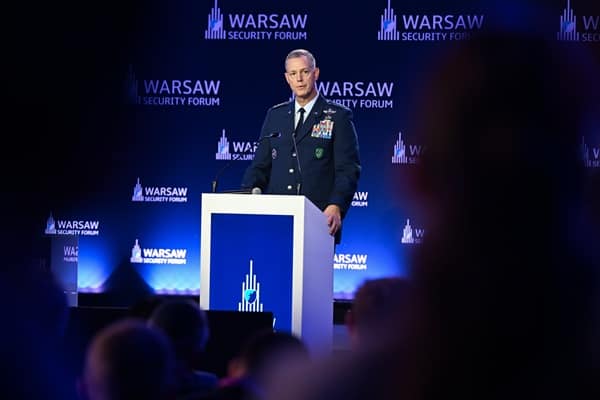
NATO’s top military commander has warned that alliance forces are ready to fight Russia “tonight”, promising to destroy the entire system sustaining any attack on member territory as European governments confront mounting fears over the continent’s preparedness for war.
General Alexus Grynkewich, the US Air Force officer serving as Supreme Allied Commander Europe, delivered the stark message at a security conference in Warsaw after an address by Ukrainian President Volodymyr Zelenskyy.
He stressed that he did not believe conflict with Moscow was “imminent or inevitable”. But his warning was unequivocal; any Russian assault on NATO territory would trigger a response designed not merely to repel the attacking troops, but to dismantle the military machinery supporting them.
“Should the adversary choose to press the attack or commit his reserves, we will break the warfighting system engaged against us,” Grynkewich said.
“This includes not just the attacking force itself, but anything and everything that supports, sustains, and controls that force.”
Read more related news:
Streeting warns Britain faces unprecedented risk of war with Russia
Bunker rat does not want peace and rejects 60-day ceasefire offering Ukraine just 24 hours to vote
Kremlin warns of assassinations on European defence chiefs for ‘doing business with Ukraine’
Expert fears UK and Europe ‘will wake up only after capitals are hit’ then ‘it’s too late’
Trump’s Putin diesel deal is ‘catastrophic’ as ‘ordinary Ukrainians will pay with their lives’
The commander said NATO would block, blunt and break an attack against any of its members, ensuring that an aggressor’s objectives became impossible to achieve.
“If someone is foolish enough to attack us, we will fight,” he said. “We will stop the attack and deny them the ability to achieve their objectives, whatever those might be.”
He added: “We will, in short, ensure any attack against any ally proves utterly futile.”
Although Grynkewich did not explicitly name Russia, his remarks come amid growing alarm across Europe over Moscow’s military posture and alleged campaigns of sabotage, drone incursions and cyberattacks against Western countries.
NATO’s 2022 Strategic Concept identifies Russia as the alliance’s most significant and direct threat to security. European capitals have increasingly questioned whether their armed forces possess the manpower, equipment and industrial capacity required to withstand a major confrontation.
Grynkewich argued that NATO’s ability to deliver overwhelming military effects, coupled with its capacity to match an adversary’s escalation, should deter any attack.
“These same factors should also give pause to any adversary seeing an alliance united, strong and ready,” he said, adding that the military cost of escalation should quickly become apparent.
Yet the confidence of NATO’s senior commander contrasts with warnings from former British military leaders that the UK itself may be inadequately prepared for a prolonged conflict.
Sir Richard Shirreff, a former deputy supreme allied commander Europe, recently argued that Britain’s armed forces could require some form of conscription to generate the manpower needed for a major war.
Comparing today’s atmosphere with the years before the First World War, he told the BBC: “In a sense it’s now a bit like those Edwardian summers before 1914, when there was a lot of talk of war, but the notion of actually going to war seemed so far-fetched as to be beyond belief, and I think that’s where we are at the moment.”
He warned that an army of about 70,000 regular personnel would be insufficient for the conflict Britain might face, arguing that the country should examine recruitment and training systems used elsewhere in Europe.
Shirreff highlighted Norway’s approach to registering young people for military service and selecting recruits for training, suggesting national service could also strengthen employment prospects.
“The case has to be made honestly by political leaders who must really look the population in the eye and say ‘this has got to be done for us to be secure’,” he said.
The two warnings expose Europe’s central security dilemma; NATO’s leaders want Moscow to believe an attack would fail, while governments must still persuade their own populations that the continent has the forces, resources and political resolve to make that deterrence credible.


Leave a Comment