
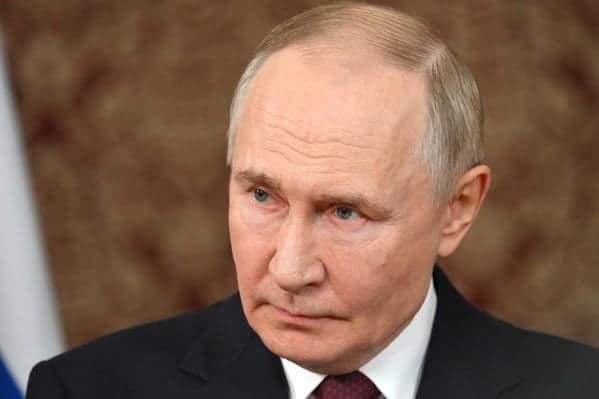
Vladimir Putin has offered Ukraine a ceasefire lasting just one day to hold presidential elections, rejecting Kyiv’s demand for a full, unconditional 60-day truce and intensifying a diplomatic confrontation over Volodymyr Zelensky’s political future.
The Kremlin dismissed the Ukrainian president’s proposal as an attempt to buy time for his military, accusing Kyiv of seeking a pause in fighting to rebuild its forces rather than organise a democratic vote.
Dmitry Peskov, Vladimir Putin’s spokesman, said on Monday that Moscow would consider suspending attacks on election day but rejected the need for a longer ceasefire.
“They really don’t want to hold elections in Kyiv. That’s completely obvious,” Peskov claimed, according to Russian state news agency RIA Novosti.
“And they don’t need a 60-day ceasefire for the elections, but to gather their strength, heal their wounds, and continue the war,” he added.
Read more related news:
Putin rejects peace receives diesel, Trump eases pressure and Ukraine get the bombs
Putin makes Trump look a fool as Russian missiles smash power plant hours after ceasefire plea
Poland foils alleged assassination plot against Tusk and defence chief
Trump’s Putin diesel deal is ‘catastrophic’ as ‘ordinary Ukrainians will pay with their lives’
Peskov subsequently said Putin would be prepared to order Russian forces not to strike Ukraine on the day of an election, according to the independent Russian outlet Astra.
“President [Putin] has already spoken about this, but in this case, I can say with full responsibility on his behalf that if they really do want to hold elections in Kyiv, the president of the Russian Federation, the supreme commander-in-chief, will be prepared to order no strikes on Ukraine on election day,” he said.
“Specifically, on election day.”
The offer falls far short of the 60-day unconditional ceasefire Mr Zelensky demands, arguing that Ukraine needs a sustained halt to hostilities to organise elections safely.
The proposal came after Donald Trump called for Ukraine to “get a new President”, renewing pressure on the Ukrainian leader as Washington attempts to force progress towards ending the war.
The Kremlin echoed Mr Trump’s demand on Monday, further aligning Moscow’s public position with the US president’s increasingly confrontational approach towards Kyiv.
Mr Zelensky had told ABC News that Ukraine could organise elections if Russia agreed to suspend hostilities for two months.
“Please tell [Vladimir] Putin, give us two months, 60 days of total ceasefire, 60 days, and we will organise elections,” he said.
The dispute over voting has become another flashpoint in the strained relationship between Washington and Kyiv, with the question of Ukraine’s democratic legitimacy increasingly entangled with negotiations over the future of the war.
Mr Trump has repeatedly questioned Mr Zelensky’s political position since returning to the White House in 2025. In February that year, he called the Ukrainian president a “dictator”, days before their notorious confrontation at the White House on February 28.
The rhetoric subsequently eased as diplomatic efforts continued, but tensions resurfaced in December 2025, when Washington presented a 28-point peace plan reportedly drafted by the Kremlin.
The latest exchange suggests that the question of elections is once again becoming a central part of the diplomatic pressure being applied to Kyiv.
Yet holding a national vote during an active war presents formidable practical and security challenges. Continued Russian attacks on Ukrainian cities would expose voters and election officials to danger, while millions of displaced Ukrainians and military personnel could face difficulties participating in the process.
Questions also remain over how voting could be conducted fairly across the country, including areas affected by fighting and territories occupied by Russia.
The disagreement over elections follows a separate diplomatic confusion surrounding Mr Trump’s announcement of an immediate “energy ceasefire” between Russia and Ukraine.
On Sunday, the US president declared that both sides had agreed to halt attacks on energy infrastructure, issuing a public warning against violations.
“Effective immediately, there is an ENERGY CEASEFIRE in the War between Russia and Ukraine,” Mr Trump wrote on social media.
“Both parties have agreed. Do not break it!”
But Mr Zelensky subsequently said the announcement had come as a surprise, casting doubt on whether Moscow and Kyiv had reached a common understanding of the arrangement.
“The ceasefire announcement was news for me. But if Russians agree to an energy ceasefire, Ukraine will agree,” he told Axios.
“If [President Trump] negotiated it with Putin, please tell us when the ceasefire begins. We are ready and we will accept it.”
The apparent disconnect raised fresh questions about the substance of Washington’s diplomatic efforts and whether the Kremlin had committed to stopping attacks on Ukrainian energy infrastructure.
Russia’s state nuclear and energy corporation, Rosatom, meanwhile, said it expected a ceasefire agreement to be reached soon, allowing damaged equipment at the Zaporizhzhia thermal power station to be repaired.
For Kyiv, the competing proposals expose the difficulty of negotiating under pressure while Russian forces continue their campaign and Washington pushes for political concessions.
Moscow’s offer of a one-day pause leaves Ukraine facing a stark choice: accept a narrow window for elections without the security guarantees it has demanded, or reject an arrangement the Kremlin portrays as sufficient.
The central question is whether the proposals represent a credible route towards a settlement or another attempt to shape Ukraine’s political future while the war continues.
For now, the gap between Kyiv’s demand for 60 days without fighting and Moscow’s offer of a single election day underlines how far the two sides remain from agreeing even on the conditions for a vote, let alone the terms of peace.





Leave a Comment