
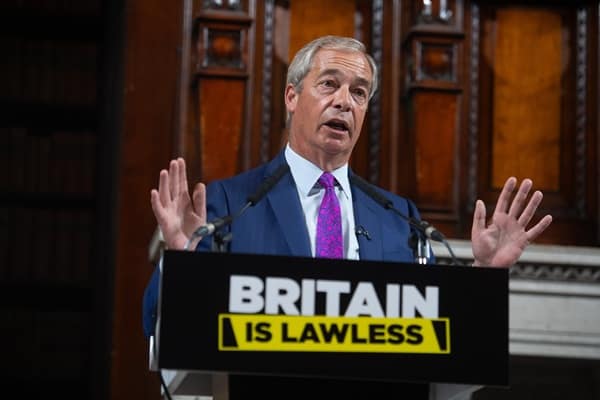
Nigel Farage has accused Andy Burnham of betraying young British workers by preparing to open the door to tens of thousands of EU citizens seeking jobs in the UK, reigniting the political battle over Brexit as Labour faces mounting pressure to tackle youth unemployment.
The Reform UK leader’s attack comes as the government considers a youth mobility agreement that could allow about 100,000 young Europeans to work in Britain each year, potentially for up to three years. Critics say the proposal risks intensifying competition for entry-level jobs at precisely the moment ministers are promising to help almost 1mn young people not in education, employment or training.
“The last thing we need is free movement of young EU citizens with one million Neets on the scrapheap,” Farage said. “Open Borders Burnham is betraying our young people.”
Former Conservative leader Sir Iain Duncan Smith warned that the proposed arrangement would put British school-leavers and disadvantaged young people in direct competition with European applicants for jobs in hospitality, retail and other lower-paid sectors.
“If Andy Burnham is serious about tackling the crisis faced by the one million Neets then he should not be opening the door to thousands of Europeans to come and take those jobs that do exist,” he told the Daily Mail.
“Burnham thinks there is some political advantage to be gained from cosying up to Brussels,” he added, arguing that young British workers would pay the price.
The row exposes a growing tension within Labour’s approach to the economy: ministers want closer economic ties with the EU, but face warnings that increased access to British jobs could undermine efforts to improve employment prospects for domestic workers.
Labour initially played down the prospect of a youth mobility scheme, describing it as synonymous with freedom of movement. But a source told the Daily Mail that Burnham had agreed in principle to allow EU citizens aged under 30 to work in Britain for up to three years, mirroring arrangements for young Britons seeking to work or study in Europe.
Ministers agreed to the principle last year but sought to restrict annual arrivals to fewer than 50,000 and limit stays to 12 months, partly to avoid counting participants in migration statistics.
Those limits now appear to be under pressure. A source said the annual cap was likely to be “much closer to 100,000 than 50,000” when the agreement is unveiled on Friday, although negotiations over the final figure remain under way.
The prospect of such an influx has drawn particular scrutiny following a report by former health secretary Alan Milburn, commissioned to examine the crisis facing young people shut out of employment and education.
Milburn argued that employers had become overdependent on migrant labour over the past 15 to 20 years and should make a greater effort to recruit from disadvantaged communities in Britain.
“My message to the country, not just to politicians but to employers, is that young people who are in disadvantaged communities, they’ve got to come first. They should be the priority,” he said.
He argued that falling migration created an opportunity for employers to redirect recruitment towards young people already living in their communities.
Milburn also insisted that many EU arrivals under a mobility scheme would be highly skilled. But one EU insider challenged that characterisation, saying: “There are already routes for skilled workers like doctors and architects. This is about people looking for bar jobs.”
The disagreement highlights the political difficulty of designing a scheme that is presented as an exchange opportunity for young people while potentially bringing additional competition into sectors where many British school-leavers seek their first jobs.
Burnham has also dismissed warnings from former Conservative prime ministers Boris Johnson and David Cameron against moving closer to the EU.
Asked about their intervention, he criticised Johnson’s record, saying he had left Britain with a poor Brexit deal and damaged relations with Europe.
“I’m afraid I’m not going to listen to Boris Johnson on this particular matter. He burned bridges and created a lot of bad feeling,” Burnham said.
Pressed on whether he would consider putting EU membership back on the table, he declined to rule out examining future options, saying he would assess what arrangements might be available.
The Prime Minister said the government would set out “later this year” whether there were options to deepen the relationship with the bloc, but insisted there was no urgency. He reiterated Labour’s 2024 manifesto commitments not to rejoin the customs union, single market or introduce free movement before the next general election.
Burnham insisted that “the British public will be in charge of whatever comes next”.
For Labour, the immediate challenge is to reconcile its ambition for a closer relationship with Brussels with the promise that British workers — particularly a generation struggling to find a foothold in the labour market — will not be left behind.


Leave a Comment