
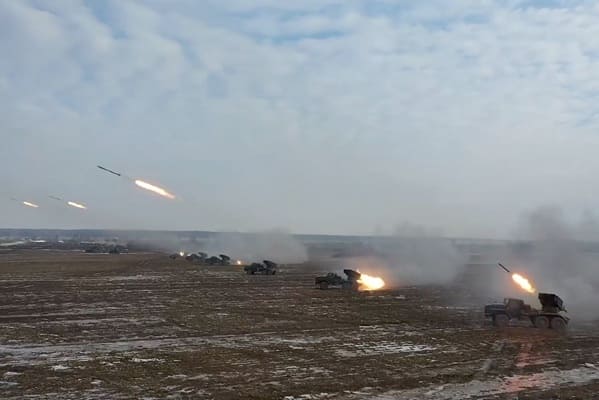
The human cost of Vladimir Putin’s invasion of Ukraine has been laid bare by a vast leak of Russian records, revealing that more than 460,000 people linked to the war had died by September 2026 – including more than 1,000 Russian soldiers who took their own lives.
The figures expose a scale of military loss that Moscow has gone to considerable lengths to conceal. In the deadliest year of the conflict, 2025, nearly 200,000 Russian deaths were recorded, equivalent to around 548 a day. During one week alone in May, 5,000 Russian soldiers died.
The data was obtained by hacking group Cyber Partisans, linked to the Belarusian opposition, and Ukrainian hacking collective Silent Crow.
An investigation by The Guardian found that the records included 11 million death certificates, providing an unusually detailed picture of the casualties suffered by Russia since the full-scale invasion began in February 2022.
Read more related news:
More than 1.3m Russian soldiers are now rotting fertiliser strewn across Ukraine
Lords committee warns Britain cannot prove it is ready for war
Berlin warns Russia ‘could launch nuclear weapon into space within weeks’
MI5 warns British defence companies to prepare for Russian attacks
The findings suggest that Russia lost an average of around 720 men every day over the period examined, with the death toll accelerating sharply as the war continued.
The Kremlin’s official figures offer a striking contrast. Russia’s defence ministry has not updated its published military death toll since September 2022, when it reported that 5,937 soldiers had been killed.
The scale of the losses far exceeds those suffered by the Soviet Union during its war in Afghanistan. Official figures put Soviet military deaths in that conflict, between 1979 and 1989, at about 15,000. Even in the worst year, 1984, around 2,300 soldiers died. In Ukraine during 2025, Russia was losing a comparable number roughly every four days.
Pokrovsk becomes a killing ground
The eastern Ukrainian city of Pokrovsk emerged as one of the most lethal areas of the conflict. At least a third of the recorded deaths were concentrated around the city, which became a major focus of Moscow’s spring offensive in 2025, when tens of thousands of Russian troops were deployed in the area.
Almost 116,000 deaths – more than a quarter of the total with a known location – were recorded in the Pokrovsk district. Before the war, the coalmining town had a population of about 60,000 and covered fewer than 30 square kilometres.
One of those killed was Alexander Korepanov, who enlisted in August 2023. After being wounded twice, he was sent back to the front on both occasions. He died in May 2025, after 20 months at war, in the village of Uspenovka near Pokrovsk. He was 52.
The figures show how dramatically the death toll has increased. Almost 20,000 deaths were recorded in the first year of the invasion, rising to 50,000 in 2023. In 2024, the figure more than doubled to over 134,000. A further 52 per cent increase followed in 2025, making it the deadliest year of the conflict.
Janis Kluge, a Russia expert at the German Institute for International and Security Affairs, told The Guardian: “There was always sort of an unknown X factor: how many Russian deaths are we missing? And that turned out to be much much more.”
Kluge said the data also suggested that Russian soldiers killed in action could outnumber those severely wounded, an unusual pattern compared with expected military casualty ratios.
Suicides and coercion inside the army
The records also reveal more than 1,000 suicides among Russian soldiers since the invasion began. The figures raise questions about conditions inside the military, including the pressure exerted by commanders and fellow troops and the fear of being sent on dangerous missions.
Rob Lee, a senior fellow at the Foreign Policy Research Institute, told The Guardian: “There’s clearly a lot of coercion used by the Russian military to force people to go forward. In some cases, they will abuse them, torture them, use different types of physical abuse.”
Kluge added: “This tells you something about this war and the way that it’s fought.”


Leave a Comment