
At least 18 passenger aircraft have been forced to divert, land unexpectedly or undergo emergency security inspections after a wave of bomb threats swept across Europe, prompting fighter jets to scramble and leaving hundreds of travellers facing disruption.
The latest incidents have affected flights involving Ryanair, LOT Polish Airlines and other major carriers, with aircraft operating routes between Britain, Italy, Bulgaria, Spain, Belgium and the Czech Republic caught up in the security alerts.
Three flights heading to Bulgaria, six bound for Italy, four travelling to Prague, three to Madrid and one each to Brussels and Vienna were affected, according to the reported figures.
The British Government has sought to reassure passengers, insisting that the threats are being treated seriously but are believed to be malicious hoaxes.
Transport Secretary Heidi Alexander said: “We have some of the most robust aviation security systems of anywhere in the world. We have established processes for dealing with hoax and malicious threats. This is what these have been.
“We do take these threats seriously, but we understand that these have been malicious hoax threats.”
Among the most disruptive incidents was Ryanair flight FR1730 from London Stansted to Sofia. The aircraft, which departed at 6am and had been scheduled to arrive at 9.25am, was diverted to Plovdiv Airport, where it landed in a remote area for security inspections.
Passengers were evacuated and transported by bus to Sofia as emergency services attended the airport.
Two other Ryanair aircraft travelling from Copenhagen and Madrid to Sofia were also affected. Bulgarian authorities confirmed that searches of all three aircraft found no explosives.
“Upon landing, the necessary inspections were carried out in accordance with the applicable procedures and no issues were identified,” Bulgaria’s transport ministry told Reuters.
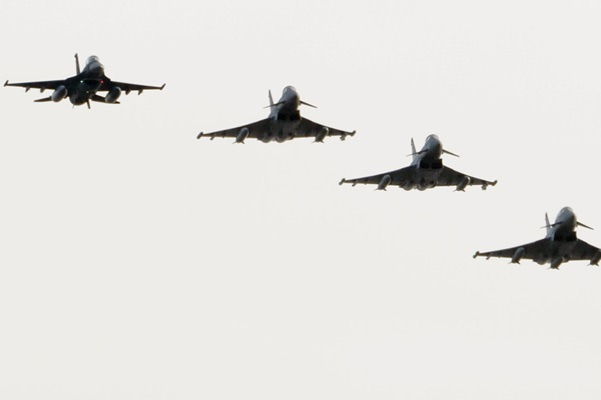
Italy experienced a particularly extensive series of alerts, involving flights from Helsinki to Rome, Dublin to Rome, Milan to Warsaw, Milan to Bucharest, Thessaloniki to Milan and Porto to Milan. Italian and French fighter jets were scrambled as aircraft were escorted towards alternative landing sites and subjected to security procedures.
In the Czech Republic, police confirmed that four passenger aircraft had landed at Prague Airport following similar warnings. Officers said the threats were being treated cautiously, despite an initial assessment that they posed a low risk.
“We are not underestimating the threat, which is why all necessary security measures have been activated with minimal impact on passengers and airport operations… After landing, all aircraft will undergo pyrotechnic inspections.”
Police subsequently confirmed that no explosives had been discovered on any of the four aircraft.
A further scare affected LOT Polish Airlines flight LO235 from Warsaw to Brussels. The carrier said its crew had been notified of a potential security threat and conducted an inspection on board before landing.
“No suspicious items were found,” a LOT spokesman said.
The incidents have intensified concerns over the vulnerability of Europe’s aviation network to repeated security scares, even when warnings ultimately prove unfounded. Each alert can trigger diversions, aircraft searches, passenger evacuations and the deployment of specialist emergency personnel.
The latest wave follows seven similar incidents on Tuesday, when aircraft travelling between Britain, Italy, Poland and Bulgaria were subjected to emergency procedures.
Those included a LOT Polish Airlines flight from London Heathrow to Warsaw, which diverted to Warsaw-Modlin Airport before passengers were evacuated and the aircraft searched. A Scandinavian Airlines service from Copenhagen to Warsaw also underwent an inspection after an emergency landing.
Three Ryanair flights, travelling from Lisbon and Dublin to Rome and from Dublin to Sofia, were investigated, alongside a Wizz Air service from Milan Bergamo to Sofia.
All seven aircraft landed safely and authorities found no explosives.
For airlines and airport operators, the cumulative disruption is becoming a serious operational challenge. Although the British Government has described the threats as malicious hoaxes, authorities must continue to investigate each warning and protect passengers until aircraft are declared safe.
The immediate concern is no longer simply the disruption caused by an individual threat, but the frequency with which European aviation is being forced to mobilise its security response.


Leave a Comment