
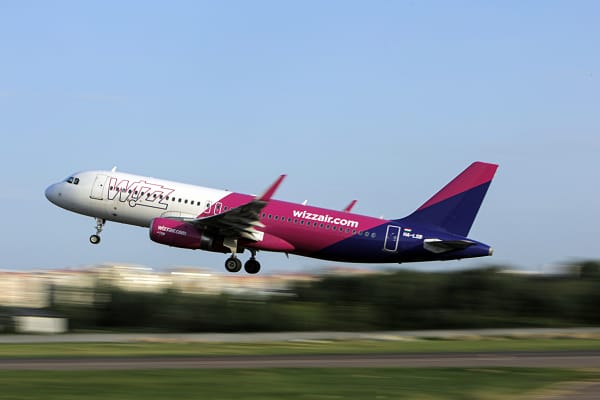
A Wizz Air passenger aircraft travelling from London to Sofia was forced to divert to Budapest after receiving a bomb threat, prompting a rapid military response in which a Hungarian Gripen fighter jet was scrambled to escort the plane to safety.
The Airbus A321neo turned back over Bosnia and Herzegovina and requested permission to land at Budapest’s Liszt Ferenc International Airport on Monday. It touched down safely at 12.08pm local time on Runway 2, according to initial reports.
Hungarian firefighters, police and counter-terrorism officials were mobilised as the aircraft arrived. Authorities began security inspections of the plane and its passengers, while police took charge of further measures at the airport.
Hungarian Defence Minister Romulusz Ruszin-Szendi confirmed the incident in a statement on Facebook, saying the military had responded within minutes after Nato’s air defence alert service issued an “ALPHA” scramble order.
“A Wizz Air flight travelling from London to Sofia received a bomb threat,” he said.
“Consequently, it diverted from its original route and requested permission to land at Budapest’s Liszt Ferenc International Airport.”
He said a Hungarian Gripen fighter jet had been deployed to escort the passenger aircraft during its approach and landing.
“Nato’s air defence alert service issued an ‘ALPHA’ scramble order. A Hungarian Defence Forces Gripen fighter jet took to the skies within minutes and provided escort for the passenger aircraft’s landing in Budapest,” Mr Ruszin-Szendi said.
The fighter jet subsequently returned to its base in Kecskemét, while police continued security operations on the ground.
The minister praised the military response, saying the incident demonstrated the importance of maintaining a rapid-response capability.
“Being on alert is not a mere routine—it is a profound responsibility,” he said. “Our soldiers have once again demonstrated that they can be deployed immediately when the need arises, and that they are fully capable of guaranteeing the security of Hungary’s airspace.”
Wizz Air confirmed that its London Luton-Sofia service had been diverted following the threat and said the aircraft had landed safely in accordance with established security procedures.
“The aircraft diverted and landed safely at Budapest Liszt Ferenc International Airport in accordance with the relevant security protocols and procedures, before taxiing to a designated stand, where the relevant authorities carried out the necessary security checks on the aircraft and passengers,” the airline said.
“Wizz Air is cooperating fully with the authorities. The safety of passengers and crew remains our highest priority.”
The incident caused temporary disruption at Budapest airport, with Runway 2 reportedly closed while emergency services and security teams attended the aircraft. Arriving and departing flights were redirected to the airport’s other runway.
The cause and credibility of the bomb threat had not been established in the initial reports, and authorities were continuing their checks following the landing.
The diversion highlights the security protocols that can be triggered by threats against commercial aviation, with military aircraft placed on alert to respond when civilian flights face potential danger.


Leave a Comment