
Twelve passenger flights have been affected by bomb threats across Europe, forcing aircraft to divert, triggering emergency security procedures and raising fresh concerns over a wave of aviation disruption that has swept several countries in recent days.
Three Ryanair flights bound for Bulgaria were among those targeted on Thursday morning, with aircraft departing from London, Copenhagen and Madrid.
The planes from Copenhagen and Madrid landed in Sofia, while the London Stansted flight was diverted to Plovdiv, Bulgaria’s Ministry of Transport confirmed to local broadcaster NOVA News.
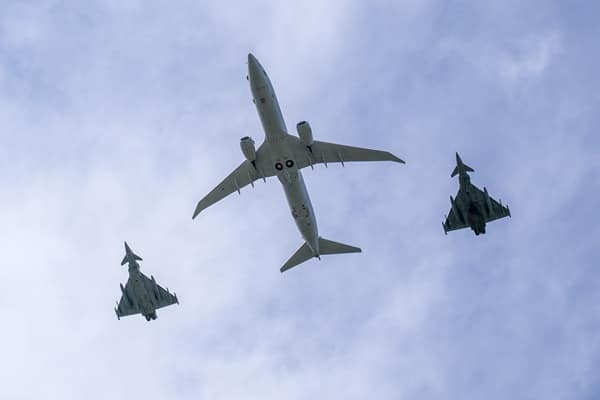
The incidents came as an Aer Lingus flight travelling from Dublin to Rome was diverted to a French military air base after a reported bomb threat. The Airbus A320, flight EI402, issued a squawk 7700 emergency alert before landing at Évreux-Fauville air base in Normandy.
France’s Prime Minister Sébastien Lecornu’s office confirmed the diversion, saying: “An A320 airliner flying from Dublin to Rome has just been diverted to the Evreux airbase following a bomb threat.
“The situation is being monitored in real time by the Prime Minister’s office (Matignon), in accordance with established procedures.”
The expanding series of alerts has also prompted security action in the Czech Republic. Police said they had received bomb threats concerning four aircraft heading to Prague. Although authorities assessed the warnings as low risk, they activated security measures and said bomb disposal teams would inspect all four planes after landing.
The police response highlights the operational dilemma facing European aviation authorities: even threats considered unlikely to be genuine must be treated seriously, potentially triggering searches, diversions and disruption to airport schedules.
Wizz Air also confirmed that one of its aircraft, travelling from Milan Malpensa to Warsaw, had been diverted to Vienna following a bomb threat received during the flight.
In a statement, the airline said: “Wizz Air confirms that today’s Milan Malpensa–Warsaw flight (W4 6387) has been diverted to Vienna following a bomb threat received during the flight.
“The diversion was initiated in accordance with established security protocols and procedures, with the safety of passengers and crew as the highest priority.
“This incident comes amid a series of similar bomb threats affecting several airlines across Europe in recent days.
“Wizz Air is not the only airline targeted, with other carriers also experiencing threats resulting in flight diversions and security checks.
“Wizz Air is cooperating fully with the relevant authorities and is taking all necessary steps to ensure the safety of everyone on board.
“The safety and security of our passengers and crew remain our highest priority.”
The reported incidents on Thursday involve airlines operating across several major European routes. In addition to the Aer Lingus and three Ryanair flights, the aircraft identified include LOT Polish Airlines flight LO235 from Warsaw to Brussels, Wizz Air flight W46387 from Milan to Warsaw, and two Finnair services from Helsinki — one bound for Rome Fiumicino and the other for Vienna.
Four further aircraft heading to Prague were also reported to have received threats, although their airlines and departure airports had not yet been confirmed.
The scale of the alerts is likely to increase pressure on aviation authorities to establish whether the incidents are connected or represent separate security scares. The threats have so far prompted significant precautionary measures, but the available information does not establish that any explosive devices were found or that the warnings were genuine.
The latest disruption follows the diversion of the Aer Lingus aircraft to France and a series of other aviation security incidents reported across Europe in recent days. The succession of warnings has raised concerns about the potential vulnerability of the continent’s tightly connected air transport network to deliberate disruption.
For airlines, the consequences extend beyond the immediate response to a threat. Diverted aircraft must be inspected, passengers need to be accommodated and aircraft and crew schedules can be thrown off course. Airports must also coordinate with police, military and bomb-disposal specialists, even when an alert is ultimately assessed as low risk.
The immediate priority remains establishing the credibility of each warning and ensuring passengers and crew are safe. But with 12 flights reportedly affected in a single morning, European authorities face mounting pressure to determine whether they are confronting an isolated succession of hoaxes or a more co-ordinated campaign against civil aviation.


Leave a Comment