
European governments are facing mounting fears of a coordinated campaign of disruption after another wave of bomb threats targeted passenger aircraft on Friday, the third day of aviation security scares this week, prompting warnings that the continent could be facing a new form of psychological warfare.
The latest threats affected flights across Denmark, the Czech Republic, France and Italy, forcing emergency inspections and diversions as authorities scrambled to establish whether the incidents were connected.
No explosives have been discovered and all affected aircraft have landed safely, but the repeated warnings have raised concerns about the vulnerability of Europe’s transport networks to relatively inexpensive and easily coordinated forms of disruption.
Danish police confirmed on Friday that they were investigating threats directed at air traffic at Copenhagen Airport, although their initial assessment found no immediate danger to passengers. The airport said it was “operating normally”.
In the Czech Republic, police received bomb threats involving flights arriving at and departing from Prague. An airport spokesperson said four inbound and five outbound flights were affected, but no aircraft had been cancelled or diverted and no explosives had been found.
An Italian airport authority source subsequently confirmed that a Wizz Air service travelling from Prague to Rome had been diverted to Venice, where it landed safely.
France also reported four fresh bomb threats involving aircraft flying through its airspace. The French prime minister’s office confirmed that all four planes landed safely.
Separately, a Ryanair flight travelling from Rome to Lisbon triggered a security operation after a bomb alert, according to CNN Portugal.
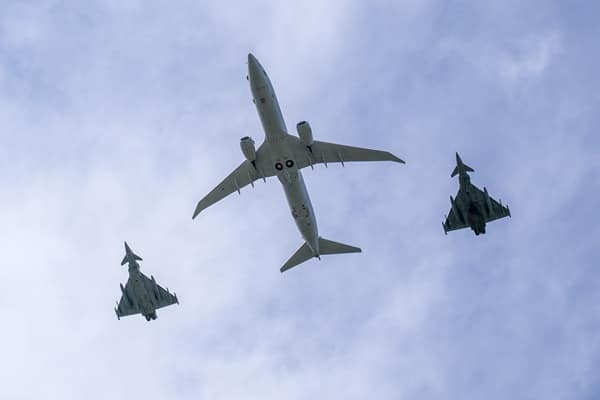
The incidents follow Thursday’s extraordinary disruption, when dozens of passenger flights across Europe were targeted by threats, forcing emergency landings, diversions and fighter jet escorts. An earlier wave of warnings had emerged on Tuesday.
The growing number of incidents has prompted security experts to question whether Europe is facing a coordinated hybrid attack designed to generate fear and disrupt essential infrastructure without triggering an outright military confrontation.
Spain’s Foreign Minister José Manuel Albares said the pattern of incidents was particularly concerning and suggested the continent needed to prepare for further attempts at destabilisation.
Speaking to national broadcaster TVE, he said: “It cannot be mere coincidence that so many incidents with exactly the same modus operandi are happening across Europe”.
“The most reasonable assumption is that we are facing an attempt at hybrid aggression and a form of psychological warfare,” he added, warning that Europe must be prepared for more such challenges.
No government has formally attributed responsibility for the latest bomb threats. While some officials have linked wider sabotage campaigns to Russia’s efforts to undermine European support for Ukraine, investigators have yet to establish who is behind the aviation alerts.
The threats come amid a broader series of suspected sabotage operations across the continent, involving German electricity substations, defence-related facilities in the Baltic region, supermarket refrigeration systems in France and other countries, and Leipzig airport in Germany.
European security officials have increasingly warned that Moscow could be exploiting the vulnerabilities of Western infrastructure through operations that are relatively cheap to execute, difficult to attribute and unlikely to provoke a conventional military response.
However, investigators have also cautioned that some threats could be copycat incidents or the actions of individuals motivated by personal grievances rather than a centrally organised operation.
The uncertainty surrounding the perpetrators has been compounded by emails sent to several airlines and airport operators in Rome and Milan on Thursday, claiming to represent “fighters of the Male State”.
Reuters was unable to independently verify the sender’s identity or establish whether the message was connected to the other threats.
Vladislav Pozdnyakov, the Russian blogger who founded the anti-feminist Male State movement in 2016, later said the organisation no longer existed and had no involvement in the incidents.
For European authorities, the challenge is increasingly twofold: protecting passengers from potential attacks while preventing repeated, unverified warnings from paralysing aviation and undermining public confidence.
As the investigation continues, the succession of threats is exposing how easily fear itself can become a weapon against the normal functioning of European society.


Leave a Comment