
Lithuania’s decision to consider removing its constitutional prohibition on nuclear weapons and offer to finance a permanent US military base has triggered a sharp warning from Moscow, exposing the growing risks of military escalation along NATO’s eastern flank.
The Kremlin said the moves represented a significant deterioration in the security environment around Russia, as Vilnius seeks deeper American military involvement to deter potential aggression.
Dmitry Peskov, Vladimir Putin’s spokesman, warned that Moscow would be “forced to take all necessary measures to guarantee its own security” if NATO military capabilities continued to expand close to Russian territory.
“A build-up of NATO forces on Russia’s doorstep cannot be perceived as anything other than a step toward escalating tensions, just as the deployment of nuclear weapons in a neighbouring country cannot,” Peskov said.
“This marks yet another significant escalation of tensions.”
The confrontation centres on two developments in Lithuania. Prime Minister Mindaugas Sinkevičius has confirmed that Vilnius is prepared to fund a dedicated American military facility, shortly after Donald Trump said Washington would “certainly look” at establishing a permanent US presence in the Baltic state.
Read more related news:
Expert fears UK and Europe ‘will wake up only after capitals are hit’ then ‘it’s too late’
Zelensky issues chilling warning as Ukraine rushes to defend cities
Labour is playing with British lives as Burnham leaves defence dangerously underfunded
Two dead and almost 200 isolated as mystery plague spreads in Russia
Lithuania’s parliament has also advanced a constitutional amendment that would remove the country’s longstanding prohibition on hosting weapons of mass destruction. A final vote is scheduled for January.
If approved, the change would remove a legal barrier to the possible deployment of NATO nuclear weapons on Lithuanian territory, although no decision has been announced to station US nuclear weapons there.
The geographic implications are nevertheless stark. Lithuania borders Russia’s heavily militarised Kaliningrad exclave and sits alongside Belarus, Moscow’s closest military ally in the region.
Lithuania does not possess its own nuclear arsenal. Several European NATO members already participate in arrangements under which US nuclear weapons are stationed on their territory while remaining under American control.
For Vilnius, the issue is less about acquiring nuclear weapons than strengthening deterrence.
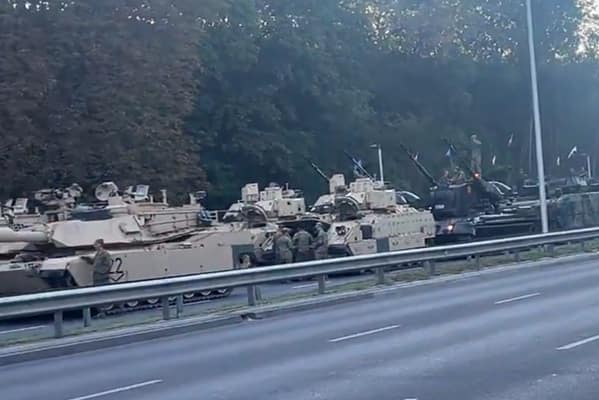
Around 1,000 US troops are already stationed in Lithuania on a rotational basis, alongside American Abrams tanks and other armoured forces. Germany is also preparing to establish a permanent brigade of about 5,000 troops in the country by the end of next year.
Lithuanian Defence Minister Robertas Kaunas welcomed Trump’s comments on a permanent American presence, saying they showed the US president “knows Lithuania, knows our investments, knows our determination to build security and appreciates it.”
Lithuania has increasingly positioned itself as one of Europe’s most heavily armed frontline states. Defence spending is expected to reach 5.38 per cent of gross domestic product this year, reflecting the perceived threat from Russia and the country’s proximity to Kaliningrad and Belarus.
The military build-up comes against an increasingly volatile backdrop. The Baltic region has experienced a series of airspace incidents, including a drone crossing from Belarus that was shot down by Italian fighter jets and reported incursions by Russian aircraft.
The latest dispute also follows a warning from Putin over Kaliningrad. Russian officials have threatened to deploy nuclear weapons if NATO attempts to attack or blockade the Russian exclave, an isolated but heavily militarised territory between Poland and Lithuania.
Russian officials in London have separately warned against British media simulations of a potential Baltic conflict, telling those contemplating action against Kaliningrad to “have no illusions about the consequences.”
The danger is not that Lithuania’s constitutional change automatically produces a nuclear deployment. It is that each side increasingly interprets the other’s defensive preparations as evidence of offensive intent.
That dynamic is reshaping the Baltic security environment: more troops produce demands for more deterrence, which prompts Moscow to threaten countermeasures, which in turn strengthens the argument for further NATO reinforcement.
For Europe, the central risk is that this cycle continues without either side deliberately choosing a wider confrontation.
But with American forces, German troops and potentially a new legal framework for nuclear weapons converging on a state bordering Russia’s most militarised Baltic territory, the margin for miscalculation is becoming increasingly narrow.


Leave a Comment