
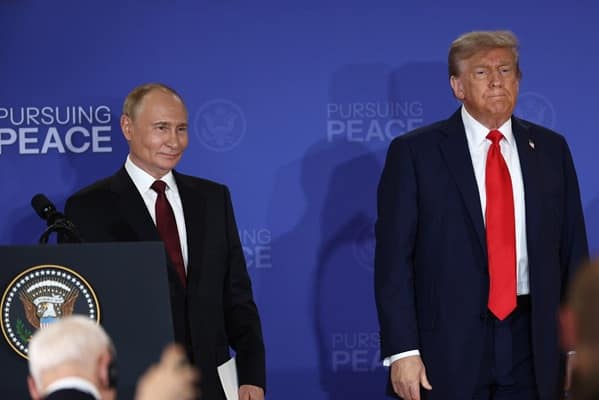
Anybody who thought Donald Trump was going to be good for Ukraine was, in my opinion, away with the fairies.
Even before his inauguration, military aid was slowing. Then came the infamous Oval Office confrontation with President Zelensky, a moment that may become Trump’s defining image on Ukraine. “You don’t have the cards,” he told the Ukrainian president.
That exchange sent a message heard around the world: Ukraine was no longer dealing with an administration instinctively committed to its defence.
Six months later, I see little evidence to suggest otherwise.
I’ve heard plenty of rhetoric, “Killer sanctions,” Bold promises, & Grand declarations. Unfortunately Vice President JD Vance only reinforces that impression. Dismissing Europe’s largest land war since the Second World War as Ukraine “haggling over kilometres” demonstrated either a profound misunderstanding of the conflict or remarkable indifference to it. Millions have been displaced, entire cities destroyed and Europe’s security fundamentally reshaped.
Vance also boasted that one of his proudest political achievements was helping halt military aid to Ukraine. Every delay in military assistance benefits the aggressor, so this was not an unintended consequence of policy but a conscious political decision, one Vance publicly celebrated as among his proudest achievements.
The administration also dismantled programmes documenting Russian war crimes while slashing humanitarian assistance. Across Ukraine, projects disappeared almost overnight while within weeks, my own wife lost her job as a direct consequence.
Meanwhile, Washington increasingly favoured selling weapons over providing assistance, while senior officials openly discussed inviting Vladimir Putin, a man wanted by the International Criminal Court, to the United States.
The message could hardly have been clearer.
At the beginning of this year there was cautious optimism that 2026 might finally become the year diplomacy overtook destruction. Donald Trump promised to end the war “within 24 hours”. President Zelensky repeatedly proposed ceasefires, humanitarian agreements and direct talks.
Instead, the opposite has happened.
Russian missile and drone attacks have intensified, while Ukraine’s own long-range strike campaign has expanded dramatically. Domestically produced drones and missiles are now reaching deeper into Russia than at any point since the full-scale invasion began. Crimea remains under pressure, Russian logistics are increasingly vulnerable and fuel shortages are becoming harder for the Kremlin to conceal.
The rhetoric speaks of peace, but the battlefield tells a different story.
Iran ultimately interrupted what had been presented as peace negotiations, while Steve Witkoff and Jared Kushner made multiple visits to Moscow but never travelled to Kyiv. That alone spoke volumes about where the White House saw its priorities.
I never believed these were genuine peace talks. They looked far more like an attempt to freeze the conflict and pressure Ukraine into accepting Russian control over territory Moscow had failed to seize militarily.
That isn’t a long lasting peace, it’s rewarding military aggression with diplomatic legitimacy and from where I sit in Ukraine, this no longer feels like a war approaching its conclusion.
It feels like a war approaching another escalation.
The uncomfortable truth is that peace is not failing because nobody is talking, it is failing because neither side currently believes compromise offers a better outcome than continued military pressure.
Ukraine believes it is finally exposing Russia’s strategic vulnerabilities, refineries burn, rail infrastructure is disrupted, logistics hubs are destroyed and the Black Sea Fleet has been pushed away from Sevastopol with the cost of occupation continuing to rise.
Perhaps the clearest indication of mounting pressure isn’t found on the battlefield at all, but inside the Kremlin’s own propaganda.
In 2022, Russian state television projected absolute confidence that Kyiv would fall within days, every setback was hidden beneath promises of inevitable victory.
That swagger has largely disappeared.
At the same time, Trump has once again questioned America’s commitment to NATO, describing US support as “ridiculous” and suggesting the alliance is not reciprocal.
Whether intentional or not, that serves one of Vladimir Putin’s oldest strategic objectives: creating doubt about NATO’s cohesion and America’s long-term commitment to European security.
For more than two decades, the Kremlin has sought to fracture the alliance politically where it could not defeat it militarily. Every suggestion that Washington may step back from NATO reinforces Moscow’s belief that Western unity will eventually fracture before Russia does.
Lastly, there is another uncomfortable question that few people seem willing to ask.
Why would Ukraine want peace right now?
That may sound provocative, but it deserves consideration.
Providing Ukraine can continue managing its manpower challenges, arguably its greatest long-term concern, the strategic picture is more favourable than it was twelve months ago. Russia has failed to achieve virtually every major strategic objective it set itself. Kyiv still stands, Ukraine remains sovereign, NATO has expanded and grew as a result of the invasion. Europe has rearmed & Crimea remains under pressure as Russia’s economy is beginning to feel the cumulative weight of sanctions and Ukraine’s long-range strike campaign.
More importantly, Ukraine has regained the initiative.
I hesitate to say Ukraine is winning because war is never that simple. Russian missiles continue to fall and civilians continue to pay the highest price, Russia has occupied territory and considerable man power and resources.
But increasingly, it is Ukraine forcing the Kremlin to react rather than Russia dictating the pace of the war, it can’t act its will militarily.
That matters.
It is also impossible to ignore what Russia has done to Ukrainian society. Civilians remain central to Moscow’s campaign of violence, every apartment block destroyed, every hospital struck and every family torn apart hardens public opinion. Hatred is not fading; if anything, it is becoming more deeply rooted.
Ukraine has already denied Russia the victory it expected in 2022. Now it believes it can convert that resilience into lasting strategic success.
That is why I struggle to see peace this year.
Not because diplomacy has disappeared, but because neither side currently believes compromise offers a better outcome than continued military pressure. Until one of those calculations changes, this war remains far more likely to escalate than end.


Leave a Comment