
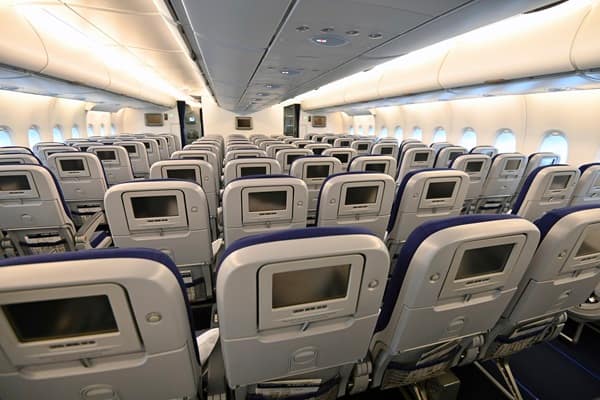
Most of what keeps an aircraft cabin hygienic happens when no passengers are on board, and most of it is invisible from a seat. The cabin you board has been through a sequence of air-filtration, surface-disinfection, and material-handling steps that airlines rarely describe in detail, partly because the systems are genuinely complex and partly because the work happens in the gaps between flights and overnight.
Some of it is more reassuring than passengers assume. The air, in particular, is cleaner than the air in most buildings. Some of it is less reassuring: the surface you touch most, the tray table, is often the least frequently cleaned. This is a look at seven things airlines actually do, what the evidence says about each, and where the genuine limits are.
None of this requires alarm. Commercial aviation has strong hygiene systems. But understanding what those systems do, and do not, cover is what lets a passenger fill the small gaps themselves.
1. They refresh the entire cabin’s air every few minutes
The air in a commercial cabin is completely exchanged every two to three minutes, roughly 20 to 30 times an hour, far more often than the air in an office or a home. Fresh air is drawn in from outside, mixed roughly 50/50 with recirculated air, and pushed down from the ceiling to floor-level vents in a continuous vertical flow. At cruising altitude the outside air is virtually free of microorganisms to begin with.
For context on how fast that is: research from the Harvard T.H. Chan School of Public Health found the average age of cabin air is around 1.8 minutes, against roughly 16 minutes in a hospital room and 240 minutes in a typical home. The air you breathe on a plane is among the most frequently refreshed of any indoor environment you spend time in.
2. They run the air through hospital-grade HEPA filters
The recirculated half of the cabin air passes through HEPA filters that capture 99.97% of airborne particles down to 0.3 microns, the same filtration class used in hospital operating theatres. That particle range includes bacteria and the droplet sizes that carry viruses, which is why properly maintained HEPA filtration removes the airborne pathogens of concern, including the particle sizes associated with SARS-CoV-2 and tuberculosis bacilli.
The filters only work if they are maintained, which is part of the invisible maintenance programme: HEPA elements are inspected and replaced on schedule as part of the aircraft’s checks. On many aircraft the flight deck receives 100% fresh air rather than the recirculated mix, a detail most passengers never learn.
3. They disinfect high-touch surfaces with approved products
Before departure, cabin crews or cleaning teams wipe high-touch surfaces, tray tables, armrests, handsets, IFE screens, window shades, and lavatory fittings, with disinfectant. The products are not supermarket sprays: aircraft interiors combine polycarbonate, acrylic, coated touchscreens, and specialist fabrics, and a cleaner with the wrong chemistry damages those surfaces over repeated use. Airlines are expected to use products approved for aircraft materials.
This is where product approval matters more than passengers realise. A cabin disinfectant has to do two things at once: kill pathogens to a verified standard, and be compatible with the aircraft materials it touches. Products such as the Alglas ALG/RCBA antibacterial sanitiser are built for exactly this: independently tested by the Public Analyst’s Laboratory at greater than 99.9% bacterial kill, carrying aerospace approvals for material compatibility, and cleared for use during flight, which lets crew maintain hygiene without a ground maintenance window.
4. They change soft furnishings between sectors
On many airlines, headrest covers, headsets, pillow covers, blankets, and bedsheets are replaced after every flight sector rather than cleaned in place. Soft furnishings absorb contamination in a way hard surfaces do not, and they cannot be wiped down to a verified standard in a turnaround, so the practical answer is replacement and off-aircraft laundering.
This is one of the more resource-intensive parts of cabin hygiene and a reason turnaround logistics are as complex as they are: clean linen has to be loaded, used linen removed, and the whole exchange completed inside the same window as cleaning, catering, and fuelling.
5. They give the lavatories far more attention than you’d guess
Lavatory high-touch points, door handles, locks, taps, flush buttons, and soap dispensers, are on the priority list for every clean, because they are touched by a large fraction of passengers on every sector. The challenge is recontamination: a lavatory cleaned at the gate is used within minutes of boarding and continuously thereafter, so the surfaces need products that disinfect quickly and crew vigilance through the flight, not just a single ground-time wipe.
Interestingly, the data suggests lavatories are not the dirtiest surfaces in the cabin. Studies of cabin contamination consistently find tray tables carry far higher bacterial counts than flush buttons, largely because tray tables get cleaned less often despite being eating surfaces.
6. They deep-clean the cabin overnight
The full surface disinfection that a turnaround cannot fit happens during the overnight clean. A between-flights turnaround resets the visible state of the cabin, removing rubbish and wiping obvious surfaces, but a complete sanitisation pass covering every surface to a defined standard typically happens once a day, at night, when the aircraft is out of service for longer.
This is the single most useful thing for a passenger to understand: the cabin that looks clean after a 30-minute turnaround has been reset, not necessarily deep-disinfected. The thorough clean is the overnight one. It is also why, when a confirmed infectious case has been on board, airlines run a separate enhanced deep-clean that can take around five times longer than the standard process.
7. They use material-specific products on screens and windows
IFE touchscreens, cabin windows, and seat-back displays are cleaned with products matched to their specific coatings and substrates, not the same cleaner used on a tray table. Touchscreens have anti-reflective and oleophobic coatings that ammonia and some solvents strip permanently; cabin windows are acrylic or polycarbonate that crazes under the wrong chemistry. Using a single general-purpose cleaner across all of these is how an airline ends up with hazed windows and degraded screens across a fleet.
It is a small detail that compounds over hundreds of cleaning cycles, which is why approved-product discipline applies to the cabin interior just as it does to the cockpit. The passenger never sees the difference on day one; they see it two years later in the condition of the cabin, or they do not, if the airline got the products right.
| The one thing a passenger can usefully do
Bring a disinfecting wipe and clean your own tray table at the start of the flight. The data is consistent that tray tables carry the highest bacterial counts in the cabin, largely because they are cleaned less often than passengers assume, and they are a surface you eat off. It is the one hygiene gap entirely within your control, and travel-medicine specialists recommend it routinely. |
The takeaway
Aircraft cabin hygiene is a layered system: very frequent air exchange, hospital-grade filtration, approved-product surface disinfection, linen replacement, lavatory vigilance, overnight deep cleans, and material-specific care for screens and windows. Most of it is genuinely strong, and most of it is invisible. The one gap a passenger can usefully close is the tray table, which the data says is cleaned less often than its constant use would suggest. Understanding the system is what tells you that.



Leave a Comment