
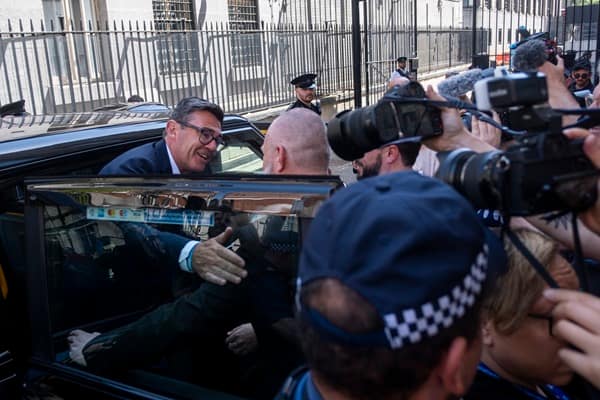
Andy Burnham has come under renewed pressure over his use of taxpayer-funded air travel after a government jet reportedly flew from Stansted to Manchester to collect the Prime Minister before carrying him on a transatlantic journey to the Caribbean.
The aircraft departed Stansted Airport in Essex at about 6am, according to the flight details supplied, before collecting Mr Burnham around half an hour later. The Prime Minister was then due to travel to Antigua and Barbuda, with a refuelling stop in Canada.
The arrangements have prompted criticism over the cost and environmental impact of using a government aircraft to collect the Prime Minister from Manchester, rather than travelling directly from London.
It would have taken Mr Burnham about 90 minutes to drive the 40 miles from Downing Street to Stansted, while his decision to spend one day a week working from Manchester at the new No 10 North site has added another layer to the debate over his travel arrangements.
The controversy is particularly awkward for a Prime Minister whose government has placed climate policy and public spending under scrutiny.
Reform UK chief whip Lee Anderson accused Mr Burnham of treating public money as an inexhaustible resource.
“It would appear that taxpayers’ money is no object for Andy Burnham,” he told GB News.
“At a time when British people face a miserable winter of increasing energy prices, increasing inflation and increasing unemployment, this out-of-touch Prime Minister is using the taxpayer as a cash cow to fund unnecessary flights.
“This is a kick in the teeth for every struggling family in the country.”
Shadow minister Neil O’Brien also questioned the contrast between Labour’s environmental policies and the Prime Minister’s travel arrangements.
“Labour are smashing normal people with higher and higher energy and fuel costs in order to pursue their obsession with net zero,” he said.
“But, as usual, it turns out the rules don’t apply to them, and they are happy to waste loads of taxpayers’ money and jet fuel so that the PM can show off and lecture.”
John O’Connell, chief executive of the TaxPayers’ Alliance, said the public was being “taken for a ride”.
“Thanks to the Prime Minister’s Manchester obsession, taxpayers are now footing the bill for what amounts to a private jet pick-up service, rather than cheaper, more sensible alternatives,” he said.
“Burnham should stop treating taxpayers’ hard-earned money as an endless pot to fund unnecessary travel arrangements and start showing some respect for those who pay the bills.”
The latest criticism follows an earlier controversy over Mr Burnham’s use of the government’s VIP Airbus A321 to travel from Stansted to Glasgow for the opening ceremony of the Commonwealth Games. The aircraft subsequently flew from Glasgow to Manchester the following morning, a journey lasting just 38 minutes.
That episode also raised questions about the Government’s commitment to curbing unnecessary flights. The Ministerial Code requires ministers to ensure that official travel arrangements are efficient and cost-effective, with special flights subject to particular scrutiny.
But the Prime Minister’s travel arrangements are now unfolding against a more politically sensitive backdrop: his decision to reopen the question of Britain’s historic responsibility for the transatlantic slave trade.
Writing in The Guardian ahead of the Commonwealth Heads of Government Meeting, Mr Burnham said he was open to calls for a formal apology on behalf of the British state.
“Listening to calls for a formal apology on behalf of the British state will form an important part of this process, and I am open to them,” he wrote.
He added: “For years, those members of the Commonwealth affected by the slave trade have asked for an honest conversation about the legacies of slavery.
“By sticking our heads in the sand, we have damaged the ability of the Commonwealth to function.”
Mr Burnham has nevertheless ruled out financial reparations, arguing that British people today should not be held liable for historical crimes in which they played no personal part. Instead, he has proposed a new initiative to help restructure the debts of poorer Commonwealth countries, with former prime minister Gordon Brown expected to play a role.
Caribbean leaders have welcomed his willingness to engage, while making clear that their demands go further. Jamaican Prime Minister Andrew Holness said he was seeking “meaningful talks on reparatory justice”.
Barbados’s Prime Minister Mia Mottley thanked Mr Burnham for “breaking new ground”, describing engagement as “the right thing, and the moral thing, to do”.
But Conservative leader Kemi Badenoch accused Labour of “navel-gazing”, arguing that Britain should acknowledge its full history rather than select the parts that were politically convenient.
“We should be honest about the whole history, not select the parts that are politically convenient today, especially given Britain’s leading role in ending the transatlantic slave trade,” she said.
The scale of any potential financial settlement remains contested. Although reparations campaigners have advanced substantial claims, no £18tn payment has been agreed or committed by the British Government. The UK also continues to provide overseas development assistance to countries affected by slavery, although such aid is not formally designated as reparations.
There is a further historical distinction: Tony Blair expressed regret over slavery in 2007, but Britain has not previously issued a formal state apology for its role in the trade.
A Foreign Office spokesman said: “We are committed to working with Commonwealth partners on issues facing the world, including the role of private finance in tackling global debt issues, addressing the climate crisis, and supporting economic development.”
As Mr Burnham arrives in the Caribbean, the twin controversies leave him facing questions both about the symbolism of his diplomacy and the cost of conducting it. His government wants to demonstrate that Britain can confront its past while building stronger Commonwealth relationships. At home, however, critics are asking whether the Prime Minister’s own travel arrangements reflect the restraint he expects of the public.


Leave a Comment