
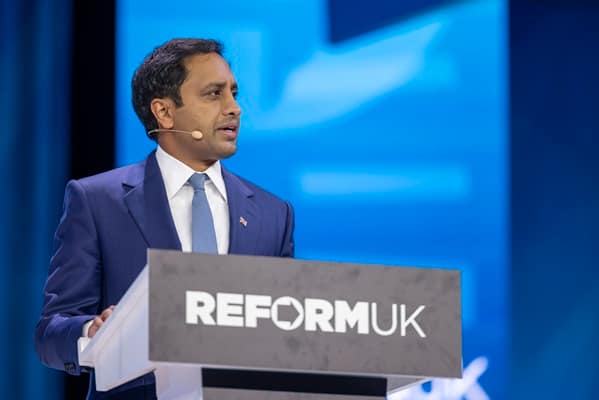
Reform UK has accused Andy Burnham of lacking the political will to confront France over small boat crossings, arguing that the Prime Minister must be prepared to risk a “diplomatic standoff” to address what the party describes as Britain’s migration crisis.
Zia Yusuf, Reform’s Home Affairs spokesman, made the comments after Nigel Farage signed a memorandum of understanding with Jordan Bardella, the leader of France’s National Rally, committing the two parties to co-operate on tackling Channel crossings should they each win power.
The agreement was unveiled at Reform’s party conference in Birmingham on Friday, where Mr Bardella joined Mr Farage on stage.
Mr Yusuf told GB News that the memorandum was evidence of Reform’s ability to build international relationships despite remaining in opposition.
He said: “One of the questions that we wanted to seek to answer with this conference is can Reform actually get things done? Because Britain has not been short of politicians claiming and promising the world.
The Tories promised in four consecutive manifestos to cut immigration to tens of thousands and then imported 10 million people.
Mr Yusuf described the agreement with Mr Bardella as a significant development in European opposition politics.
He said he was “very proud” of the document and described it as the “most important memorandum of understanding signed between two opposition parties in Europe.
However, Christopher Hope, the GB News presenter, questioned the practical value of an agreement between two politicians who are not currently in government.
“But neither of you are in power. If you don’t win next year, is it for the birds?” he asked.
Mr Yusuf said Reform had alternative plans should Mr Farage or Mr Bardella fail to enter government, but acknowledged these could involve a significant deterioration in relations between London and Paris.
“Well if somebody else wins, we’ve always said we’re serious about the plan. There is an alternative path, one in which the French Government is not going to be too happy about it. The reality in that scenario is we have a diplomatic standoff.
And if the Prime Minister of the United Kingdom is unwilling to have a diplomatic standoff about the invasion of this country by hundreds of thousands of largely adult military aged men from countries – some of whom have literally attempted mass casualty terrorist attacks on our soil – I don’t know what you would have a diplomatic row about.
The comments represent a further escalation in Reform’s rhetoric on migration and underline the party’s willingness to advocate a more confrontational approach towards France.
Successive British governments have relied on co-operation with Paris to disrupt small boat crossings, including agreements providing British funding for French policing and border security operations.
Reform has argued that those arrangements have failed to prevent continued crossings and that a more fundamental renegotiation of Britain’s relationship with France on migration is required.
Mr Yusuf said the agreement with National Rally demonstrated what Mr Farage could achieve before entering government.
The point I want to make about this is it is Nigel Farage delivering in the way that we can as an opposition party with a handful of MPs, by the way, outside of office.
“Just imagine what Prime Minister Farage is going to be able to do if we win.”
The discussion later turned to allegations surrounding Reform’s funding, following a recent undercover investigation into donations to the party.
Mr Hope asked whether Reform was “letting people down with these mistakes” and whether Mr Yusuf wanted to “apologise” for the controversy.
Mr Yusuf said the party was treating the allegations seriously but declined to comment in detail while an internal investigation was under way.
“With regards to the donation stuff, I’ve said it before, I say it again, the party is taking it seriously.
We’ve commissioned an investigation, I don’t want to prejudice by commenting on it, but the most important thing to say is that, look, nothing goes up in a straight line. I came from the world of business, I’ve been in politics for just over two years, working with Nigel.
“Every single one of those days, there’s been some ups, there’s been some downs. There’s been a lot more ups than there have been downs.”
Mr Yusuf sought to place the controversy within the broader trajectory of Reform’s rise, arguing that the party had already fundamentally altered the structure of British politics.
He concluded: “For a lot of people in this country, and frankly all the people here, they see Nigel and this movement as their last chance. Now, are we perfect? No. Do I think we bring something new and fresh to British politics? Yes.
“Yes, we’ve slipped a little bit in the polls in the last few months, but what we have already achieved in a short few years is unlike anything before in British politics. We’ve broken the two party duopoly that has existed basically for 100 years.”
The intervention highlights the balancing act Reform faces as it attempts to convert its insurgent political appeal into a credible programme for government.
The party is seeking to demonstrate that it can develop international partnerships and detailed policy proposals while simultaneously maintaining the anti-establishment message that has underpinned its electoral rise.
Its proposed approach to France illustrates that tension. While the agreement with Mr Bardella offers Reform a potential route towards bilateral co-operation if both parties enter government, Mr Yusuf’s comments also suggest the party is prepared to contemplate a more confrontational strategy if diplomatic agreements fail to deliver its objectives.
For Mr Farage, the pact with National Rally is intended to demonstrate that Reform can exercise influence beyond Westminster. Whether that influence can translate into practical policy, however, will ultimately depend on whether the party can convert its electoral support into power.


Leave a Comment