
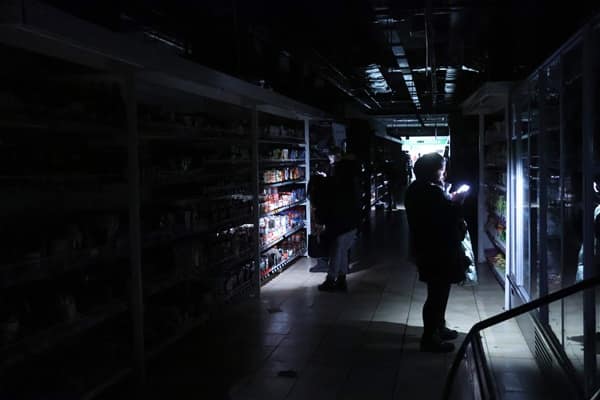
Russia has stopped trying to capture Ukraine’s cities. It is trying to make them unlivable, one substation at a time. Britain’s response is still counted in missiles when it should also be counted in transformers.
Earlier this week, Russian missiles struck both of Kyiv’s main bridges across the Dnipro and cut heating and water to parts of the capital.
On the same day, in Brussels, Britain pledged more than 1,000 short-range air-defence missiles to Ukraine, with deliveries beginning in mid-December.
Those two facts belong in the same paragraph, because they describe one campaign. The decisive front in Ukraine this winter is not a trench in the Donbas
It is a radiator in a seventh-floor flat, and a phone that has stopped ringing.
Consider Daryna Kulchytska, a single mother in Kyiv who spoke to the BBC this month. She lives on the seventh floor with two children. Some days the family gets four or five hours of electricity, never at the same time: two hours on, eight hours off. When the current dies, the pumps stop, so the taps run dry.
Read more related news:
Kremlin insider threatens total destruction as Russia declares war on NATO amid Crimea bridge attack
Russia accused of sabotage then cries victim as NATO country slams border shut
‘This is a warning to Russia’ as British reservists test drone-killing missiles on NATO’s eastern flank
Putin’s winter weapon: Britain sends Ukraine a thousand missiles to blunt Russian attacks
The lift stops. The wi-fi drops. Her twelve-year-old son, Kyryll, described the winter better than any analyst: “All the fun got sucked out with the electricity.”
This is not collateral damage. It is the design.
Russia has already destroyed most of Ukraine’s non-nuclear generation. Now it is cutting the grid at its joints: the substations that carry power from the three working nuclear plants, which supply about 80% of the electricity used this winter, to the cities. The Ukrainian government counted 2,147 strikes on energy facilities between mid-July and mid-October — roughly 23 a day. Engineers at one large station told the BBC they manage one or two productive hours a day between air raids. Regulators from 38 countries warned this week that a nationwide blackout could put all nine operating reactors’ cooling systems at risk.
The cruelty is that this kills quietly. Kyiv recorded no deaths linked to last winter’s outages. A capital of three million people, a winter that touched minus 25, and an official figure of zero. Cold rarely writes itself on a death certificate. It arrives as a stroke, a heart attack, respiratory failure — as the underlying condition a coroner can name. In Ternopil and Rivne, at least ten “white deaths”, the local term for hypothermia, were reported last winter, and one rough extrapolation, published by Al Jazeera, put the national figure near 200. By February, at least 18 people had died of carbon monoxide after burning wood or running generators indoors. On 8 November, in Chupyra, south of Kyiv, three people, including a child, died that way after a generator was run in a basement.
Then there is the silence. A blackout is also a communications blackout: no air-raid alert on your phone, no outage schedule, no call to a doctor, no word to the daughter in Warsaw. Ukraine requires mobile operators to keep base stations running for ten hours without grid power; in Dnipropetrovsk, 80% now have backup. Elsewhere the network thins as the hours pass. In early November, hackers pushed fake warnings of an imminent nuclear strike to phones across Ukraine. A dead phone is not an inconvenience. It is solitary confinement with the lights off.
Britain has been quicker than most to grasp that air defence is now a humanitarian instrument. This week’s £240m package is well aimed: short-range missiles and radars have proved effective against the jet-powered Shaheds that terrorise cities, and 400 interceptors were already delivered. But interceptors cannot cover a grid with thousands of nodes. The International Energy Agency’s assessment this month is blunt. The most effective measures available this winter are unglamorous: connect generating equipment that has already been delivered, let batteries and households shave the evening peak, and protect and decentralise district heating, on which more than 30% of households depend. Because transformers and turbines take six to nine months to arrive, procurement for the winter of 2027-28 should begin now.
Britain’s £34m for heating and water, announced in October, is the right instinct at the wrong scale. A thousand missiles and a thousand transformers would be a wiser mix.
Scaling up that grid support is not charity, either. British firms in grid engineering, telecoms resilience, combined heat and power and war-risk insurance have precisely the capabilities Ukraine needs, and the £10.5bn package this month expanded UK Export Finance capacity to supply them. The economic damage is already visible: refrigerated warehouses running on diesel, and most of the country’s food stocks shifted west. The commercial case is real, and London should make it without embarrassment. But it is not the reason to act. A country whose radiators are cold and whose phones are silent cannot function as an economy, an ally or a democracy. That is precisely what the campaign is designed to do.
Peace talks grind on in Abu Dhabi and Brussels, and a Washington blueprint has already been dubbed “Yalta 2.0” in Kyiv. No agreement will be signed, ratified and implemented before February. February in Ukraine means minus 20. The cold does not negotiate. A radiator is warm or it is not. A phone rings or it is not. For millions of people this winter, those two facts will matter more than any communiqué. While diplomats talk, London must ensure it is sending the hardware to keep both alive.


Leave a Comment