
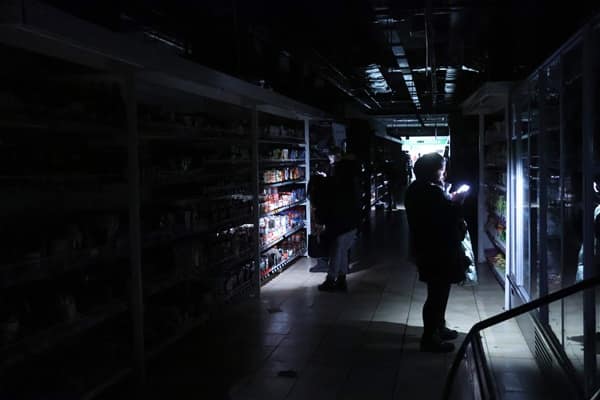
Kyiv residents are enduring electricity blackouts lasting several hours or even days, alongside prolonged interruptions to water and heating, as a growing public dispute between President Volodymyr Zelensky and Mayor Vitali Klitschko exposes tensions over the city’s preparedness for Russia’s relentless attacks on critical infrastructure.
The Ukrainian capital is facing the country’s most serious utility disruption, according to Zelensky, who blamed both Moscow’s bombardment and failures to implement preparations at the municipal level.
“The worst situation is in Kyiv: People and businesses face prolonged electricity and water outages, and the challenges are very serious,” the president wrote following a national co-ordination meeting on recovery efforts.
Zelensky argued that the crisis reflected failures to implement municipal decisions designed to prepare the capital for the heating season, although he did not specify which measures had been neglected or identify individual officials.
Klitschko defended the city’s preparations, arguing that Kyiv’s resilience plan had remained unapproved for almost six months. His statement did not identify who was responsible for the delay.
The mayor also criticised the emphasis on bureaucratic arrangements to support the capital, contrasting discussions about administrative assistance with what he described as months of inaction over the city’s preparations.
Klitschko said an energy co-ordination headquarters had been operating since spring, bringing together specialists, technical experts and scientists to prepare contingency measures for different scenarios. He added that some details could not be disclosed publicly.
But he warned that even extensive preparations and physical protective structures would offer limited protection against repeated missile and drone attacks without stronger air defences.
“With attacks of this intensity, without air defense systems protecting key facilities, their restoration, stable operation, and very existence are in serious doubt,” Klitschko said.
He added that protective structures could not withstand several missiles or drones striking the same location simultaneously.
The disagreement highlights the enormous challenge facing Ukrainian authorities as Russia continues targeting the energy systems on which millions of civilians depend. It also exposes the tension between national and municipal officials over whether enough has been done to protect the capital against another winter of sustained attacks.
Zelensky said the central government was providing additional equipment and accelerating repair operations. Agreements reached with Germany and Spain would help supply generators, electrical cables and other essential materials following discussions with political leaders and companies in both countries.
He also called on state-owned and private energy companies to deploy additional repair teams.
The Government has introduced supplementary monthly payments for workers involved in restoring essential services, including electricity, utilities, railways and water supplies. Military capabilities have also been mobilised to support repairs to damaged power networks and energy facilities.
Military commanders briefed the president on efforts to intercept Russian Shahed attack drones using combat aircraft, mobile air defence units and specialist teams protecting critical infrastructure.
Ukraine is also preparing additional ammunition supplies for its F-16 fighter jets under agreements with international partners, Zelensky said, highlighting the importance of sustained Western military assistance in protecting civilian infrastructure.
The confrontation comes with Kyiv carrying painful memories of previous winters, when Russian attacks left entire neighbourhoods without heating and electricity during freezing temperatures.
In January 2026, authorities reported that more than 1,670 buildings had lost heating following a major Russian strike, with thermal power plants among the facilities targeted.
Temperatures plunged to minus 30C in some areas. Kyiv Post correspondents documented apartment interiors falling to just 6.9C, with residents enduring power cuts lasting more than 24 hours. Authorities were forced to drain water from heating pipes to prevent them freezing and bursting.
The prospect of another winter of prolonged outages therefore carries enormous consequences for the capital’s population.
For Kyiv, the immediate battle is not simply repairing damaged infrastructure but keeping essential services operational while Russian forces continue trying to overwhelm the country’s energy network.
Zelensky and Klitschko agree that stronger air defences and international assistance are essential. Their disagreement over preparations, however, raises uncomfortable questions about whether Ukraine’s capital is sufficiently equipped to withstand the next phase of Russia’s campaign.
With heating, electricity and water supplies increasingly vulnerable, the consequences of any further failure will be measured not just in damaged infrastructure but in the hardship endured by millions of civilians.


Leave a Comment