
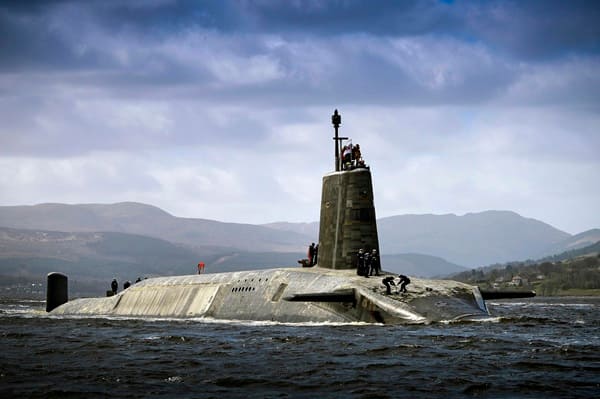
Britain’s nuclear deterrent is protected by one of the country’s most sophisticated weapons systems. Yet when Royal Navy submarines are alongside at their principal Scottish base, one reported element of their defence against small drones is strikingly basic: high-pressure water hoses wielded by sailors on deck.
The revelation raises questions about the protection of Britain’s most sensitive military infrastructure as the proliferation of inexpensive drones creates new vulnerabilities for installations designed to withstand far more conventional threats.
According to a report in The Sun, Vanguard-class submarines at HM Naval Base Clyde in Faslane have hoses fitted with pistol-grip nozzles that could be directed at approaching drones. A source told the newspaper that, in a worst-case scenario, sailors could use the equipment to knock a drone off course or bring it down.
“You have to use what you’ve got,” the source said.
Read more related news:
Royal Navy chief delivers damning warning to Burnham over Britain’s defences
Burnham told to ‘wake up’ and warned Putin is plotting ‘something bad’
Badenoch warns Burnham to act now as ‘Europe is at risk of burning’
Putin’s sycophant issues another yawning threat as France test-fires a new ballistic missile
The contrast is stark. The Vanguard-class fleet carries Trident II ballistic missiles and forms the maritime component of Britain’s nuclear deterrent. Yet the reported use of water jets as a last-resort measure against small unmanned aircraft highlights the challenge of defending high-value military assets against relatively cheap and accessible technology.
The hoses are reportedly positioned on submarine decks as a precaution when vessels are alongside at Faslane. The measure is understood to address small and medium-sized first-person-view drones, rather than larger, longer-range systems that could require different interception capabilities.
The source suggested the threat had evolved beyond the nuisance posed by hobbyists and casual surveillance.
“We always thought this would be for small spy drones or civilian dicking around — but the threats moved on a lot,” the source added.
Faslane is among Britain’s most sensitive military sites, housing the Royal Navy’s submarine service and the vessels central to the country’s continuous at-sea nuclear deterrent. Its protection is therefore not simply a matter of guarding military equipment: it concerns the security of a capability at the heart of Britain’s national defence.
The base benefits from its geography, but that does not remove the risks posed by drones operating nearby. A Navy source described the location as providing “excellent natural protection”, while acknowledging that it remained “at risk of drones”.
“There are lots of public roads, people can roam on the hills,” the source said. “If several drones were launched nearby there is less time to react.”
The concern is not confined to Scotland. Charlie Williams, a defence analyst and researcher at the London-based International Institute for Strategic Studies, said Faslane was clearly of interest to Russia and had been targeted before.
He said it would not be surprising if the site were targeted again, citing reported drone activity around sensitive military and nuclear-related facilities elsewhere in Europe, including France’s Île-Longue submarine base, Belgium’s Kleine-Brogel airfield and RAF Lakenheath in Suffolk.
“It is very surprising they are relying on fire hoses to defend the submarines,” Mr Williams said. “We have to hope the MoD is investing in the right kind of capability to defend it.”
The Ministry of Defence insists that the hoses form only one element of a broader security system. A spokesman said the protection of military sites was subject to constant review, with measures including physical barriers, patrols, surveillance, monitoring and counter-drone capabilities.
The department also pointed to an additional £470mn being invested over the next four years through the Defence Investment Plan to strengthen the protection of UK military sites.
That commitment will be judged not simply by the amount allocated, but by whether suitable equipment can be deployed where it is needed and quickly enough to meet an evolving threat. Water hoses may offer a limited emergency response to certain small drones; they are not, by themselves, a substitute for a dedicated counter-unmanned-aircraft system.
The distinction matters because drone defence is increasingly a contest between cheap, adaptable technology and the costly infrastructure it can threaten. A low-cost aircraft does not need to damage a submarine directly to create a security problem: surveillance, disruption or a coordinated incursion could expose weaknesses and force military personnel to respond under pressure.
The reported precautions at Faslane do not establish that Britain’s nuclear submarines are undefended, nor do they reveal the full capabilities available to protect them. But they do expose a difficult question for the Ministry of Defence: whether the protection of the country’s most strategically important assets is keeping pace with the changing nature of the threat.
For a nuclear deterrent intended to provide the ultimate guarantee of national security, the credibility of the system depends not only on the weapons it carries, but also on the resilience of the bases, personnel and infrastructure that support it.
The government says it is investing in that protection. The test will be whether the investment translates into credible defences against a threat that is becoming cheaper to deploy, harder to predict and increasingly difficult to ignore.
Last month Andy Burnham was accused of putting Britain’s expanding welfare bill ahead of national security after refusing to commit to spending 3 per cent of GDP on defence by 2030.
The Labour leader suggested that increased defence spending should take precedence over social security.
“Yes, we do everything to support our national security. But it can’t come at the expense of social security. Having strong national security also depends on having resilience in our communities.”


Leave a Comment