
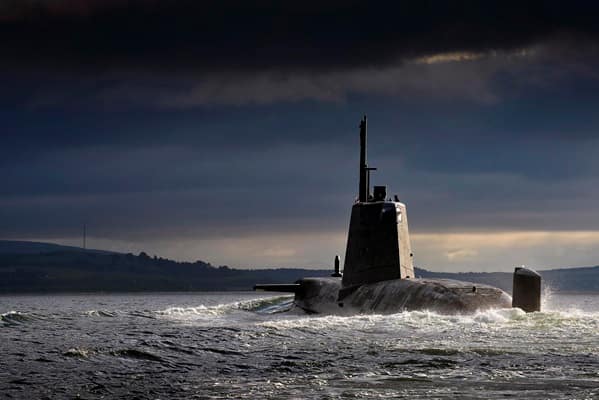
Britain should have at least two Astute-class attack submarines fully operational and deployable at all times, with one patrolling northern waters or the English Channel and another protecting the country’s nuclear deterrent, according to a new assessment of the Royal Navy.
The recommendation, made by the 878 Institute in the first of a planned series examining the state of the senior service, comes amid concerns over the availability of Britain’s most advanced attack submarines, rising Russian activity around UK waters and persistent delays in the nuclear submarine maintenance programme.
The paper calls for a permanent presence in two strategically important areas, setting out the requirement: “To ensure that two of the five Astute-class submarines are fully deployable and indeed operational at all times: one actively patrolling the North Sea, the Greenland-Iceland-UK (GIUK) Gap, or English Channel to deter increased Russian submarine activity around British waters; a second always patrolling alongside the CASD.”
The scale of the problem is illustrated by the institute’s account of the summer. Despite a fleet of five boats, it says, none was operationally deployed.
Read more related news:
‘Risk of sudden escalation is high’: Britain on alert as three nuclear submarines deploy
‘Millions could be called up’ for war as US army rehearses for mass casualties
Ex Army chief warns Burnham ‘the lack of strategic urgency is shocking’ as Putin says he’s ‘ready for war’
Record Russian losses raise questions over Moscow’s ability to sustain Ukraine offensive
“Despite maintaining a fleet of five vessels, it was reported that not a single Astute-class submarine was operationally deployed through summer 2026, and that all five remained laid-up in British harbours. Only HMS Agamemnon (one of the two planned additions to the five in service) is at sea conducting trials.
“This is deeply concerning, given both the rise in Russian sub-surface activity around British waters, but perhaps more worrying because of the lack of available escorts for Britain’s nuclear deterrent.”
The Ministry of Defence does not comment on submarine operations.
The institute argues that availability will not improve without a substantial increase in resources. Its second recommendation calls for additional investment to tackle maintenance delays, industrial constraints and inadequate dockyard capacity.
“To increase resource allocation for the troubled Astute-class submarines, all of which were in docks for a period from June 2026. Increased resources are needed to alleviate maintenance backlogs, industrial bottlenecks, and dockyard infrastructure limitations. Without this, the Astute-class must be said to be failing, and with it, Britain’s nuclear deterrent risks being left defenceless at sea or dependent upon allies for support, eroding the UK’s ‘sovereign’ nuclear deterrent.”
The operational ambition is demanding. Keeping two boats deployed continuously would require 40 per cent of the five-strong in-service fleet to be at sea at any given moment.
Submarine forces typically need around three boats to sustain one continuously deployed, allowing for maintenance, training, crew changes and operational preparation. On that basis, a permanent two-boat commitment would imply a requirement for six or seven available submarines — more than the current fleet, even with the two additional boats planned.
The Astute class performs two critical functions: hunting hostile submarines and protecting the Vanguard-class ballistic missile submarines that underpin Britain’s continuous at-sea nuclear deterrent (CASD). The paper describes its purpose as “anti-submarine warfare, as well as fleet protection for the nuclear-armed Vanguard-class.”
The pressure extends beyond the submarines themselves to the infrastructure needed to keep them operational. Devonport is Britain’s only licensed facility for refitting nuclear submarines. Ministers told parliament this week that the programme to rebuild its submarine berths is being recovered following design difficulties, but construction has yet to begin.
The scale of the challenge is evident in the refit of HMS Vanguard at the same dockyard, which took seven and a half years against an original estimate of three and a half.
Meanwhile, Russian naval activity is placing greater demands on an already stretched fleet. The paper records that the Royal Navy spent 21 days in July alone monitoring Russian ships, while tracking operations increased by 25 per cent compared with the previous year.
The Defence Committee added to the concerns this month, reporting that the availability of destroyers, frigates and attack submarines raised questions about Britain’s ability to meet its commitments in the High North. It also said the Ministry of Defence had accepted that a gap existed in the UK’s anti-submarine warfare capability in northern waters.
The emerging picture is of a navy facing a widening gap between its operational commitments and the vessels and infrastructure available to meet them. The 878 Institute’s proposed two-submarine requirement would make that gap explicit; Britain is being asked to sustain a level of continuous underwater presence that its existing fleet and maintenance system are struggling to provide.


Leave a Comment