
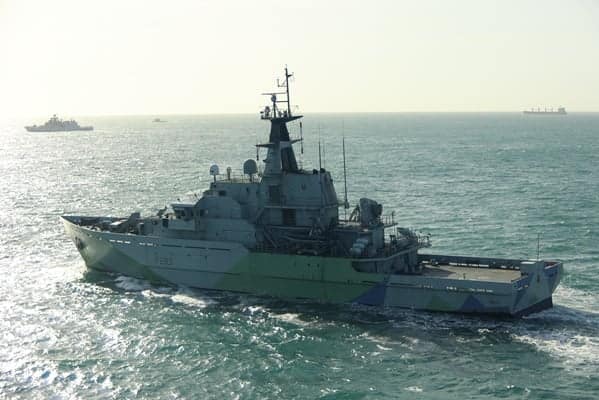
A Royal Navy warship will be kept outside Irish territorial waters despite Dublin requesting British assistance to protect a major European security meeting, exposing the unusual constraints created by Ireland’s constitutional neutrality.
Britain is preparing to deploy an air-defence frigate to waters off Ireland next week as EU foreign and defence ministers gather in County Wicklow to discuss the war in Ukraine.
But legal advice obtained by the Irish government means the British vessel must remain about 14 miles from the Irish coast, preventing it from entering the country’s territorial waters.
The restrictions stem from Ireland’s constitutional provisions governing the deployment of foreign military forces. Under Article 15 of the Irish constitution, only the country’s parliament can authorise the raising of military forces on Irish territory.
Ireland has also received legal advice from Attorney General Rossa Fanning that foreign warships cannot fire across Irish territory to neutralise airborne threats, including drones and ballistic missiles.
The arrangement has prompted Dublin to devise a workaround. An Irish military liaison officer is expected to be stationed aboard the British frigate, with the intention of allowing Irish personnel to authorise the use of long-range weapons if required.
The unusual rules of engagement underline the complications created by Ireland’s policy of military neutrality at a time when European governments are placing greater emphasis on integrated air and missile defence.
The British deployment was requested by Dublin as part of security preparations for the meeting, which will bring senior European officials to Ireland.
Rather than allowing the Royal Navy vessel to operate from within Irish territorial waters, the ship will remain offshore while an Irish officer serves aboard it.
The arrangement is not without precedent.
On July 1, the French frigate Aquitaine was similarly required to remain about 14 miles from the Irish coastline during a meeting of European leaders following the start of Ireland’s six-month EU presidency.
An Irish naval officer was deployed to the French ship’s bridge on that occasion.
Ireland’s neutrality also creates practical difficulties for cooperation with NATO members. Because the country is not part of the alliance, it does not have access to NATO-level secure radio communications, meaning French officers have previously had to use Irish communications equipment.
The latest deployment comes amid renewed criticism that Ireland relies disproportionately on neighbouring countries for aspects of its security despite maintaining a policy of neutrality.
Ireland announced earlier this year that it would increase defence spending to a record £1.29bn, an 11 per cent rise. Yet military spending remains equivalent to only about 0.2 per cent of GDP, among the lowest levels in Europe.
The government has therefore faced pressure to strengthen its own capabilities as security threats become more complex.
The issue was brought into sharper focus during Ukrainian President Volodymyr Zelensky’s visit to Ireland in December last year, when drones were reported near the flight path of his aircraft despite a designated no-fly zone.
A security source said at the time: “They had the capability and intent. They could have taken action at any moment of their choosing.”
The deployment of a British air-defence frigate close to Ireland’s coastline is consequently intended to provide an additional layer of protection during a high-profile international gathering, while remaining within the limits imposed by Irish law.
For Britain, the episode demonstrates the practical difficulties of providing military assistance to a close European neighbour that remains outside NATO. For Ireland, it highlights the tension between maintaining neutrality and relying on allied military capabilities to manage modern security threats.
The result is an unusual compromise: a British warship providing protection for an Irish-hosted European meeting, but legally barred from entering Irish waters or independently using its weapons to defend Irish territory.


Leave a Comment