
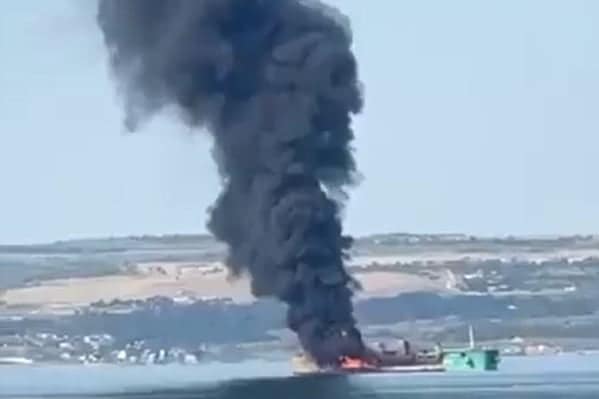
Kyiv expands sea warfare campaign as unmanned vessels strike Russian oil tankers, gas carriers and military-linked shipping.
Ukraine has launched a dramatic new phase of its maritime drone campaign, claiming a major overnight assault that targeted 20 Russian vessels in the Black Sea.
The operation, announced by Ukraine’s Unmanned Systems Forces commander Robert “Madyar” Brovdi, marks a significant expansion of Kyiv’s campaign to disrupt Russia’s naval logistics and energy networks.
Brovdi said the mission, codenamed “MoLoChKa”, had moved beyond the Sea of Azov and into the Black Sea — opening a new front in Ukraine’s battle against Russian maritime supply lines.
“The first round of the maritime battle is over. Now it’s the Black Sea,” Brovdi said.
According to the Ukrainian commander, drones struck 17 oil tankers, two gas tankers and one tugboat during the overnight operation.
The reported attacks follow weeks of escalating Ukrainian strikes aimed at vessels accused of supporting Russia’s war effort.
Brovdi said Ukrainian forces had already targeted 116 vessels in the Sea of Azov before shifting focus towards the wider Black Sea.
The Kyiv Independent could not independently verify the claims, and Russian authorities have not publicly commented on the reported strikes.
💥 russia’s Sanctioned Fleet in the Black Sea — Get Ready. USF Operators Struck 20 More Enemy Vessels.
On the night of July 15, operators of the Unmanned Systems Forces continued inflicting losses on the russian fleet that supports military logistics and energy exports.
The… pic.twitter.com/WE3i9L4ivE
— 🇺🇦 Unmanned Systems Forces (@usf_army) July 15, 2026
The latest operation highlights Kyiv’s growing reliance on unmanned technology to strike targets far beyond the front line.
Rather than attempting to match Russia’s conventional naval power ship-for-ship, Ukraine has increasingly turned to drones as a cheaper and highly effective weapon against Moscow’s maritime infrastructure.
Ukrainian officials say many of the targeted vessels are linked to Russian military logistics, transporting supplies, fuel and equipment while supporting operations in occupied territories.
The campaign aims to force Russia to divert resources into protecting ports, shipping routes and commercial vessels.
The Black Sea has become one of the most important arenas of the war.
Since Russia’s full-scale invasion, Ukraine has used missiles and drones to challenge Moscow’s naval dominance, damaging warships and disrupting operations around Crimea and occupied coastal regions.
The shift of the MoLoChKa operation into the Black Sea suggests Kyiv is now attempting to broaden that pressure against Russia’s wider maritime network.
For the Kremlin, the threat extends beyond military vessels.
Energy shipments, export routes and commercial shipping are increasingly vulnerable to Ukrainian attacks.
Ukraine has opened the Black Sea chapter of russian maritime ass-kicking.
For the first time, 20 russian vessels were hit in a single night — not in the Sea of Azov, but in the Black Sea.
Glory to Ukrainian sanctions. pic.twitter.com/90jgkfMHDz
— UAVoyager🇺🇦 (@NAFOvoyager) July 15, 2026
The strikes create a difficult choice for Moscow.
Protecting every vessel, port and offshore facility across the Black Sea would require significant resources — potentially pulling assets away from other areas of the war.
Ukraine’s drone strategy is designed to create exactly that pressure: forcing Russia to spend more defending its rear areas while keeping its frontline forces supplied.
The reported operation also comes as Ukraine continues a wider campaign targeting Russian energy infrastructure, including refineries and fuel facilities deep inside Russian territory.
The Black Sea has become a testing ground for a new style of warfare where relatively inexpensive unmanned systems can challenge a much larger military power.
Ukraine’s latest maritime offensive signals that the war is expanding beyond trenches and battlefields.
The message from Kyiv is clear: Russia’s supply lines, energy routes and maritime assets are no longer beyond reach.


Leave a Comment