
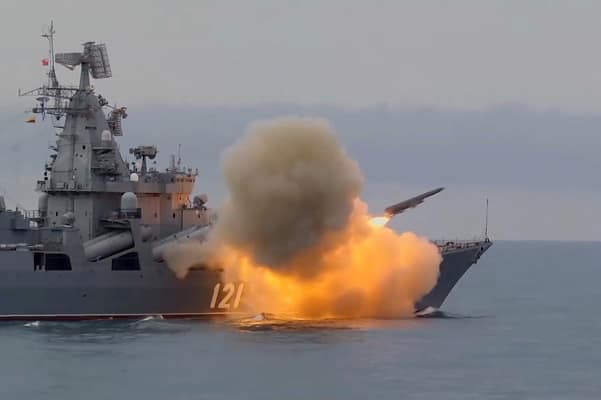
Russia has stopped launching Kalibr cruise missiles directly from the open Black Sea, instead relying on launches from port, according to Ukraine’s navy, in a reported shift that highlights the mounting risks facing Moscow’s naval forces.
Dmytro Pletenchuk, spokesperson for the Ukrainian Navy, said Russian Black Sea Fleet vessels had not ventured into open waters for five consecutive months. The fleet, based at Novorossiysk on Russia’s Black Sea coast, has increasingly been operating under the threat of Ukrainian attacks, he said.
The Russian military continues to use sea-based cruise missiles against Ukraine, but the reported change in launch practices suggests that protecting naval assets has become a central consideration for Moscow.
“They say that Russian ships are being sunk in the Black Sea,” Pletenchuk said. “So, accordingly, they probably decided it is better to launch missiles from their own harbour, despite the fact that if it detonates, there will be hell to pay in the harbour.”
His remarks point to a dilemma for Russia: keeping its warships in port may reduce their exposure to attacks at sea, but concentrating military assets and conducting missile operations from a harbour can introduce different risks.
Read more related news:
‘We’ll be under someone else’s rule’: Former officer delivers terrifying warning over the lack of UK’s defences
Brits told ‘our nation is going to need you’ as Britain prepares for war and the ‘unthinkable’
‘Take care of this problem’: Kremlin demands Trump has Zelensky assassinated
Thousands of NATO troops descend to Russian border in Latvia for the largest brigade deployment
The Ukrainian account has not been independently verified here, and it remains unclear whether the reported absence of Russian surface vessels from open waters reflects a complete halt in deployments or a change in the fleet’s operational pattern.
A fleet under pressure
The Black Sea has become a strategically contested theatre of the war, with Ukraine seeking to restrict Russia’s ability to use its naval forces freely despite having a much smaller conventional navy.
Ukraine has repeatedly targeted Russian naval infrastructure and vessels. The reported consequences of an August 12 attack on the naval base at Novorossiysk have added to scrutiny of the Black Sea Fleet’s ability to operate safely from its own facilities.
According to a report cited by Ukrainian media, two Russian frigates were damaged in the attack. The vessels’ reported damage is significant because frigates capable of carrying Kalibr cruise missiles can provide Russia with a platform for striking targets across Ukraine.
The extent of the damage and its effect on the vessels’ operational readiness would need to be established independently to assess the attack’s full military significance.
Nevertheless, the episode underlines the vulnerability of naval forces even when they remain close to their home bases. Ports offer protection, logistical support and access to maintenance facilities, but they can also become targets when an adversary develops the ability to strike naval infrastructure at range.
For Russia, the challenge is not simply to preserve its ships, but to maintain their usefulness in the campaign against Ukraine.
Missile strikes without freedom of movement
Kalibr cruise missiles remain part of Russia’s arsenal for long-range attacks. The reported shift in launch locations does not mean that Moscow has abandoned the weapons or lost the ability to employ them.
Instead, Pletenchuk’s account suggests that Russia is adapting its operations to reduce the risks associated with sending surface vessels into the Black Sea.
The Ukrainian spokesperson said Russian aircraft and helicopters remained active over the sea, but stayed about 100km away from Ukrainian defence forces. That distance, if accurate, would indicate continued Russian military activity alongside caution about operating closer to Ukrainian positions.
Pletenchuk also said submarine missile carriers had played a limited role in the reported change: they were not launching missiles from the harbour and were not going out to sea, according to his account.
The operational picture is therefore more complex than a simple halt in Russian naval activity. Moscow continues to possess naval and air capabilities, but Ukraine’s claims suggest that the risks of deploying them have influenced how they are used.
The distinction matters. A fleet can retain its weapons and strike capability while losing some of the freedom of movement that makes those capabilities most flexible.
The risks of launching from port
Launching missiles from a harbour creates a different set of operational considerations from firing them at sea. Vessels operating close to shore may have access to support and protection, but they also operate within a more confined environment, where an accident or attack could threaten surrounding infrastructure and other ships.
Pletenchuk specifically warned of the consequences if a missile detonated during a launch from port, arguing that the risks could extend beyond the vessel involved.
His comments did not establish that Russia had suffered such an incident. Rather, they highlighted what he described as the danger of continuing missile operations from a base where ships and supporting facilities are concentrated.
The reported shift also raises questions about the future role of Novorossiysk as a hub for Russia’s Black Sea naval operations. If vessels remain in port for extended periods, maintaining their readiness and sustaining operations without exposing them to attacks at sea could become more challenging.
For Ukraine, restricting the movement of Russian warships would offer a way to impose costs on a larger adversary without matching its fleet vessel for vessel. For Russia, the task is to preserve the ability to launch attacks while protecting the platforms and infrastructure needed to sustain them.
The Ukrainian account does not establish that Russia has lost control of the Black Sea, nor that Kalibr strikes have ended. It does, however, describe a naval force whose operations are being shaped by the threat of attack.
If the reported five-month absence from open waters continues, the central question will be whether Russia can maintain its maritime strike capability while keeping its ships safe — or whether protecting the fleet increasingly limits how it can be used.


Leave a Comment