
NATO is developing military plans that would allow the alliance to strike deep inside Russia in the event of an attack on its territory, marking a significant shift towards offensive operations designed to cripple Moscow’s ability to sustain a war.
The proposed strategy envisages targeting not only Russian troops and military bases but also the supply networks, industrial facilities and critical infrastructure that support an invasion.
It reflects lessons drawn from Russia’s full-scale war against Ukraine, where the ability to disrupt logistics and weapons production has become central to the battlefield.
The plans, reported by The Wall Street Journal, are being developed under the direction of NATO’s supreme allied commander in Europe, US General Alexus Grynkewich. They represent a departure from decades of European defence planning, which largely concentrated on stopping Soviet or Russian forces from advancing after crossing alliance borders.
Read more related news:
Kyiv warns ‘Russia is ready for war with Europe’ amid expansion of military infrastructure
Badenoch warns ‘we’re at war now’ and ‘three days of tinned food won’t save us’ as UK is unprepared
Thousands of NATO troops descend to Russian border in Latvia for the largest brigade deployment
Military strategists increasingly believe that containing an attack at the front line would not be enough. Instead, NATO would seek to destroy the machinery behind an assault before Russia could sustain a prolonged offensive.
Polish Major General Ireneusz Nowak told the newspaper that effective defence would require the ability to strike back at the source of an attack.
“In the event of a conflict with Russia, we would certainly want to strike its military-industrial base,” he said, describing precision attacks deep inside Russian territory as an essential element of deterrence.
Nowak argued that Ukraine’s war might have taken a different course if Kyiv had possessed such capabilities at the beginning of Russia’s invasion. Without the ability to hit the infrastructure supporting Russian forces, he suggested, the conflict had developed into positional warfare resembling the First World War.
Under the emerging Nato approach, strikes could reach from about 150km (93 miles) behind the front line to targets thousands of kilometres inside Russian territory. The potential arsenal would combine precision missiles with cheaper weapons, including drones, allowing the alliance to attack a wider range of targets without relying exclusively on expensive systems.
The target list could extend well beyond airfields and military installations to industrial plants, raw material resources and critical infrastructure that sustain Russia’s military production and operations.
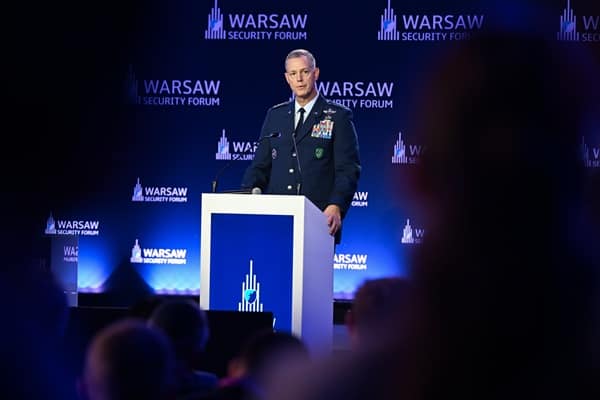
Grynkewich outlined the concept at a recent security conference in Warsaw, describing it as part of his “theory of victory”. Nato forces would first aim to stop the opening wave of an attack. They would then weaken the enemy’s ability to maintain subsequent operations by striking the networks that supply, support and direct its forces.
If Russia continued its offensive, the alliance would target both the troops on the battlefield and the wider system enabling them to fight.
The strategy does not envisage the use of nuclear weapons. Nato held its first symposium dedicated to deep-strike capabilities in June, signalling the growing importance attached to the concept.
Precision weapons are expected to play a central role. Established systems such as US Tomahawk cruise missiles and ATACMS ballistic missiles could feature alongside weapons still being developed. European governments are also seeking to expand their stocks of Storm Shadow, SCALP and Taurus cruise missiles, while investing in new long-range capabilities.
The scale of the industrial effort is considerable. Fabian Hoffmann, a senior research fellow at the Norwegian Institute for Defence Studies, told the Journal that 20 European manufacturers were pursuing at least 48 projects to develop inexpensive cruise missiles, although he cautioned that not all would succeed.
Ukraine has already demonstrated elements of the strategy, increasingly using longer-range weapons to strike military and economic targets inside Russia. Its domestically developed Flamingo cruise missiles are among the systems intended to extend the reach of attacks beyond the battlefield.
But the growing sophistication of military planning exposes a potentially more difficult obstacle: political willingness.
NATO commanders may conclude that striking Russian military infrastructure is necessary to defeat an invasion, but that does not guarantee European leaders would authorise such operations. The risk of escalation and the possibility of retaliation would make decisions to attack targets deep inside Russia politically fraught.
Nico Lange, a former senior German defence ministry official, told the newspaper that a gap remained between military thinking, which increasingly incorporates offensive action, and political approaches that still tend to define defence through barriers or a proposed “drone wall”.
That divide goes to the heart of Nato’s deterrence challenge. A credible threat to destroy the infrastructure behind a Russian offensive could make an attack less attractive to Moscow. But deterrence depends on an adversary believing that the alliance would actually carry out its threat.
The unresolved question is therefore not simply whether NATO can develop the weapons and plans to strike deep inside Russia. It is whether European leaders would be prepared to authorise the attacks their military commanders believe might be necessary to stop a war.


Leave a Comment