
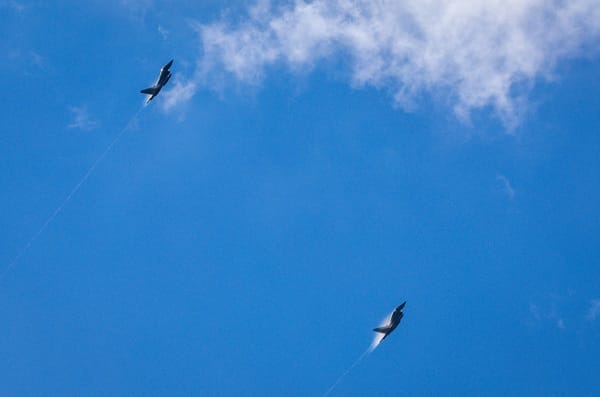
NATO fighters were scrambled over Poland on Tuesday after Russia launched a massive wave of drone strikes across western Ukraine, escalating fears the war is inching ever closer to the alliance’s borders.
Poland’s armed forces confirmed combat aircraft and helicopters were deployed after Vladimir Putin’s forces unleashed a barrage of Shahed drones targeting cities near NATO territory in one of the largest attacks since the Kremlin’s short-lived three-day ceasefire collapsed.
The aerial assault came as US President Donald Trump arrived in Beijing for high-level talks, adding a fresh layer of geopolitical tension to an already volatile international landscape.
Explosions rocked multiple Ukrainian regions overnight, with dramatic footage appearing to show a Russian drone slamming into a building in the western city of Lutsk before erupting in flames. Ukrainian reports suggested the strike may have targeted a local SBU security service facility.
In a stark statement, the Operational Command of the Polish Armed Forces confirmed NATO-aligned air assets had been activated in response to the scale of the Russian assault.
“Due to the massive attack by the Russian Federation on Ukrainian territory, conducted using a large number of unmanned aerial vehicles, military aviation has begun operating in our airspace,” the command said.
“Duty fighters and helicopters are operating, and ground-based air defence and radar reconnaissance systems have reached a state of increased alert.”
Warsaw stressed the operations were “preventative in nature” and designed to protect airspace close to threatened regions bordering Ukraine.
The renewed bombardment underlines how rapidly the conflict is intensifying after the collapse of Putin’s much-publicised ceasefire, which Kyiv accused Moscow of repeatedly violating almost immediately after it was announced.
In Lutsk, emergency services rushed to multiple strike sites as parts of the city centre were sealed off amid reports of casualties. Air raid alerts continued well into the day as further waves of drones crossed Ukrainian airspace.
Elsewhere, in the Rivne region, two people were killed after a Russian strike hit a residential building, with four others wounded.
In Kryvi Rih, a nine-month-old baby girl was left fighting for her life after suffering catastrophic leg injuries in another attack, Ukrainian officials said.
The latest strikes stand in sharp contrast to recent claims by Vladimir Putin that the war was “coming to an end”.
Instead, Moscow appears to be intensifying pressure both militarily and politically.
Kremlin spokesman Dmitry Peskov repeated Russia’s long-standing demand that Ukraine surrender the remaining territory it controls in Donetsk as a precondition for negotiations.
“After the withdrawal of Ukrainian troops, there will be a ceasefire, and the parties can calmly engage in negotiations,” he said.
Kyiv has flatly rejected the proposal, viewing it as an ultimatum amounting to capitulation rather than a serious peace offer.
For NATO, the growing frequency of attacks near alliance territory is becoming increasingly difficult to ignore. Poland has repeatedly scrambled aircraft during major Russian missile and drone barrages, particularly when strikes occur close to its eastern frontier.
The danger for Western leaders is no longer merely theoretical. With hundreds of drones now routinely crossing Ukrainian skies during coordinated attacks, the risk of spillover into NATO territory — whether accidental or deliberate — continues to rise alongside the broader threat of escalation across Europe.


Leave a Comment