
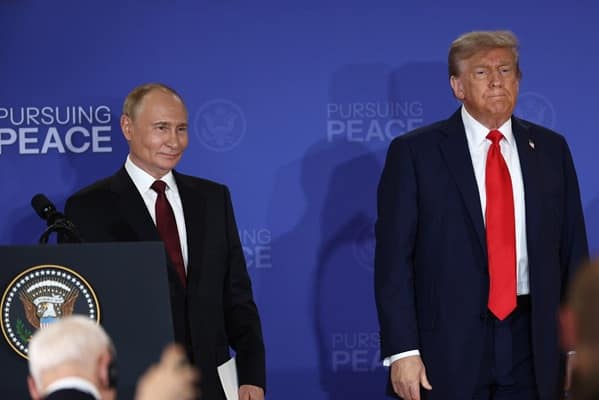
Vladimir Putin has reaffirmed Moscow’s determination to continue its war against Ukraine until the Kremlin’s objectives are achieved, according to a senior Russian official, delivering a fresh setback to US efforts to establish a negotiating framework while Washington moves to ease restrictions on Russian fuel exports.
The Russian president made his position clear during a telephone conversation with Donald Trump, Kremlin foreign policy aide Yuri Ushakov told Russian state media.
The call, which Ushakov said was initiated by Trump to offer birthday greetings, produced no indication that Moscow was prepared to soften its terms for ending the conflict.
“Putin made it clear that Moscow will continue hostilities until it achieves all stated goals,” Ushakov said.
Read more related news:
Royal Navy chief delivers damning warning to Burnham over Britain’s defences
Burnham told to ‘wake up’ and warned Putin is plotting ‘something bad’
Badenoch warns Burnham to act now as ‘Europe is at risk of burning’
According to the Kremlin aide, Putin also accused Ukraine of attempting to disrupt Russian elections and claimed that Russian forces held the operational initiative along the front. Those assertions reflect Moscow’s account of the conversation and were not independently verified.
Ushakov further claimed that Trump had instructed US officials to convey the diplomatic signals received from the Kremlin directly to Kyiv.
The exchange underscores the difficulty facing Washington as it seeks to turn diplomatic contacts into substantive negotiations. Multilateral consultations convened by the US in Miami on Friday, bringing together Ukrainian negotiators, European representatives, Nato officials and US special envoy Steve Witkoff, concluded after six hours without an announced breakthrough.
Witkoff described the discussions as constructive, but Ukrainian and European officials remained sceptical about Moscow’s willingness to agree to meaningful de-escalation.
Ukraine’s foreign minister, Andrii Sybiha, warned on Friday that concessions could be interpreted by the Kremlin as evidence of Western weakness rather than an incentive to negotiate. His comments reflect Kyiv’s concern that pressure on Ukraine to compromise, without corresponding restraints on Russia, could leave Moscow in a stronger position.
That concern has been sharpened by Washington’s decision to permit Russian diesel shipments into US and international markets under a temporary sanctions waiver.
Trump announced that Russia had agreed to supply more than 300,000 tonnes of diesel immediately, followed by 500,000 tonnes in November and a further 1mn tonnes thereafter. Deliveries could rise to 3mn tonnes, depending on refinery operations, according to the announcement.
The US president said the supplies, alongside what he described as “total control of the Strait of Hormuz”, would help restrain fuel prices amid volatility associated with the US-Israeli conflict with Iran.
Shortly afterwards, the US Treasury Department issued a temporary general licence authorising the sale and import of Russian diesel until April 7 2027.
The decision creates an apparent tension in US policy. The waiver offers Moscow access to an important export market at a time when Washington is attempting to secure diplomatic movement over Ukraine, while the Kremlin continues to insist that its military objectives must be met.
The timing is particularly striking because Trump signed the Lindsey O. Graham Sanctioning Russia and Iran Act of 2026 into law on September 18. The legislation was designed to expand statutory penalties affecting Russian energy, banking and defence interests.
Hours before the waiver was issued, Ukrainian president Volodymyr Zelensky had appealed to visiting US lawmakers to enforce sanctions strictly, arguing that economic pressure was essential to compel Moscow to negotiate.
The relief also addresses a restriction Russia had imposed on its own diesel exports in July, following Ukrainian drone strikes that damaged major Russian refining facilities. Trump has previously urged Kyiv to halt attacks on Russian oil infrastructure, blaming them for elevated diesel prices.
The immediate question is whether commercial accommodation can help create conditions for diplomacy or weaken the leverage Washington hopes to use at the negotiating table.
For now, the Kremlin’s public position remains unchanged: Russia intends to continue fighting until it achieves its stated goals. The diesel waiver may alter the economic calculations surrounding the war, but it has yet to produce any publicly announced concession from Putin on the central question of peace.


Leave a Comment