
Germany is considering financial support for Britain’s nuclear deterrent as Berlin accelerates efforts to strengthen Europe’s independent nuclear capability and reduce its reliance on the United States for strategic security.
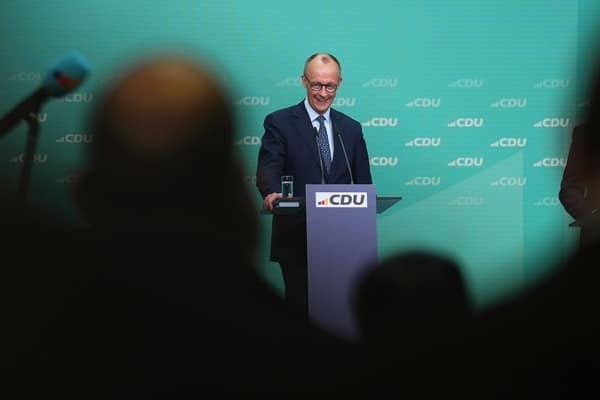
Friedrich Merz’s government is examining ways to deepen Germany’s involvement with the British and French nuclear arsenals rather than pursuing an independent German weapons programme, which remains politically difficult given the country’s history.
One well-placed source told the Telegraph: “We have a very strong interest that the existing nuclear powers in Europe extend their capabilities.”
Trilateral discussions between Britain, France and Germany have intensified in recent months as European governments reassess the reliability of the US security guarantee.
“Policymakers are waking up each morning and asking themselves what the hell the Americans are going to do tomorrow,” a German diplomatic source told the publication.
Berlin is considering several possible forms of practical support for Britain’s nuclear programme. These could include contributions to the next generation of submarines, assistance with missile development or support for uranium enrichment connected to future warheads.
German industry already has experience in submarine construction for Israel, whose vessels are widely associated with the country’s undeclared nuclear deterrent.
The discussions could also encompass conventional military capabilities. One proposal would involve Germany deploying Patriot air-defence systems operated by German forces around strategically important sites, potentially including Faslane naval base in Scotland, home to Britain’s Trident submarine fleet.
A British defence source questioned whether German industry had the specialist expertise required to contribute meaningfully to nuclear submarine construction.
Protecting Faslane, however, was described as a more realistic avenue for cooperation.
“The ability to contribute to the defence of Faslane is more credible, likely and appropriate,” the source said.
The talks come as Britain faces a £63 billion nuclear modernisation programme at a time when defence budgets are under pressure from the need to expand conventional military capabilities.
Four Dreadnought-class ballistic-missile submarines are being built to replace the Royal Navy’s Vanguard fleet and preserve Britain’s continuous at-sea nuclear deterrent.
Britain retains sovereign authority over the use of its nuclear weapons, but the system remains deeply intertwined with the US defence industrial base.
Trident missiles are manufactured and maintained at the US Navy’s Kings Bay facility in Georgia, while Britain’s next-generation Astraea warhead is being developed alongside the American W93 programme.
That dependence has become increasingly uncomfortable for Berlin as European capitals debate how to construct a credible strategic deterrent that would remain viable if Washington reduced its military commitment to the continent.
Germany is pursuing a parallel dialogue with France, whose nuclear arsenal is entirely independent of the United States.
Berlin and Paris have already conducted exercises simulating the use of nuclear weapons in the defence of Europe, while German forces are expected to participate for the first time in France’s “Poker” nuclear exercises this autumn.
The durability of France’s nuclear offer is nevertheless uncertain. Emmanuel Macron, who has offered to “open the strategic debate” with European allies seeking protection under France’s nuclear umbrella, is due to leave office next year.
His potential successors, including Marine Le Pen and Jean-Luc Mélenchon, could favour a more narrowly national nuclear doctrine, limiting France’s willingness to extend its deterrent to European partners.
Russia’s invasion of Ukraine and Donald Trump’s repeated demands that Europe take greater responsibility for its own defence have accelerated debate across the continent.
Poland and Nordic countries have also begun discussing nuclear options, increasing pressure on Germany to find a collective European solution that strengthens existing arsenals without triggering a wider proliferation of nuclear weapons.
By supporting the British and French deterrents, Berlin hopes to strengthen Europe’s ability to deter Russia while reducing incentives for individual countries to develop nuclear weapons of their own.
A Ministry of Defence spokesman said: “Our nuclear deterrent is the cornerstone of our national security, protecting the UK and our Nato allies every moment of every day.
“We remain the only European ally to commit its nuclear deterrent to the defence of Nato. This means that all Nato allies already benefit from the protection of our nuclear deterrent.”
For Berlin, the emerging debate represents a significant shift. Rather than asking whether Germany should acquire nuclear weapons, policymakers are increasingly asking how much the country should invest in the nuclear capabilities already available in Europe — and how far that investment could insulate the continent from an uncertain American security guarantee.




Leave a Comment