
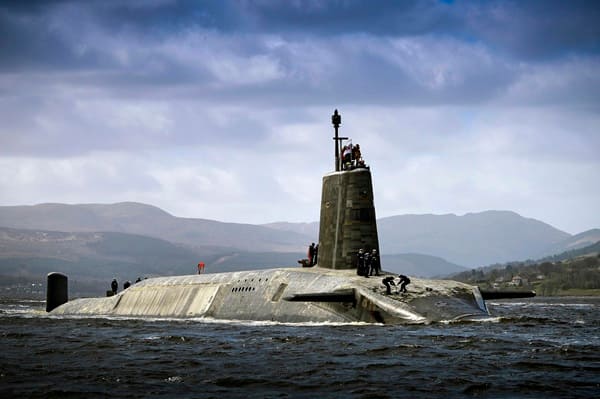
Britain’s future fleet of nuclear-powered attack submarines will prioritise operations in the Atlantic and the Mediterranean, a senior defence official has confirmed, as the UK strengthens its undersea capabilities amid rising tensions with Russia.
Sir Stephen Lovegrove, the Prime Minister’s special representative for the AUKUS programme, said these regions would remain the “primary theatres” for Royal Navy submarine operations.
His remarks follow reports that a suspected Russian mission to map critical undersea infrastructure north of the UK was recently disrupted, underscoring growing concern about the vulnerability of subsea cables and energy networks.
Under the AUKUS pact—agreed between the UK, US and Australia in 2021—Britain plans to build up to 12 next-generation SSN-AUKUS attack submarines, while Australia is set to acquire three as part of a broader effort to expand allied naval power.
Speaking at the Undersea Defence Technology conference in London, Lovegrove said the partnership would deliver a “stronger, larger and more integrated” submarine force capable of operating across multiple regions within a coordinated allied network.
The submarines, to be built in the UK and Australia using shared technology from all three partners, are expected to replace the Royal Navy’s current Astute-class fleet from the late 2030s.
Although not explicitly framed as a response to Beijing, AUKUS has been widely seen as part of a broader Western effort to counter China’s growing influence in the Indo-Pacific.
The programme has also faced scrutiny, including a review under President Donald Trump, though officials indicate the agreement is largely unchanged.
Lovegrove said that increasing the number of fast, stealthy nuclear-powered submarines would significantly enhance deterrence, adding that AUKUS offers “unparalleled strategic reach and power projection capabilities” for the UK and its allies.
The development signals a renewed focus on undersea warfare as NATO countries respond to both Russian activity closer to home and to shifting power dynamics further afield.


Leave a Comment