
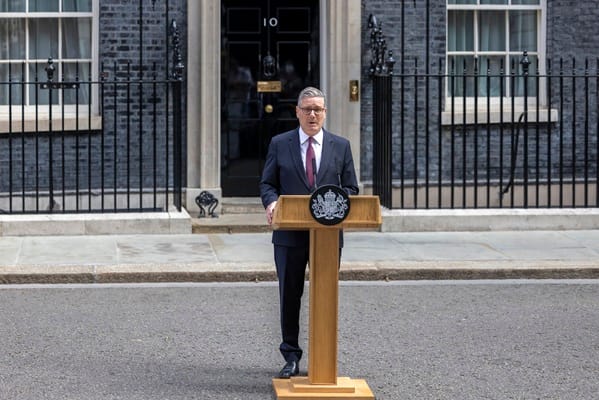
Financial markets moved swiftly to reassess the outlook for the UK economy after Sir Keir Starmer announced his departure as prime minister, with sterling coming under pressure and government borrowing costs remaining elevated amid uncertainty over the future direction of Labour’s economic policy.
The pound initially weakened following the resignation announcement, as investors turned their attention to the leadership contest and the potential implications for taxation, public spending, and fiscal credibility.
Nigel Green, chief executive of deVere Group, one of the world’s largest independent financial advisory organisations, said markets were already signalling concern over the uncertainty ahead.
“Financial markets have already begun to react,” he said. “Sterling weakened against the dollar following the announcement, while gilt yields remain elevated after months of political uncertainty and concerns about the UK’s fiscal outlook.”
Investors, he argued, were less focused on the identity of the next Labour leader than on what that leadership could mean for Britain’s economic framework.
“The market’s first question isn’t who replaces Keir Starmer. It’s whether the next Prime Minister pushes Britain further towards taxing wealth and capital,” Mr Green said.
“If investors conclude the answer is yes, sterling falls, gilt yields rise and money leaves.”
Attention has increasingly focused on Andy Burnham, whose rising profile has prompted speculation about a possible shift in Labour’s economic approach. Any suggestion of a move towards higher taxation on wealth, capital or internationally mobile individuals could become a key concern for investors, Mr Green said.
“Markets react to direction, not just legislation,” he added.
The uncertainty also extends to the future of Chancellor Rachel Reeves, who has been central to Labour’s message of fiscal discipline and economic credibility.
“Rachel Reeves has been the face of Labour’s economic credibility,” Mr Green said. “Starmer’s resignation leaves a giant question mark over her future.”
A change at the Treasury, he argued, could unsettle investors already watching Britain’s debt position, weak growth outlook and productivity challenges.
“Britain already has a debt problem, a growth problem and a productivity problem,” he said. “The last thing financial markets want to hear is talk of wealth taxes, exit taxes and bigger spending commitments.”
The debate over wealth taxation has become increasingly sensitive among investors, particularly those with the ability to move capital internationally. Mr Green warned that policy uncertainty alone could influence behaviour before any measures are introduced.
“There is a dangerous assumption in politics that wealthy people will simply sit still and pay whatever governments demand,” he said.
“They won’t. Some will restructure, some will relocate, and some will move capital elsewhere.”
The warning comes as markets remain highly sensitive to political credibility following the turmoil triggered by the 2022 mini-budget under Liz Truss, when a loss of investor confidence sent UK borrowing costs sharply higher.
“Investors remember what happened in 2022,” Mr Green said. “The lesson was brutally clear. Bond markets punish governments the moment confidence starts to crack.”
Gilt investors are expected to scrutinise statements from leadership contenders for signs of future borrowing, spending and taxation policies.
Ultimately, the market reaction will depend less on personalities and more on whether investors believe Britain can maintain a credible long-term economic strategy.
“If investors conclude Britain is moving in the wrong direction on fundamentals, they will demand a higher price for financing the country,” Mr Green said.
The pound’s early move lower and continued pressure on gilts represent a warning sign that political uncertainty is once again becoming a significant factor for UK assets.
As Labour begins the process of choosing its next leader, investors will be watching closely for clues on whether Britain’s economic direction is set to remain stable — or enter a new period of uncertainty.


Leave a Comment