
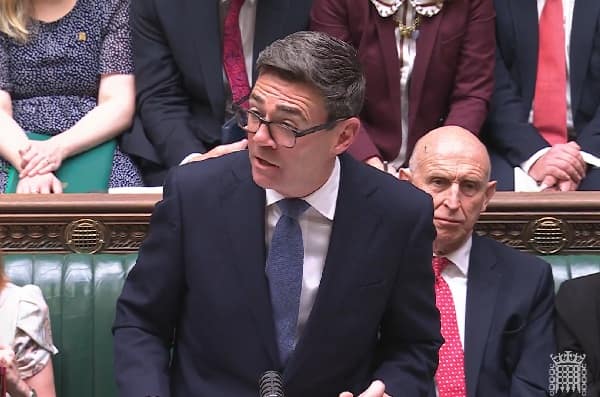
Andy Burnham’s flagship 10-year plan for Britain has been thrown into fresh uncertainty after one of his closest allies appeared to soften Labour’s commitment to nationalising key industries, insisting that public ownership was not a prerequisite for greater state control.
The proposals, billed as the Prime Minister’s blueprint for transforming the country, had been expected to set out a decisive shift towards bringing essential services under public control. But Louise Haigh, the First Secretary of State, sought to reassure business leaders that Labour was not preparing a sweeping return to state ownership.
Speaking at the Confederation of British Industry’s annual conference in Westminster, Ms Haigh declared that the Government was not pursuing “full fat nationalisation”, adding bluntly: “Ownership is not a requirement.”
Her intervention raises questions about the scale of the ambitions behind Mr Burnham’s long-awaited programme, which was initially expected to be unveiled next month but has since slipped towards January.
Addressing the Commons in September, Mr Burnham had promised that the strategy would “set out plans for stronger public control over these essentials, making them work for people and places again”.
Earlier this month, however, he admitted that the public might not see the proposals until next year.
Ms Haigh attempted to draw a distinction between ideological nationalisation and what she described as a pragmatic approach to managing essential services.
“Public control should not alarm anyone in this room. It’s not ideological, it’s pragmatic, and it’s essential for people, for places, and for business,” she told delegates.
She argued that Britain’s privatised utilities model was itself an ideological choice, pointing out that other countries had not followed the same approach.
Citing the United States, which she described as “hardly a hotbed of state socialism”, Ms Haigh noted that most consumers there receive their water from a public utility.
The message to business was that greater public intervention would not necessarily mean nationalisation, but could instead provide greater certainty, lower costs and a more stable environment for investment.
Energy is expected to be central to that ambition. Ms Haigh pledged to bring British energy costs into line with those of other European countries over the next decade, promising to accelerate grid connections and develop an “energy system for the benefit of its users, not producers”.
The Government also intends to overhaul the judicial review process for major infrastructure projects, arguing that lengthy legal challenges are leaving essential developments stalled.
Ms Haigh warned that the existing system was allowing critical projects to remain “in limbo”, undermining investment and delaying the expansion of national infrastructure.
“Time is a tax, and we will empower Parliament to designate and authorise the country’s most critical infrastructure projects,” she said.
“When challenge is unavoidable for the most critical projects, we will offer indemnities so that developers do not down tools.”
She argued that this was the practical advantage of public control, offering businesses greater stability while encouraging both public and private investment.
“That is what public control offers – an opportunity for stability and certainty, for national renewal through public and private investment.”
Mr Burnham has previously presented the 10-year programme as the defining political project of his premiership. In his first speech on the steps of Downing Street in July, he pledged that it would take Britain “from where we are now to where we all want Britain to be”.
Speaking to The Economist earlier this month, he insisted the strategy would be substantial and would set out his vision for the country’s future.
“It will also be… compelling because I am weaving the different threads together, and I will do that,” he said.
The programme is expected to extend beyond the future of utilities, encompassing reindustrialisation, devolution, infrastructure expansion and efforts to reduce the cost of living.
Its publication is expected to be followed by a consultation lasting between six and nine months, meaning the final shape of the Government’s plans could remain unsettled well into next year.
But Ms Haigh’s intervention has already exposed a central question facing the Prime Minister, of whether Labour’s promise of stronger public control represents a genuine restructuring of Britain’s essential industries or a more limited attempt to influence privately operated services.
For a Government that has presented the plan as its defining blueprint, the distinction could prove politically significant. Mr Burnham has promised a substantial transformation; businesses are now being told that nationalisation is not necessarily part of it.


Leave a Comment