
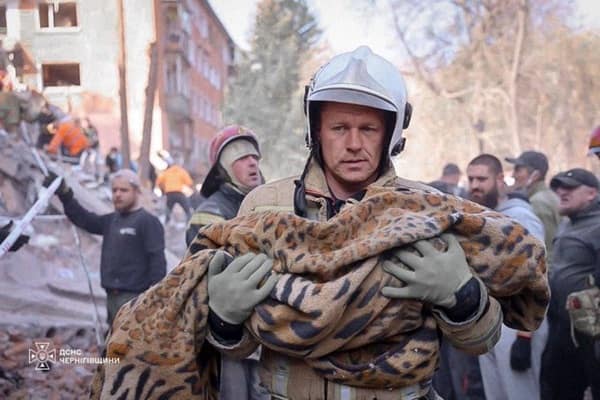
An ordinary bus journey should not end with bodies scattered across a road; children sleeping in their beds should not become another casualty statistic; and boarding a passenger train should not involve preparing to evacuate into nearby woodland to escape Russian drones.
Yet these are increasingly the realities of civilian life in Ukraine, more than four and a half years into Russia’s full-scale invasion.
On 8 October, a Russian glide bomb struck near two city buses in Kramatorsk, killing at least 33 people and injuring 18.
The previous day, a Russian Kh-101 cruise missile devastated a five-storey apartment building in Pryluky, Chernihiv region, killing 22 people, including five children, and injuring another 54.
President Volodymyr Zelenskyy said recent attacks across Ukraine had killed 78 people and injured 215, “This is a brutal Russian escalation, terror against people and life,” he declared.
Read more related news:
Royal Navy chief delivers damning warning to Burnham over Britain’s defences
Burnham told to ‘wake up’ and warned Putin is plotting ‘something bad’
Badenoch warns Burnham to act now as ‘Europe is at risk of burning’
A nuclear power with a water pistol as Royal Navy’s reported drone defence sparks alarm
For those living and working in Ukraine, these attacks are no longer isolated emergencies, they increasingly dictate how people travel, work and organise their daily lives. I recently travelled between Dnipro and the Polish border, spending approximately 24 hours travelling out and another 27 hours returning. Repeated drone warnings, delays and evacuations transformed an ordinary railway journey into an exhausting exercise in uncertainty where passengers were ordered from carriages and directed towards cover as drones operated nearby.
Families, elderly passengers and workers waited in darkness, uncertain whether the next explosion would be close enough to kill them.
Ukraine’s railway network remains essential to keeping the country functioning, making attacks against it particularly damaging, in April, humanitarian organisation UK-Med reported more than 600 attacks on railway infrastructure during 2026, including damage to over 40 passenger carriages.
The wider civilian casualty figures are equally disturbing.
According to revised United Nations figures, 448 civilians were killed and 2,675 injured in July, followed by 372 killed and 2,349 injured in August, while across the first eight months of 2026, the UN verified 2,222 civilian deaths and 13,058 injuries.
That combined toll rose 55% over the corresponding period in 2025, exceeding the total recorded for the entire year.
These are minimum verified figures, not the complete human cost of Russia’s war.
International condemnation has followed, alongside additional British sanctions targeting Russian oil revenues, military supply chains and sanctions evasion. Britain has also announced further humanitarian, energy and accountability assistance.
However, the fundamental question remains whether these measures are sufficient to change Vladimir Putin’s calculations. President Zelenskyy’s increasingly public disagreement with US Secretary of State Marco Rubio over Washington’s description of a “strategic stalemate” reflects growing frustration.
A diplomatic deadlock does not mean every available means of pressure has been exhausted; meanwhile, reports of potential American commercial involvement in Russian energy projects raise uncomfortable questions about the direction of Washington’s negotiations, with Reuters reporting discussions involving Jared Kushner and Kremlin representative Kirill Dmitriev concerning possible American investment in Nord Stream, while recording the White House’s denial of recent discussions.
Separately, The New York Times reported proposals involving Lukoil’s overseas assets and business groups connected to individuals with relationships to Kushner or Steve Witkoff’s family, with neither report establishing wrongdoing, but both raise legitimate questions about transparency, potential conflicts of interest and the relationship between diplomacy and private commercial opportunities.
My concern is that the prospect of Russia’s economic rehabilitation risks emboldening Putin while his military continues killing Ukrainian civilians. Peace negotiations cannot become an opportunity to discuss future profits without securing meaningful changes in Russian conduct.
Ukraine urgently requires dependable air-defence deliveries, increased interceptor production and tighter enforcement against companies supplying Russia’s weapons industry, according to Ukraine’s presidency. The Kh-101 missile used in Pryluky contained more than 100 foreign components, highlighting continuing concerns about sanctions enforcement.
Having survived Russian captivity and torture, and lost my family home to this invasion, I understand the human consequences beyond the statistics. I want diplomacy to succeed, but diplomacy without credible pressure risks becoming another opportunity for Moscow to prolong its aggression.
After four and a half years, the question is no longer whether Russia’s attacks deserve condemnation; it’s whether those condemning them are prepared to impose consequences sufficient to stop them.
And, more importantly, what changes for the next Ukrainian family boarding a bus or passenger train?


Leave a Comment