
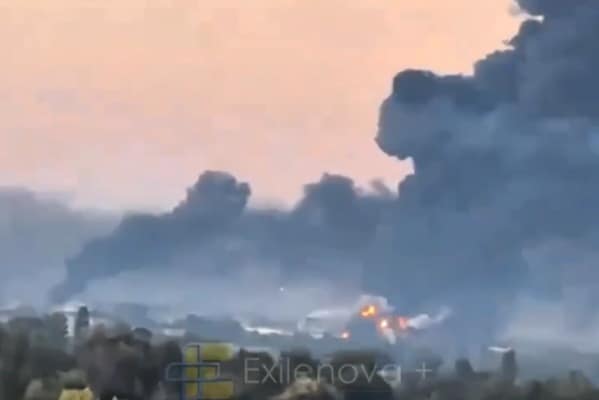
Ukraine has stepped up its campaign against Russia’s energy infrastructure, striking a major oil refinery in the Samara region in an attack that underlines Kyiv’s expanding ability to hit targets hundreds of kilometres inside Russian territory.
Large plumes of black smoke were reported over the Kuibyshev refinery in Samara following an overnight drone attack. The facility lies about 765km from Ukraine’s border, highlighting the growing reach of Kyiv’s long-range unmanned systems.
Former Ukrainian government official Anton Geraschenko posted footage of the blaze on X, saying: “The Kuibyshev oil refinery in Russia’s Samara region is on fire following a drone attack.
“The refinery has a design capacity of around 7 million tonnes of oil per year.
“Explosions were also reported in Tolyatti.”
The refinery has a stated processing capacity of about 10,000 tonnes of crude a day, equivalent to roughly 73,000 barrels, and produces fuel products used across Russia’s industrial and military economy.
Footage circulated by Ukrainian monitoring channels Exilenova+ and Supernova+ appeared to show a large fireball illuminating the night sky before heavy smoke spread over the facility. Russian opposition outlet ASTRA also reported that Ukrainian drones had struck the refinery.
The Kuibyshev plant has previously been targeted. Ukrainian forces struck the facility on June 10, according to the supplied reports, forcing operations to be suspended.
The latest attack forms part of a broader Ukrainian strategy aimed at reducing Russia’s ability to refine crude oil and supply its armed forces while placing additional pressure on domestic fuel markets.
The Kuibyshev oil refinery in Russia’s Samara region is on fire following a drone attack.
The refinery has a design capacity of around 7 million tonnes of oil per year.
Explosions were also reported in Tolyatti. pic.twitter.com/J6IfzNv1xQ
— Anton Gerashchenko (@Gerashchenko_en) September 22, 2026
The Kyiv Independent has reported that Ukrainian strikes contributed to fuel shortages across Russia during the summer, with refinery output coming under increasing pressure.
By September, half of Russia’s six largest diesel-producing refineries had either reduced production or halted operations following Ukrainian drone attacks, according to the publication.
The escalation follows President Volodymyr Zelensky’s approval of further long-range operations. Kyiv has increasingly targeted refineries, military facilities, logistics hubs and weapons production sites, with Zelensky saying in July that Ukraine could strike targets more than 3,000km inside Russia.
The campaign has created tensions with Washington. US President Donald Trump has urged Kyiv to stop attacking Russian oil refineries, arguing that the strikes were contributing to a global diesel shortage.
Zelensky, however, has argued that Ukraine must continue striking Russian targets while Moscow maintains its attacks on Ukrainian cities and infrastructure.
The refinery strikes demonstrate a shift in the economic geography of the war: Russia’s rear areas are no longer insulated from the conflict, while Ukraine is increasingly seeking to impose costs on the energy and industrial infrastructure underpinning Moscow’s war effort.


Leave a Comment