
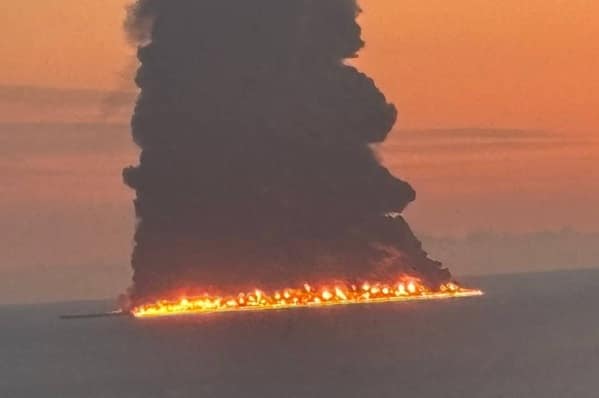
A burning oil tanker drifting off the Russian Black Sea resort of Sochi has exposed the environmental risks surrounding Moscow’s shadow fleet, after Ukrainian drones struck a vessel accused of helping Russia circumvent Western sanctions on crude exports.
Russian authorities have sought to reassure tourists and residents that the damaged tanker poses no threat to the coastline, despite footage showing the 246-metre vessel engulfed in flames about 15 nautical miles from Sochi.
Sochi mayor Andrey Proshunin said the fire had been extinguished and that environmental monitoring had detected no oil pollution.
“At present the open fire on the tanker has been liquidated and rescue vessels are observing. Pollution of water with the oil cargo [carried in the tanker] has not been recorded. The tanker is drifting with the current along the shoreline,” Proshunin said.
He added that environmental agencies were testing water, air and ground across the greater Sochi region.
Read more related news:
Algerian Hercules flying weapons to Russia raises fresh airspace security questions for NATO
Kremlin’s war spending hits $199bn whilst a delusional Trump believes the conflict is ending
Russian plague outbreak could lead ‘to anarchy in days’ in a terrifying warning
Putin’s sycophant issues another yawning threat as France test-fires a new ballistic missile
“I ask all to remain calm, to observe current rules and restrictions, and to trust only reliable sources of information. The situation is under constant monitoring by the city operational staff,” he said.
Rospotrebnadzor, Russia’s environmental watchdog, similarly said there had been no pollution of the Black Sea from the tanker fire, while local authorities subsequently said beaches and waters had been cleared for public use.
The assurances contrast with the scale of the incident.
The Liberia-flagged Aframax Rio, a 107,113-tonne vessel built in 2004, was reportedly carrying oil when it was attacked on Tuesday evening. Ukrainian President Volodymyr Zelensky confirmed that Ukraine’s military had struck and badly damaged a tanker in the Black Sea, although he did not identify the ship.
Local Russian media attributed the attack to Ukrainian drones.
Satellite fire-monitoring data from NASA’s Fire Information for Resource Management System showed fires near the vessel for more than 24 hours before they were extinguished. Shipping reports said the blaze began around the central cargo area before spreading along the ship.
The environmental stakes are potentially significant. The Black Sea coast around Sochi is one of Russia’s most important tourist regions, while the surrounding coastline includes beaches and sensitive wetlands.
The incident also highlights the increasingly complex risks created by Russia’s shadow fleet, a network of ageing or opaque-ownership tankers used to transport Russian oil despite western sanctions.
Ukraine has designated the Rio as a shadow tanker. Shipping databases identify its operator as Athens-based Hellenic Tankers, while its registered owner is Rio Enterprises SA, based in the Marshall Islands.
The vessel’s last recorded voyage was from Novorossiysk to Saudi Arabia’s Rabigh port in May, according to shipping data.
Ukraine has increasingly targeted vessels it says are involved in Russia’s sanctions-evasion network. Robert “Magyar” Brovdi, commander of Ukraine’s Unmanned Systems Forces, said last month that Ukrainian forces had attacked or disabled hundreds of Russian shadow-fleet tankers since July.
The danger is not confined to sanctions policy. In December 2024, the tanker Vologaneft-212 sank near Anapa carrying more than 4,000 tonnes of heavy fuel oil, contaminating hundreds of kilometres of Russian Black Sea coastline and sensitive wetlands.
With the storm season approaching, the Rio incident raises a familiar but increasingly costly question for Moscow: how much environmental and commercial risk can the shadow fleet absorb before the consequences reach the resorts, ports and coastlines it is intended to protect?


Leave a Comment