
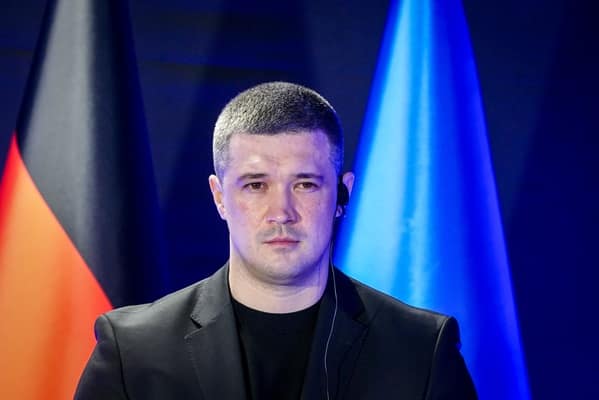
After nearly two weeks of political turbulence, President Volodymyr Zelensky appears determined to close one of the most contentious chapters of his wartime presidency.
Despite sustained public demonstrations calling for the return of Mykhailo Fedorov as defence minister, the Ukrainian leader has decided not to reverse his earlier decision, according to people close to the president cited by RBC-Ukraine.
Instead, Zelensky believes the dismissal of former Commander-in-Chief General Oleksandr Syrskyi has already addressed the protesters’ principal concerns, allowing the government to move forward.
The decision illustrates the delicate balancing act confronting Ukraine’s leadership as it attempts to preserve both democratic legitimacy and wartime cohesion.
Fedorov’s departure triggered one of the largest domestic protest movements since Russia’s full-scale invasion.
Read more related news:
Ukraine destroys Russia’s vital oil reserve in a stunning deep strike
Russia faces grim choice as losses outpace recruits
Ukraine war is becoming more dangerous as Iran threatens to strike
Zelensky’s biggest gamble yet: Can Ukraine’s new defence chief win a war of innovation?
Demonstrators gathered in Kyiv and other cities carrying handmade cardboard placards, arguing that the architect of Ukraine’s defence technology transformation should remain at the heart of government. Many credited Fedorov with accelerating drone production, modernising procurement and forging closer links between the military and Ukraine’s rapidly expanding defence industry.
His resignation followed an increasingly public disagreement with Syrskyi over military reforms. While Zelensky subsequently removed the commander-in-chief and appointed Major General Mykhailo Drapatyi, protesters viewed that as only half a victory.
The president evidently disagrees.
By appointing Yevhen Khmara, the former head of the Security Service of Ukraine’s elite Alpha unit, as defence minister, Zelensky has signalled that operational experience and continuity now outweigh demands for another political concession.
The appointment also reflects Ukraine’s evolving military priorities. Khmara is widely associated with special operations and deep-strike capabilities that have increasingly allowed Kyiv to target Russian logistics, fuel depots and military infrastructure far behind the front line. As the war becomes more technologically sophisticated, those capabilities are likely to remain central to Ukraine’s strategy.
Yet the episode exposes a broader tension within Ukraine’s wartime governance.
The Ministry of Defence has evolved into far more than a military institution. It oversees billions in procurement, coordinates international arms deliveries, manages an expanding domestic defence industry and drives innovation across the battlefield. Critics argue those responsibilities require not only military expertise but also the kind of technological and managerial leadership that Fedorov embodied.
For Zelensky, however, repeatedly revisiting cabinet appointments carries its own risks.
Governments fighting existential wars depend upon clear lines of authority. Reversing major personnel decisions in response to public demonstrations could weaken perceptions of executive control at a time when Ukraine remains under relentless military pressure.
That does not diminish the significance of the protests themselves.
The demonstrations underline that even during wartime, Ukrainian civil society remains remarkably active and willing to challenge government decisions. Zelensky has publicly acknowledged citizens’ right to protest, and according to RBC-Ukraine, even rejected internal proposals last year to stage unspecified provocations aimed at discrediting demonstrators.
That restraint reflects one of the defining differences between Ukraine and the authoritarian system it is fighting.
Whether the protests now lose momentum, as officials reportedly expect, will depend largely on whether organisers can transform broad public frustration into a more focused political movement.
For now, however, Zelensky has made clear that the debate over the defence minister is over.
The far more consequential question is whether Ukraine’s new leadership team can maintain the pace of military innovation while confronting a Russia that continues to expand both its war aims and its industrial capacity. In that respect, the success of Khmara’s appointment will ultimately be judged not by political controversy in Kyiv, but by events on the battlefield.


Leave a Comment