
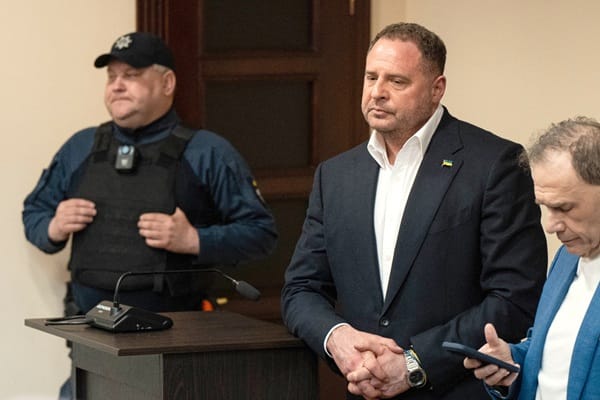
For much of the war, Andriy Yermak stood shoulder to shoulder beside President Volodymyr Zelenskyy as one of the defining faces of Ukraine’s resistance and one of the most powerful men in the country, though he never escaped controversy.
That now famous image from the opening days of Russia’s full-scale invasion, Zelenskyy standing in central Kyiv alongside his closest advisers declaring “we are all here”, became symbolic of a country refusing to collapse under overwhelming pressure. Yermak was right there beside him, calm, composed and central to the wartime leadership structure.
Today, however, the political atmosphere surrounding the former presidential chief-of-staff looks very different.
Ukraine’s anti-corruption bodies, NABU and SAPO, have formally named Yermak as a suspect in a major money-laundering investigation connected to an elite housing development near Kyiv. The case, linked to the wider “Operation Midas” investigation, is now being described as the largest corruption probe of Zelenskyy’s presidency so far.
The symbolism matters enormously, not simply because Yermak remains one of the most powerful figures in Ukraine during the war, but because the investigation itself demonstrates something equally important:
Ukraine’s anti-corruption institutions are still functioning, even during an existential war for national survival, a point often missed abroad.
The image that became symbolic of Ukraine’s defiance in the opening days of the invasion, President Zelenskyy flanked by his closest inner circle, including Yermak, in central Kyiv declaring to the world: “We are all here.”
For years, critics of Ukraine, particularly pro-Kremlin commentators, have attempted to portray the country as hopelessly corrupt while simultaneously ignoring the fact modern Ukraine has spent the last decade building institutions specifically designed to tackle that problem. NABU and SAPO were created after the 2014 Revolution of Dignity precisely because Ukrainians themselves demanded accountability from their political system, and Ukrainians have repeatedly shown they are willing to defend those institutions publicly.
Last year, public outrage erupted across Ukraine after controversial legislation threatened the independence of NABU and SAPO, triggering rare wartime protests in cities across the country. Critics argued the move risked undermining anti-corruption oversight and damaging Ukraine’s EU ambitions. The backlash became so intense parliament ultimately reversed course and restored the agencies’ independence, with protests taking place despite the threat of Russian air attacks.
That episode may ultimately prove just as important as the Yermak investigation itself because it demonstrated something many outside observers still fail to understand:
Ukraine is not Russia.
In Russia, corruption investigations largely function as political weapons wielded selectively by the state. Under Vladimir Putin, a former KGB officer who has spent virtually his entire adult life inside government structures, estimates of personal wealth have ranged into the billions despite no conventional business career ever publicly existing on paper.
Moscow continues lecturing the world about corruption in Ukraine while presiding over one of the most opaque political systems on earth, where oligarchic wealth, offshore structures and state power have become deeply intertwined. The Kremlin’s so-called anti-corruption rhetoric has long functioned less as genuine reform and more as information warfare aimed at discrediting Ukraine internationally.
Yet ironically, the very fact Ukraine openly investigates senior officials, even during wartime, highlights the difference between the two systems and rarely receives the recognition it deserves.
No serious observer claims Ukraine has solved corruption, because clearly it has not. However, the existence of functioning investigations targeting people at the very top of the political hierarchy is itself evidence of institutional pressure still operating under conditions where many states would already have suspended normal accountability entirely.
That matters enormously to Ukraine’s Western partners, especially as billions in military and financial assistance continue flowing into the country.
The danger now for Zelenskyy is not necessarily immediate political collapse, as polling still shows substantial public trust in his leadership during wartime, but the deeper risk of erosion unquestionably exists.
For years, Yermak was viewed as Zelenskyy’s closest political operator, gatekeeper and strategist. Any scandal attached to him inevitably drifts toward the presidency itself, regardless of whether Zelenskyy is personally implicated or not, although Ukraine’s anti-corruption agencies have already publicly clarified the president himself is not part of the investigation.
Still, politically, proximity matters, especially in a wartime environment where public patience is thinner, economic pressure remains immense and society is already exhausted after years of invasion, mobilisation and loss. It is probably only a matter of time before protests emerge again, because there is also a broader modern reality at play here: public trust increasingly fluctuates not simply through evidence, but through perception, speculation, online reaction cycles and Russian propaganda, although in my experience Ukrainians themselves often understand Russian information warfare far better than many Western observers do.
Putin’s ‘three-day war’ enters year four as Kremlin clings to propaganda
One only needs to look at the enormous swings surrounding financial betting markets and political announcements internationally, including the dramatic fluctuations repeatedly seen around statements made by Donald Trump, to understand how volatile modern political narratives have become in the digital age. Markets, social media outrage and public perception now move almost instantly, often long before investigations themselves conclude.
Ukraine is not immune from that environment.
Nor is Zelenskyy.
But perhaps the most important question now is not whether corruption exists inside Ukraine, but whether Ukraine continues confronting it openly while simultaneously fighting the largest land war Europe has seen since 1945. So far, despite enormous pressure, it still appears willing to do exactly that, and that may ultimately prove far more significant than the downfall of any single political figure.
In Ukraine’s case, what we are seeing is how quickly wartime heroes can become political liabilities, and in modern Ukraine even those once standing at the very center of power are no longer guaranteed protection from scrutiny.


Leave a Comment