
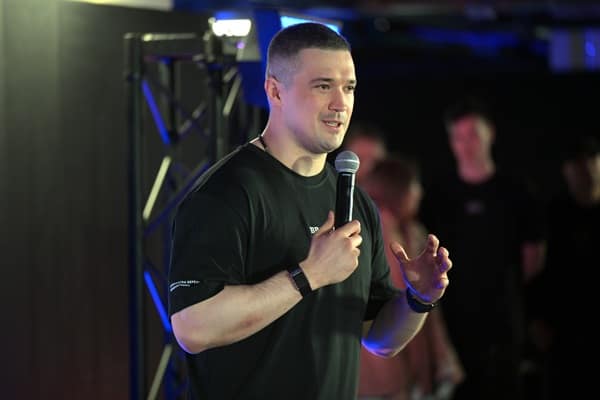
Mykhailo Fedorov may have just made his first major political mistake since leaving Ukraine’s Ministry of Defence.
For weeks, the former Defence Minister barely needed to say anything.
The protests were growing, questions surrounding his departure remained unanswered, and the political vacuum created by the government’s poor communication was doing much of the leg work for him.
Then came YouTube.
Fedorov has now called for Ukraine to find a way to hold elections during the war, while warning of a “systemic crisis of governance” and attacking what he described as an old system that protects itself, resists change and rewards loyalty over results. His intervention is the first demand for wartime elections from a major Ukrainian political figure since Russia launched its full-scale invasion in 2022.
That changes the political picture dramatically.
I find this whole thing increasingly bizarre.
Ukraine’s parliament is reportedly preparing to vote on a new Defence Minister, with Acting Defence Minister Yevhen Khmara apparently struggling to secure enough support.
Yes, Ukrainian law requires the Defence Minister to be a…
— Shaun Pinner (@ShaunPinnerUA) August 18, 2026
For the past month, I have been broadly sympathetic towards Fedorov. I understood the anger surrounding his departure and why thousands took to the streets during a war in some of the largest protests I have seen in nearly eight years living in Ukraine.
There were, and remain, legitimate questions surrounding why somebody so closely associated with military innovation and reform was not returned to the Defence Ministry.
But calling for elections now is something else entirely.
Ukraine remains at war. Russian and North Korean-made ballistic missiles continue to fall on Ukrainian cities, hundreds of thousands of Ukrainians are serving in the Armed Forces, millions remain displaced abroad and significant Ukrainian territory remains under Russian occupation.
So how exactly would an election work?
How do soldiers fighting along more than 1,000 kilometres of frontline vote? How do Ukrainians under Russian occupation vote freely? How do millions of refugees participate? And how do you safely operate polling stations in cities routinely attacked by ballistic missiles and Shahed drones?
These are not minor technical difficulties.
They go to the very legitimacy of any election held under those conditions.
Fedorov himself acknowledged the difficulties facing soldiers, refugees and Ukrainians living near the frontline, arguing that complexity should not make elections impossible.
Perhaps not forever.
But there is an enormous difference between preparing Ukraine for its eventual post-war elections and injecting the issue into an increasingly bitter political confrontation now.
And the timing could hardly be worse.
The Verkhovna Rada is preparing to settle the question of Ukraine’s permanent Defence Minister, while Fedorov’s intervention comes alongside another potentially damaging political development for the Zelensky administration.
Ukraine’s anti-corruption agencies, NABU and SAPO, announced on Wednesday that they were conducting a major operation targeting an alleged criminal organisation involving current and former MPs and senior officials from the Presidential Office.
НАБУ та САП проводять спецоперацію із викриття злочинної організації, що діяла під керівництвом чинного та колишнього народних депутатів України, за участі високопосадовців Офісу Президента України та інших осіб.
Деталі – згодом— NAB Ukraine (@nab_ukr) August 19, 2026
There is no evidence linking those investigations to Fedorov, nor should allegations involving officials automatically be attributed personally to President Volodymyr Zelensky.
But politically, the backdrop is becoming increasingly combustible.
And Zelensky’s administration helped create the conditions for it.
When Prime Minister Yuliia Svyrydenko resigned in July, her Cabinet followed as part of Ukraine’s constitutional process. Fedorov’s departure itself was therefore not some unconstitutional presidential purge.
The political shock came when it became clear that he would not be reappointed as Defence Minister.
What followed was uncertainty.
There was never a sufficiently convincing public explanation for why such a popular minister, associated with innovation and military modernisation, was not being returned to the job at such a critical point in the war.
Instead, Ukrainians got poor communication and eventually silence.
When governments leave an information vacuum, people inevitably fill it themselves.
Was Fedorov encountering resistance to military reform? Was it personality? Institutional opposition? Had somebody become uncomfortable with his growing popularity?
Or was it ultimately about power?
Those questions helped turn Fedorov into something potentially far more politically dangerous: a martyr.
Until this week, he could comfortably occupy the position of the popular reformer removed from office while Ukrainians protested on his behalf.
He didn’t need to attack Zelensky.
The government was doing much of the political donkey work for him.
Now Fedorov has directly challenged the way Ukraine is governed.
Whether he intends to run for president is almost beside the point. His intervention inevitably looks political, particularly when polling cited by Reuters suggests he could represent a serious electoral challenge to Zelensky in a future contest.
And that risks changing the question Ukrainians are asking.
Instead of “Why did Zelensky remove Fedorov?”, it becomes “What exactly is Fedorov trying to achieve?”
That could prove disastrous for him.
Ukraine absolutely needs accountability. The Ukrainian military still needs reform. And when conditions allow it, Ukraine unquestionably needs elections.
But democracy is not simply putting ballot boxes somewhere and calling it an election.
Fedorov had considerable political capital, while the government’s handling of his departure arguably gave him even more.
With one YouTube video, however, he may have transformed himself from the victim of a badly communicated reshuffle into an active participant in what increasingly looks like a very public power struggle.
Politically, Fedorov may just have shot himself in the foot.
Or perhaps he knows something we don’t.


Leave a Comment