
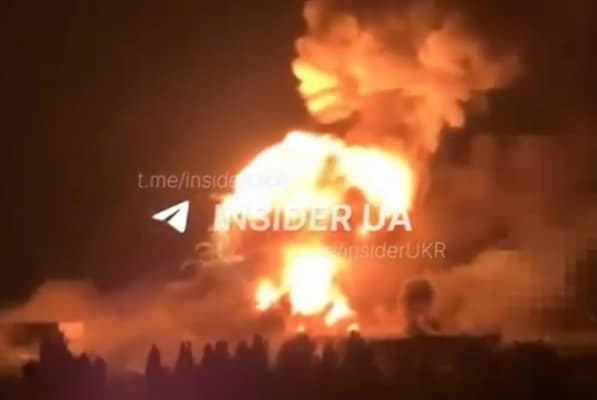
Russia launched another major overnight missile and drone barrage against Ukraine, killing at least 12 people and injuring 34, as the war again spilled across borders and a nuclear safety crisis deepened at the Russian-occupied Zaporizhzhia plant.
The strikes hit Kyiv and surrounding areas in the early hours of Thursday, with residents driven into shelters as explosions shook the capital.
Apartment blocks, warehouses and industrial facilities were damaged, while a children’s hospital and an educational institution were among the buildings affected, according to Ukrainian officials.
Kyiv mayor Vitali Klitschko said people were trapped inside a destroyed residential building. Windows were shattered and vehicles set ablaze as emergency crews searched damaged sites.
Russia’s defence ministry said its forces had used “high-precision weapons” launched from land, air and sea against Ukrainian drone facilities, industrial targets and transport and logistics infrastructure.
The distinction between military and civilian impact was less clear on the ground. Ukraine’s emergency service said residential buildings had been struck, while the repeated bombardment of the capital has turned air-raid sirens and underground shelters into an increasingly routine feature of life.
The escalation also forced Poland to activate “defensive air operations” after Russian long-range aviation began its strikes.
Polish military authorities said aircraft were deployed to protect national airspace along the country’s south-eastern border, underlining the growing risk that Russia’s long-range campaign could produce consequences beyond Ukraine.
The Polish military wrote on X: “Due to the activity of Russian long-range aviation carrying out strikes on Ukrainian territory, military aviation operations have begun in Polish airspace.”
But the more dangerous warning came from southern Ukraine.
I’m afraid Moscow has everything coming to it, and this is only the beginning. Putin has internationalised his war by bringing in North Korean troops, missiles and now missile units, while simultaneously escalating Russia’s terror campaign against Ukrainian cities.
You cannot… https://t.co/mVHHByKSqb
— Shaun Pinner (@ShaunPinnerUA) August 20, 2026
The Zaporizhzhia Nuclear Power Plant, Europe’s largest nuclear facility, suffered another loss of external electricity supplies after a high-voltage line was damaged. The incident marked the plant’s 27th blackout since Russia seized the facility in 2022 and the 15th such disruption this year.
Backup diesel generators were activated to maintain essential systems.
Energoatom warned that repeated reliance on emergency generators was degrading equipment and increasing the risks surrounding the plant. The Ukrainian nuclear operator said the repeated interruptions demonstrated that conditions at the facility remained precarious.
A Ukrainian telegram read: “As emphasized by Pavlo Kvtunyuk, head of Energoatom, the regular blackouts at the ZNPP are wearing down equipment and increasing safety risks.
“Frequent activation of diesel generators leads to faster degradation of the equipment.
“This latest blackout once again confirms that the situation at the Zaporizhzhia Nuclear Power Plant remains precarious. The risks to nuclear and radiation safety are being exacerbated by the incompetent actions of Russian “administrators.”
“The only guarantee of safe operation of the plant remains the de-occupation of the ZNPP and its return to full control of Ukraine and the sole legitimate operator, PJSC “NAEK Energoatom.”
The problem is not simply that the plant has lost access to the grid again. Nuclear facilities depend on reliable external power to maintain cooling and safety systems even when reactors are not generating electricity.
Every additional interruption therefore increases the pressure on infrastructure already operating under extraordinary wartime conditions.
Moscow-installed officials said plant personnel were monitoring equipment and that radiation levels remained normal.
Russia is losing the war it started.
And it is retaliating by targeting civilians and civilian infrastructure.
We are working with Member States and our partners to support Ukraine’s anti-ballistic capabilities.
So that Ukraine has the means to prevent the loss of lives.
— Ursula von der Leyen (@vonderleyen) August 20, 2026
That reassurance does little to resolve the underlying political problem.
Russia has occupied the plant since the opening phase of the invasion and installed its own management. Kyiv continues to insist that the facility must be returned to Ukrainian control, while Moscow and Kyiv routinely accuse each other of actions endangering nuclear safety.
Meanwhile, the conflict continued to test the limits of Nato’s eastern air defences.
A drone crossed into Romanian airspace near Galați before crashing in an uninhabited area, according to Romanian authorities. A small fire was quickly extinguished.
For Ukraine, the latest strikes demonstrate the widening gap between the demands of an industrial-scale war and the diminishing margin for error around critical infrastructure.
For its neighbours, the message is equally uncomfortable. Russian missiles are increasingly forcing Nato states to activate aircraft and air-defence measures, while a nuclear power station under occupation continues to depend on emergency systems.
The war is no longer confined to the battlefield. It is becoming a contest over how much pressure Ukraine’s cities, infrastructure and nuclear facilities can absorb before the consequences become impossible to contain.


Leave a Comment