
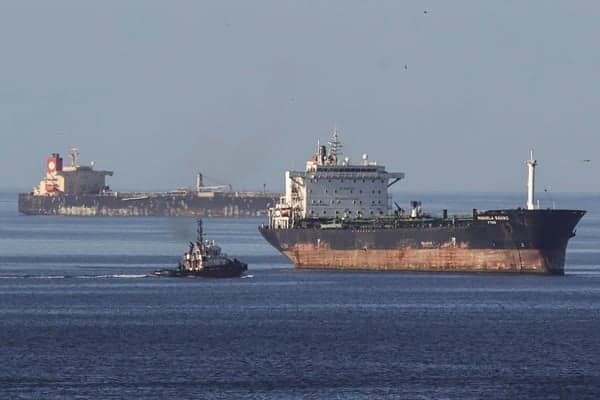
A Russian cargo vessel suspected of secretly transporting submarine nuclear reactor components to North Korea exploded and sank in mysterious circumstances off the coast of Spain, according to a bombshell investigation.
The Ursa Major went down in the Mediterranean on December 23 last year after a series of blasts on its starboard side, roughly 60 miles from Spanish waters, according to a CNN investigation citing Spanish officials and sources familiar with the probe.
Investigators reportedly believe the vessel may have been carrying components for two submarine nuclear reactors bound for the North Korean port of Rason, raising explosive questions about covert military cooperation between Vladimir Putin and Kim Jong Un.
The alleged shipment came months after Pyongyang dispatched troops to aid Russia’s war effort in Ukraine.
Spain’s government later confirmed the ship’s Russian captain eventually admitted the cargo included “components for two nuclear reactors similar to those used in submarines”.
According to CNN, the captain initially described the mysterious freight as oversized “manhole covers” before allegedly changing his account during questioning.
The vessel had departed from Saint Petersburg on December 11 with a publicly filed manifest listing two large cranes, 129 empty containers, and two huge “manhole covers”.
Officially, the ship was supposedly heading for Vladivostok in Russia’s Far East.
Investigators reportedly questioned why Russia would transport such a small volume of cargo thousands of miles by sea instead of using its own rail network across Siberia.
The ship’s journey was further shrouded in suspicion by the presence of two Russian military escort vessels — the Ivan Gren and the Aleksandr Otrakovsky.
Portuguese naval surveillance aircraft tracked the convoy through European waters before contact was reportedly lost shortly before the explosions.
CNN said the Ursa Major unexpectedly slowed on December 22 while sailing near Spain, though crew members initially denied any emergency was unfolding.
Roughly 24 hours later, the vessel abruptly changed course before issuing a distress call at 11:53 am UTC on December 23.
Spanish investigators concluded the ship suffered three explosions on its starboard side near the engine room, leaving it crippled, heavily listing and ultimately doomed.
Two crew members were killed in the blasts, while 14 others escaped aboard a lifeboat and were later rescued by Spanish authorities.
Footage obtained by CNN reportedly showed a Spanish rescuer attempting to access the ship’s engine room, only to discover it had been sealed shut.
The rescuer also searched onboard containers, with some allegedly containing only rubbish, fishing nets and miscellaneous equipment.
A later forensic inspection reportedly uncovered a 50 cm by 50 cm hole in the hull, with surrounding metal bent inward — a detail investigators are examining closely.
Spanish authorities are said to be investigating whether the damage may have been caused by an explosive device or even a high-speed “supercavitating” torpedo.
Such weapons use air bubbles to slash water resistance and strike targets at extreme speed. Only a small number of countries — including the United States, Russia, Iran and several NATO members — are believed to possess them.
The mystery deepened further when four additional explosions were reportedly detected after the Ivan Gren fired red flares over the wreck site.
Russia’s state-linked ship owner, Oboronlogistics, later described the sinking as a “targeted terrorist attack”.
Neither the Russian, Spanish nor British militaries publicly commented on the allegations, while the Pentagon reportedly declined to discuss the incident.
CNN said several Western intelligence officials privately described the sinking as “strange” and questioned aspects of the Spanish investigation, though none reportedly offered an alternative explanation.
Further intrigue followed when the suspected Russian spy ship Yantar returned to the wreck site and remained there for five days.
Additional explosions were later detected near the seabed, possibly targeting the wreck itself.
The network also reported that a rare US WC-135R Constant Phoenix “nuke sniffer” aircraft twice flew over the area after the sinking.
The specialised aircraft are typically deployed to detect radioactive material and monitor nuclear activity.


Leave a Comment