
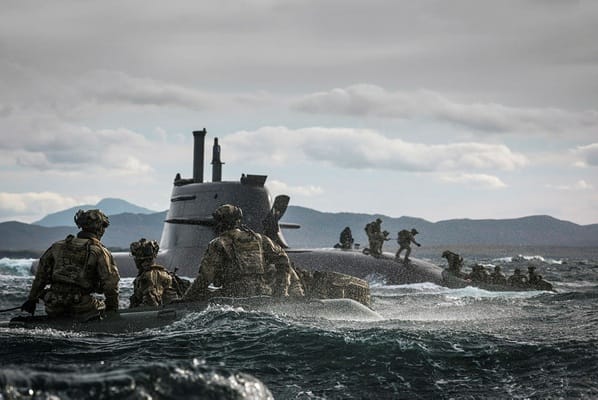
British commandos have carried out a high-risk training operation from the deck of a German submarine as NATO allies stage one of their largest exercises in the North Atlantic in years, underscoring the growing focus on high-intensity warfare in Europe’s northern approaches.
The operation formed part of Strike Warrior 26, the largest test of the UK Commando Force’s combined capabilities for 15 years and a major rehearsal for allied crisis-response operations across the High North and North Atlantic.
More than 2,000 military personnel from Britain, Germany, the Netherlands, Canada, Norway, Portugal and the United States are taking part in the exercise, which involves eight warships and 19 aircraft.
At Cape Wrath on Scotland’s north coast, specialist British commandos used inflatable raiding boats to move ashore and establish an observation post on exposed cliffs after being deployed in an operation involving a German submarine.
From the position, personnel from 148 Battery Commando Forward Observation Battery directed the guns of Portuguese warship NRP Dom Francisco de Almeida against simulated enemy positions.
The exercise demonstrated how allied forces could combine intelligence, covert reconnaissance, maritime manoeuvre and long-range fires in a contested environment.

LPhot Hutchins
“The submarine operation showed the powerful combination of bringing allies together, with the German U-boat charged with identifying targets, commandos discreetly landing ashore and the Portuguese bringing the firepower onto the target,” the Royal Navy said.
The scenario reflects a central feature of modern NATO planning; the ability to move forces rapidly across multiple domains while linking sensors, special operations personnel and weapons systems into a single targeting network.
The 148 Battery personnel involved are trained to conduct reconnaissance and direct naval gunfire from positions behind simulated enemy lines, enabling commanders to bring maritime fires against targets identified by small specialist teams operating close to hostile territory.

LPhot Hutchins
The exercise also includes amphibious landings, boarding operations, intelligence and surveillance missions, logistics and sustainment, maritime security and anti-submarine warfare.
The scale of the rehearsal reflects a shift in European defence planning towards the prospect of prolonged, technologically sophisticated conflict involving multiple allied forces rather than isolated national operations.
The Royal Navy said the exercise marked the first time since the war in Afghanistan that specialist elements of the UK’s elite Commando Force had worked together at this level.

LPhot Hutchins
An operations officer from 148 Battery, who could not be named for operational reasons, said the complexity of the exercise represented a significant milestone for the unit.
“This level of complexity and coordination of live assets has not been achieved by 148 Battery for nearly 30 years,” the officer said.
“We wanted to demonstrate to our partners across the United Kingdom Commando Force, wider UK Defence and NATO Special Operations Force community the type of missions we are prepared to execute against future threats.

LPhot Hutchins
“Warfighting is our focus, and we are prepared to employ specialist assets to deliver Multi-Domain Fires and Targeting.”
Strike Warrior began on September 28 and concludes this week. Its geographical focus is significant: the High North and North Atlantic are increasingly important to European security, linking the Arctic, northern Europe and the sea lanes on which NATO relies for reinforcement.
The German submarine operation offered a vivid demonstration of that changing battlefield.

LPhot Hutchins
Rather than operating as separate national forces, the exercise is designed to make submarines, commandos, aircraft and warships function as parts of a single allied combat system — a capability NATO increasingly regards as essential to credible deterrence in a more contested European security environment.


Leave a Comment