
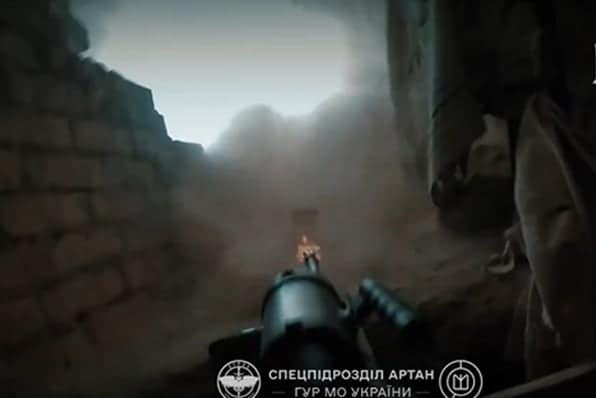
Ukraine is testing a new model of warfare in which soldiers are increasingly being replaced at the most dangerous points on the battlefield by machines.
During Operation Vivaldi in northern Donetsk, Ukraine’s Third Army Corps has used heavy bomber drones to drop kamikaze unmanned ground vehicles more than 10km behind Russian lines, combining robotic systems with electronic warfare and conventional drones to penetrate Russian defences. The corps described the tactic as the first of its kind.
The operation has provided a glimpse of how Ukraine is seeking to turn its experience with drones into a broader robotic battlefield. Rather than relying on infantry to probe exposed positions, unmanned ground vehicles are sent ahead to reconnoitre, attack and clear routes before troops move forward.
Read more related news:
Streeting warns Britain faces unprecedented risk of war with Russia
Russia builds huge nuclear command centre deep beneath the Urals
24 hours inside Ukraine’s most dangerous railway journey
Defence Secretary tells Brits to prepare for ‘war’ and buy water and food
The Ukrainian military says the Vivaldi operation has resulted in more than 3,000 Russian casualties across its first two phases and helped return 125 sq km to Ukrainian control, including the settlements of Shandryholove and Derylove and full control of Drobysheve. Those casualty figures are Ukrainian military claims and have not been independently verified.
Footage released by the Third Army Corps shows ground robots being delivered by heavy bomber drones before moving through Russian-held territory. Cameras mounted on the vehicles recorded their movements as they approached Russian positions.
Mykola Zinkevych, commander of the NC13 ground robotic systems unit, described the technology as a breakthrough precisely because it appeared where Russian forces were least prepared to encounter it.
The Ukrainian operators dubbed the missions “safari – just driving around”, with the most important effect coming from the confusion created among Russian troops.
Electronic warfare was central to the operation. Ukrainian forces used jamming and air-defence systems to “blind” Russian reconnaissance drones, preventing them from identifying the assault force or understanding the direction of the Ukrainian advance.
Mykola compared the concept with the airborne operations of earlier wars, but with a fundamental difference: instead of deploying soldiers from aircraft, Ukraine is deploying machines.
“You could hear it all on the radio: a vehicle drove up, then exploded…”
“Their command didn’t believe the reports – a huge row broke out, total panic.”
The sequence illustrates the changing economics of combat. A relatively inexpensive unmanned vehicle can be risked in terrain where sending a soldier would expose an assault team to artillery, mines, drones and small-arms fire.
❗️During the 🇺🇦Third Army Corps offensive in Operation Vivaldi, the world’s first strike UGV unit NC13 used modernized ground kamikaze drones armed with two Bullspike grenade launchers: the robots attacked Russian positions, detonated inside their shelters, and created the… pic.twitter.com/fMNByEYwCQ
— 🪖MilitaryNewsUA🇺🇦 (@front_ukrainian) September 27, 2026
Ukraine’s Third Army Corps says its ground robotic systems have already completed more than 15,700 missions and transported about 3,300 tonnes of supplies. The corps says unmanned systems now perform up to 80 per cent of infantry support needs in some formations and account for 90 per cent of frontline evacuations.
The implications extend beyond a single operation. Ukraine has spent more than four years adapting to a battlefield dominated by surveillance drones, electronic warfare and precision strikes. The next stage is to connect those technologies into a single system in which drones identify targets, electronic warfare suppresses enemy sensors, ground robots move into the danger zone and infantry follows behind.
The result is not yet a battlefield without soldiers. Robots cannot hold terrain indefinitely and remain constrained by communications, mobility, production and the complexity of fighting in urban environments. Reuters reported earlier this month that Ukraine sees unmanned ground vehicles as a way to reduce human exposure, rather than a complete replacement for infantry.
But Operation Vivaldi offers a striking indication of where the technology is heading.
The battlefield is no longer simply a contest between armies. Increasingly, it is becoming a contest between networks of machines — and the soldiers capable of coordinating them.


Leave a Comment