
I was up at 2am and on the road out of Dnipro by three, with all the uncertainty around taking the train, driving seemed the safer option, the curfew also meant the roads were empty, but the winter cold and thick fog made the drive treacherous.
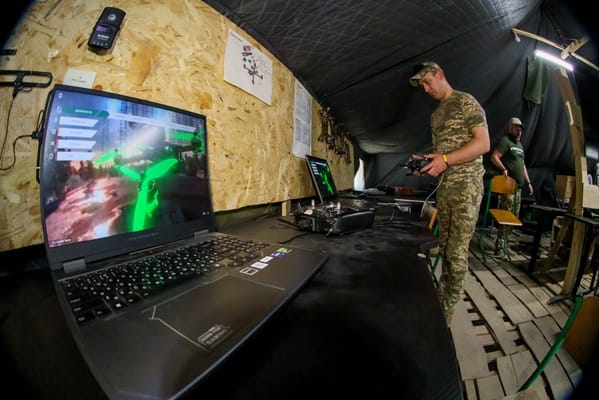
I was travelling with H, a British-born platoon commander in a Ukrainian drone unit, and his Jack Russell, Beef, so as we set off for London, my wife and the city we call home were heading into a sixth day without power.
In Ukraine, weighing up how to travel and what you’re leaving behind has become part of everyday life, but I have to confess, leaving gets harder each time.
We finally reached London on Thursday afternoon, by Friday, I was at the Royal United Services Institute in Whitehall for the sixth UK–Ukraine Defence Tech Forum. Where discussions were held under the Chatham House Rule, I can report what was discussed while keeping the identities and affiliations of speakers and participants confidential.
Over the past month, I’d been on the receiving end of jet-powered Russian drone attacks and watched Russia strike our local power station in Dnipro, now, sitting in Whitehall, it felt almost surreal to hear just how far British and Ukrainian defence cooperation had come since the first forum.
But with my wife back home facing another day without electricity, I had one question at the forefront of my mind: how quickly can Britain and Ukraine move from producing a few dozen systems to manufacturing and delivering thousands?
I was thinking particularly about air defence, for reasons that should be fairly obvious, while in September 2025, British Defence Secretary John Healey made a commitment that has stayed with me: “We will innovate at a wartime pace, support UK and Ukrainian security, and boost jobs here in Britain.”
I wanted to know just how far we had come.
One phrase stayed with me from the battlefield briefings, “Underground war.” Tunnel-boring machines came up alongside sensors, uncrewed ground vehicles and what some call “uncrewed combined arms”. In practice, that means finding ways for those systems to work alongside infantry, armour and artillery.
I was taught combined arms in the British Army in the 1990s, the principle of getting different parts of a force to work together, but even after a decade in Ukraine, some of what I heard in Whitehall sounded closer to Terminator than to anything I remember from those lessons.
There was discussion about smaller units operating with more autonomy and the effort it takes to hold ground before trying to break a stalemate. What caught my attention was when the word “tank” came up, then artillery, especially when bad weather limits drone operations. Infantry still have ground to hold, AI helps them do their jobs more efficiently as more machines face each other on the battlefield, but also playing a significant factor now is how quickly each side can update its software.
From the start, one point kept coming up, the people building the equipment need to hear from the people using it. Ukraine brings experience of adapting systems in wartime, Britain brings engineering, finance and manufacturing capacity, so for firms on both sides, the question is whether the people funding, approving and buying equipment can move at the pace of the companies developing it.
Procurement is where innovation becomes a business decision, a letter of intent can signal interest, but a manufacturer deciding whether to hire staff, buy machinery or expand a production line needs to know which orders it can count on. Getting to that point means testing the equipment and proving it works in the field.
Manufacturing outside Ukraine can also add capacity and reduce exposure to Russian strikes and the disruption they cause. For Ukrainian firms looking to scale up alongside British manufacturers, reliable access to components, secure logistics and long-term orders will help determine whether they can deliver consistently.
Britain has been one of Ukraine’s most reliable strategic partners, with the 100 Year Partnership, signed in January 2025, giving both countries a framework for sharing technology and manufacturing equipment together. Project OCTOPUS shows what that can look like. It’s a Ukrainian-designed air defence interceptor that the Ministry of Defence announced would be manufactured in Britain, with a production target of thousands a month.
I actually left Whitehall more hopeful than I’d expected, initiatives such as the Kyiv Business Centre and the ingenuity I saw at the forum gave me a sense of what Britain and Ukraine can build together, and I was struck by how much Ukraine has to teach its partners while fighting a war and trying to keep the lights on.
One of the unexpected pleasures of the trip was seeing Vadym Prystaiko, Ukraine’s former ambassador to Britain. I’d last seen him shortly after my release from Russian captivity in 2022, we laughed about how I look a little different these days, and we put it down to my good Ukrainian wife and, of course, my never-ending love of food.
After a day spent talking about manufacturing and procurement, it was good to laugh with someone I hadn’t seen since I’d just got home from captivity. I thought about the people I’d met since then, the friendships I never expected to make, and how many Britons and Ukrainians are still pulling together nearly five years into the full-scale war.
My thoughts were never far from my wife and family in Dnipro and the familiar sound of generators. When you’ve left home as it heads into a sixth day without power, it can be hard to find a ray of sunshine, on a typically grey English November day, I found a little of it in Whitehall.


Leave a Comment