
The United Nations has delivered another damning assessment of Russia’s invasion of Ukraine, concluding that Moscow’s systematic attacks on civilian energy infrastructure constitute war crimes and crimes against humanity.
The findings, published on 26 October by the UN Independent International Commission of Inquiry on Ukraine, establish that Russia’s campaign against power stations, heating facilities and electricity networks was not simply collateral damage from military operations, but part of a deliberate state policy to inflict suffering on Ukraine’s civilian population.
Pablo de Greiff , UN Commissioner, speaking at the Commission’s press conference, explained that investigators had established the attacks were intentional and carried out under a state policy designed to deprive civilians of essential services and cause suffering.
His particularly important conclusion was “Those attacks that target civilian objects indispensable to the civilian population are unlawful and amount to war crimes.”
For those of us living here, this comes as absolutely no surprise.
Read more related news:
‘No kit or bullets to fire’: Healey invokes son’s military experience in blistering defence attack
Putin’s chilling nuclear signal to Europe as he fires nuclear-capable missile hours after talks with Nordic leaders
Ukrainian posties ‘destroy Russian drones’ as Nova Post build their own air defences
‘The risk of being killed is very high’ Russian children sent to the front as Putin’s war grinds on
Only last week, I filmed a Russian attack on Dnipro’s power infrastructure, watching the consequences of a campaign designed to deprive Ukrainians of electricity and heating as winter approaches.
Ukrainian restrictions on publishing footage of sensitive infrastructure prevent me from sharing the recording, but the timing was particularly extraordinary.
In the very same week, the words “Putin” and “humanitarian” were being used in the same sentence, as international attention turned towards a limited ceasefire and humanitarian operation around Russian-occupied Oleshky.
The irony was almost impossible to comprehend.
While Vladimir Putin was being discussed in the context of humanitarian cooperation, Russian forces were continuing attacks on infrastructure essential to civilian survival, and now, the United Nations has formally documented the criminal nature of that campaign.
The Commission concluded that Russian commanders knew the facilities they were targeting were indispensable to civilians, particularly during freezing winter conditions, with the attacks having left families without heating, disrupted hospitals, interrupted water supplies and forced millions to endure prolonged electricity shortages.
Crucially, the Commission identified evidence of a deliberate Russian state policy, rather than a series of isolated incidents, that distinction matters enormously when considering criminal responsibility further up the chain of command.
The International Criminal Court has already issued arrest warrants against senior Russian military figures in connection with attacks on Ukraine’s electricity infrastructure.
In March 2024, warrants were issued for Lieutenant General Sergei Kobylash and Admiral Viktor Sokolov.
Three months later, the ICC issued further warrants against former Russian Defence Minister Sergei Shoigu and Chief of the General Staff Valery Gerasimov.
The alleged offences include attacks against civilian objects, disproportionate civilian harm and crimes against humanity.
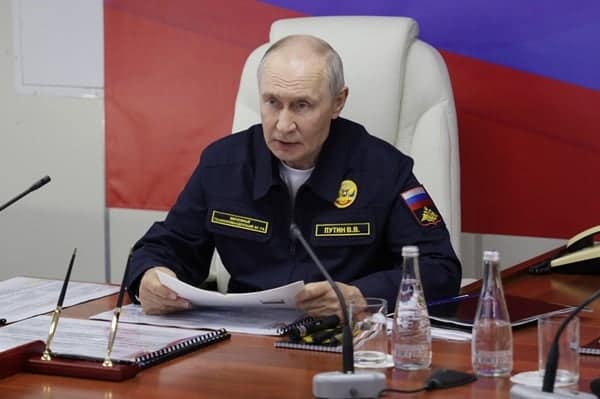
And above them sits Vladimir Putin, already wanted by the ICC over the alleged unlawful deportation and transfer of Ukrainian children.
Quite a rap sheet forming, and with the evidence continuing to mount, the question is no longer simply what crimes have been committed, but whether those responsible will ever be brought to justice.
So what happens next?
The UN findings do not automatically create new ICC arrest warrants, nor do they establish Putin’s personal criminal responsibility for the energy attacks, however, they provide further documented evidence that prosecutors may examine when investigating the wider Russian command structure.
The next question is whether investigators can establish sufficient evidence connecting political and military decision-makers to the continuing attacks.
That requires demonstrating individual responsibility, including orders issued, knowledge of criminal conduct or failures to prevent offences by forces under their control.
The ICC has no police force of its own, arrests depend upon cooperation from states, and Putin remains beyond its immediate reach while protected by the Russian state.
Nevertheless, these arrest warrants carry real consequences, and history has shown that even those who once appeared untouchable can eventually find themselves in the dock.
Former Serbian President Slobodan Milošević was transferred to The Hague in 2001, while Bosnian Serb leader Radovan Karadžić spent nearly 13 years evading justice before his arrest in 2008. His military commander, Ratko Mladić, was finally captured in 2011. Both Karadžić and Mladić were subsequently sentenced to life imprisonment.
And there is another significant development on the horizon.
The Special Tribunal for the Crime of Aggression against Ukraine, being established through the Council of Europe with international backing, is intended to prosecute those at the very top of Russia’s political and military leadership for launching the invasion itself.
Unlike the ICC’s existing war crimes investigations, this tribunal will focus on the crime of aggression, and the decision to wage an unlawful war against Ukraine in the first place.
International justice can be painfully slow, yet the passage of time does not necessarily mean escaping accountability.
A temporary ceasefire, humanitarian corridor or diplomatic handshake cannot absolve anyone of responsibility for alleged atrocities, as much as some people want to whitewash those crimes. I know from personal experience what Russian captivity and the disregard for international law can mean.
The international community must now move beyond condemnation, preserve evidence, support investigations and ensure existing arrest warrants are enforced wherever legally possible.
Because while politicians debate humanitarian gestures, Ukrainians are preparing for another winter under Russian bombardment.
The UN has established the criminal nature of this campaign, the ICC has already identified senior suspects, what remains is the political will and international cooperation needed to bring those responsible before a court.
Because there can be no lasting peace without justice.


Leave a Comment