
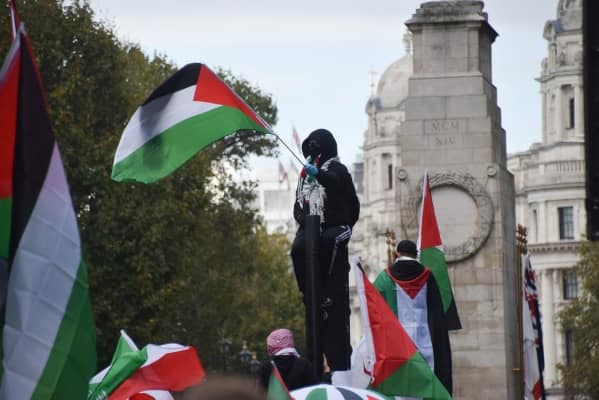
Britain’s political leadership has condemned demonstrations taking place on the third anniversary of the October 7 attacks, as ministers appealed to protesters to show restraint while police imposed stringent conditions on a student march through central London.
Defence Secretary Wes Streeting described the planned demonstrations as “shameful”, while Education Secretary Lucy Powell urged students “to show compassion and protest on another day”.
The protests have become a fresh flashpoint in an increasingly bitter debate over antisemitism in Britain, with the anniversary of Hamas’s deadly assault on Israel coinciding with continuing political divisions over the war in Gaza.
Prime Minister Andy Burnham sought to reassure Britain’s Jewish community, saying: “we stand with you” against antisemitism.
His intervention came as the Israeli embassy in London warned that Britain had experienced what it described as a “profound rise in antisemitism” since the attacks, with Jewish people facing intimidation and hostility in public spaces, schools, universities and online.
In a statement marking the anniversary, the embassy said it was deeply saddened that the British government’s position towards Israel had “changed so substantially from the solidarity expressed in those first days”.
It nevertheless said: “We continue to value the longstanding friendship between our two countries and the many British people who have continued to stand with Israel.”
Against that backdrop, pro-Palestinian protesters gathered in central London on October 7, with a student march scheduled to travel from King’s College London in the Strand towards University College London in Russell Square.
The Metropolitan Police imposed conditions requiring demonstrators to assemble at Lincoln’s Inn Fields by 12.30pm, follow a prescribed route and bring the event to an end by 2pm.
The force also warned that anyone wearing a face covering concealing their identity could be arrested.
The restrictions underline the increasingly difficult task facing police forces attempting to balance the right to protest with the prevention of intimidation, disorder and hate crime on a date carrying profound significance for the Jewish community.
Deputy Assistant Commissioner James Harman, who leads Met operations including public order policing, said the force had imposed “stringent conditions” on the march.
“We have imposed stringent conditions on those taking part in this march.
“These will help us manage the event and minimise serious disruption. Anyone who breaches these conditions or commits offences should be under no illusion they will face arrest. We have zero tolerance for hate crime and those who chant or display placards calling for intifada or encourage unlawful extremism will be arrested.”
The police warning reflects the heightened sensitivity around demonstrations held on the anniversary of the Hamas assault, when chants or symbols associated with militant organisations or calls for violence could trigger fears of intimidation or disorder.
For ministers, the political challenge is equally acute. The government must uphold the legal right to peaceful protest while responding to concerns from Jewish communities that demonstrations held on the anniversary of the attacks can create an atmosphere of hostility or distress.
The Israeli embassy has used the anniversary to highlight what it regards as a deterioration in Britain’s political climate towards Israel, while the government’s public statements have sought to separate opposition to Israeli policy from hostility towards Jewish people.
That distinction has become increasingly important as the conflict in Gaza has transformed political debate across Britain.
Three years after October 7, the repercussions of the attacks extend far beyond the Middle East. They have reshaped diplomatic relations, university campuses, public demonstrations and the domestic debate over antisemitism.
The central London march therefore carries significance beyond its immediate route from Strand to Russell Square.
For Jewish communities marking the anniversary of the deadliest attack on Israel in decades, the sight of protesters marching through the capital on the same day has become an intensely sensitive issue. For demonstrators, the protests are presented as opposition to Israel’s conduct of the war in Gaza.
The resulting confrontation presents Britain with a difficult test: whether freedom of protest and the protection of communities from intimidation can coexist on one of the most politically charged dates in the calendar.
The Met has made clear that the boundary will be enforced through arrests where necessary.
Harman’s warning — that those breaching conditions or committing offences should expect arrest — represents an attempt to draw a hard line between lawful protest and conduct police regard as threatening or criminal.
But the deeper political conflict is unlikely to disappear with the march.
Three years after October 7, Britain’s streets remain a battleground for competing responses to the attack, the war that followed and the unresolved question of how a democratic society protects both the right to protest and the security of a minority community facing heightened fears of antisemitism.


Leave a Comment