
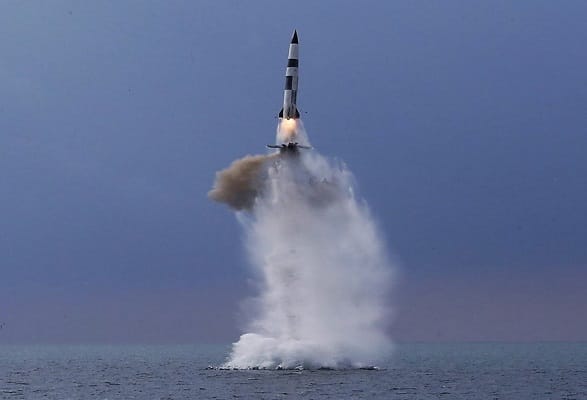
Vladimir Putin oversaw a demonstration of Russia’s strategic nuclear capability hours after holding rare talks with the leaders of Finland and Norway over the war in Ukraine, underscoring the difficulty of separating diplomatic efforts to end the conflict from Moscow’s military pressure on Europe.
A Russian nuclear-powered submarine launched a Bulava intercontinental ballistic missile across thousands of miles of Russian territory towards a designated test range in the country’s north-west, close to the borders of two Nato members.
The launch followed a telephone conversation between Putin, Finnish President Alexander Stubb and Norwegian Prime Minister Jonas Gahr Støre, in which the Nordic leaders urged the Russian president to take steps towards de-escalation. The discussion, the first known direct contact between the leaders and Putin since the early months of Russia’s full-scale invasion in February 2022, produced no immediate sign of a breakthrough.
The Bulava missile was fired from the Generalissimus Suvorov, a Borei-A class strategic nuclear-powered submarine operating in the Sea of Okhotsk in Russia’s Far East. It travelled approximately 3,400 miles before reaching the Chizha missile test range in the Arkhangelsk region.
Read more related news:
UK’s ‘defence spending must be increased to 5% immediately’ as time is running short to prepare for war
War is ‘no longer distant storm clouds’ as RAF chiefs chilling warning UK faces ‘existential’ threats
Ukrainian posties ‘destroy Russian drones’ as Nova Post build their own air defences
The chilling lesson of the Second World War, women could be called up if Britain goes to war
The range is about 320 miles from Vardø in Norway and 386 miles from Nuorgam in Finland, placing the exercise within a wider context of heightened concern over Russia’s military posture near Nato territory.
Russia’s Defence Ministry said the missile’s warhead reached its designated target area at the scheduled time, describing the launch as part of routine combat training.
“The crew of the Project 955A Borei-A strategic nuclear-powered missile submarine Generalissimus Suvorov of the Pacific Fleet, in accordance with the combat training plan, carried out a launch of a Bulava intercontinental ballistic missile at the Chizha test range in the Arkhangelsk region,” the ministry said.
It added that “the missile firing was carried out from a submerged position in the waters of the Sea of Okhotsk”.
Although Moscow presented the exercise as a scheduled military activity, its timing gave the launch additional political significance, coming as European leaders seek a route towards ending a war that has reshaped the continent’s security calculations.
Stubb described the conversation with Putin as “frank and substantive”, arguing that Finland and Norway had a direct interest in the conflict’s outcome because of their geographical proximity to Russia.
“We are neighboring countries to Russia. The outcome of this war will directly affect our security and that of Europe. Ending the war requires direct discussions,” he said.
Støre emphasised the long-term human and economic consequences of the fighting and called for an immediate reduction in tensions.
“The war comes with enormous human and material costs. The suffering and destruction will impact generations. In the call we stressed the importance of de-escalation,” he said.
The Kremlin said Putin had defended Russia’s conduct of the war and offered his interpretation of the two countries’ shared history. It also maintained that any lasting settlement would have to take Russia’s interests fully into account, while accusing the EU and Nato of pursuing policies that prolonged the conflict.
A source close to the Kremlin told Reuters that Putin reiterated Moscow’s refusal to compromise on its objective of taking control of the entire Donbas region in eastern Ukraine, a central obstacle to negotiations.
Ukraine was consulted during preparations for the Nordic leaders’ discussions with Putin. Afterwards, Stubb and Støre spoke to Ukrainian President Volodymyr Zelensky to brief him on the exchange.
Zelensky subsequently called for concrete steps towards de-escalation, including measures relating to energy and infrastructure, sectors repeatedly affected by Russian attacks during the war.
The submarine’s name carries its own historical symbolism. Generalissimus Suvorov is named after Alexander Suvorov, the 18th-century Russian commander associated with the expansion of Moscow’s control over Crimea and southern Ukraine, as well as the bloody capture of Izmail, now in Ukraine’s Odesa region, in 1790.
The latest launch was only the third time since 2020 that an intercontinental ballistic missile had been fired from the Sea of Okhotsk towards the Chizha range, according to the information provided.
The diplomatic initiative also appeared to leave fundamental disagreements intact. Russian Foreign Minister Sergei Lavrov said after the talks that “nothing new was discussed” and warned that the war was “likely to escalate”.
The juxtaposition of the call and the missile test illustrated the narrow space for diplomacy; European leaders are seeking direct engagement with Moscow to reduce the risks of a prolonged conflict, while the Kremlin continues to insist on its strategic demands and demonstrate the capabilities underpinning its military power.
For Finland and Norway, both Nato members sharing borders or close proximity with Russia, the implications extend beyond the battlefield in Ukraine. The course of the war, and the terms on which it might eventually end, remain central to their assessment of European security.


Leave a Comment