
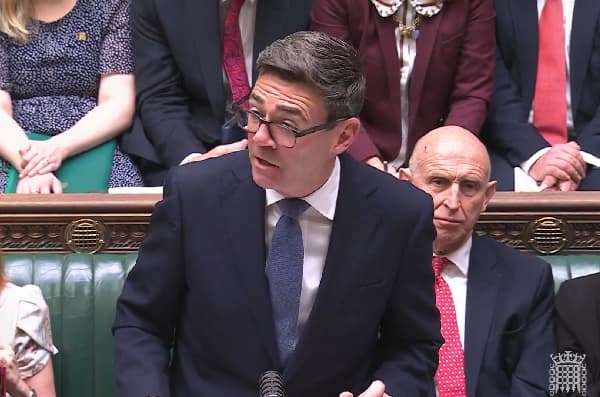
Prime Minister warns maintaining the status quo would be a “dereliction of duty” as critics accuse him of reopening Britain’s bitterest political divide, with warnings the row could unleash fresh economic uncertainty.
Andy Burnham has delivered his clearest signal yet that he wants to bring Britain closer to the European Union, igniting a fresh Brexit confrontation at Westminster as critics question his judgment and demand answers over allegations of Russian interference.
Addressing the Commons on Monday, the Prime Minister said he would use the forthcoming EU-UK summit in Brussels to pursue a “serious dialogue” about Britain’s future relationship with the bloc, arguing that maintaining the current “status quo” amid persistent trading difficulties would be a “dereliction of duty”.
Although Mr Burnham acknowledged that any closer relationship would ultimately depend on the British public’s will, his intervention threatens to reopen a political battle that has divided the country for years.
Conservative leader Kemi Badenoch challenged the decision to focus on Brexit when Britain faces pressing economic and domestic problems, while critics warned that renewed uncertainty could unsettle businesses and investors.
Read more related news:
Burnham claims Russia ‘clearly’ interfered in Brexit referendum as he reignites EU debate
Germany vows to help Burnham reverse Brexit as Farage declares ‘I’ll fight’
Burnham’s Brexit bombshell undermined by own minister as Russia interference row erupts
MI5 chief warns Britain faces ‘seismic shock’ as Russia prepares for years of confrontation
The controversy has intensified after Mr Burnham claimed Russian interference in the 2016 referendum. He previously told a podcast that, on entering No 10, he had been told it was “clear” Moscow was behind state-sponsored interference.
But in the Commons, he denied seeking to question the legitimacy of the referendum, telling MPs: “It is a matter of record that Russian actors sought to interfere in the 2019 general election and we think it is inconceivable that this was the first time.”
The distinction has done little to quell the political storm, with opponents accusing the Prime Minister of blurring the lines between interference in a general election and the vote that took Britain out of the EU.
Former Bank of England economist Andy Haldane, an informal adviser to Mr Burnham, warned that revisiting the dispute “opens up a can of worms”.
Speaking to LBC, Mr Haldane said: “Do we want to rerun that Brexit referendum? Would that not be a thing that escalated uncertainty, and therefore set business back on its heels? I think that is the risk in this. That it opens up a can of worms that generate more uncertainty at a time when stability is needed.”
He also raised questions about the Prime Minister’s political and economic prospects, saying: “I think from here we’re into the downslope economically and possibly politically as well.”
Criticism from within the broader circle of economic advisers adds pressure on Mr Burnham to show that closer ties with Brussels would deliver tangible benefits rather than reignite old divisions.
Sir Iain Duncan Smith, the former Conservative leader, issued an especially sharp rebuke on X, writing: “Andy Burnham keeps dragging us back to the Brexit referendum, claiming Russian interference, yet has produced no evidence to substantiate it. Now, when challenged, he tries to wriggle out of it by claiming he meant a general election instead.
“As Kemi Badenoch and Nigel Farage have pointed out, these are two very different things. You cannot make serious claims like this and then dodge around when challenged.
“For God’s sake, Andy Burnham, you’re the Prime Minister now, not a student debating in a student common room. Start acting like a Prime Minister.”
Sir Jacob Rees-Mogg savaged Burnham, telling GB News: “It’s paranoia. It’s absurd. It’s crazy stuff. We voted to leave the European Union because the great British people like democracy. They want to rule themselves. They don’t want to be told what to do by a large bureaucracy in Brussels.
“It was as simple as that, and we quite liked having the cash back too. It’s not a grand conspiracy. The dear old Prime Minister is off his rocker.”
The row has now drawn a warning from MI5 director-general Sir Ken McCallum, who said Russian trolls had attempted to meddle in the referendum but stressed that attempts to interfere should not be confused with proof of a changed result.
“It is important to focus on the difference between what may have been attempted and what actually resulted,” he said.
Sir Ken also warned that Moscow would be “delighted” if the controversy continued to dominate Britain’s political agenda, allowing adversaries to exploit divisions within society.
For Mr Burnham, the stakes extend beyond the forthcoming Brussels summit. He must now explain how closer EU relations would work in practice while reassuring voters that he is not seeking to overturn their democratic decision.
His declaration that the status quo would be a “dereliction of duty” has sharpened the debate. With opponents demanding evidence, economists warning of uncertainty and the intelligence chief cautioning against amplifying Russian propaganda, the Prime Minister faces a test of whether he can reset relations with Europe without reigniting the Brexit wars.


Leave a Comment