
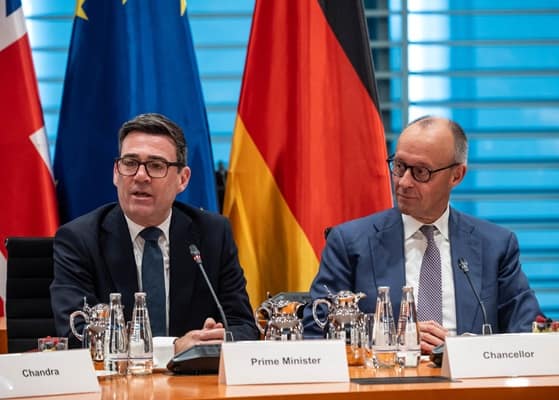
Andy Burnham has signalled that Labour’s ambitions to rebuild Britain’s relationship with the European Union extend well beyond removing post-Brexit trade barriers, insisting that closer ties with Brussels could help bring down the cost of living.
The intervention comes ahead of a November 20 summit with EU representatives, where the Government is expected to pursue agreements covering food standards, farming and emissions trading.
But Mr Burnham’s suggestion that the meeting should be only the beginning of a deeper relationship risks reigniting political divisions that Labour has so far been keen to contain.
Speaking to the Sunday Mirror, Mr Burnham made the economic case for closer European cooperation, arguing that practical agreements could deliver tangible benefits for struggling households.
It pays to have a good relationship with your neighbours, and the practical deals we are agreeing with Europe will pay off for families across the UK,” he said.
Cutting red tape on food coming in and out of the country will ease pressure on prices at the supermarket, while making life easier for farmers and food producers.
But it was his subsequent remarks that are likely to attract the greatest political attention.
“This summit will show what we can achieve when we work together, but it doesn’t need to be the end of our ambition,” he said.
Working more closely with Europe could drive growth, make our country safer and give us more tools to tackle illegal migration. That’s a conversation worth having.”
The Government is seeking to remove some of the regulatory friction introduced by Brexit, including through a new sanitary and phytosanitary agreement aligning British food standards more closely with EU requirements.
The changes could eliminate certain border checks and allow British producers to remove labels marked “not for EU”. However, the agreement also brings new regulatory obligations, with some products potentially requiring reformulation to comply with European standards.
For businesses, the prospect of smoother trade offers potential savings. For critics, however, the price could be a gradual surrender of the regulatory independence Britain secured by leaving the bloc.
Labour has also announced that Britain will rejoin the Erasmus+ education programme, restoring opportunities for students and institutions to participate in European exchanges.
Behind the economic arguments lies a much larger political question: how far does Labour ultimately want to reverse the consequences of Brexit?
Mr Burnham has previously acknowledged wanting Britain to return to the EU and has suggested there should be an “honest conversation” about deeper integration, including the possibility of restoring free movement.
Nigel Farage has condemned such proposals as a “betrayal”, while senior Labour figures reportedly fear that an increasingly pro-European direction could cost the party support in constituencies vulnerable to Reform UK.
The Government is also exploring access to European migration databases, which ministers believe could improve intelligence-sharing and help tackle illegal Channel crossings and organised immigration crime.
Yet closer integration comes with significant complications.
Michel Barnier, the EU’s former chief Brexit negotiator, has warned that Britain cannot simply select the advantages of the single market while rejecting its obligations.
Speaking to the BBC’s Sunday with Laura Kuenssberg, he indicated that EU member states would expect commitments including free movement of people in exchange for significantly improved access to European markets.
That presents Labour with a difficult balancing act. The economic attractions of closer cooperation are considerable, but the political consequences could prove far more complicated.
Mr Burnham has insisted that any range of options should ultimately be presented to the public, ruling out major changes before an election.
Nevertheless, his latest intervention suggests the debate over Britain’s relationship with Europe is far from settled.
For Labour, the challenge will be convincing voters that a closer relationship with Brussels means cheaper shopping, stronger growth and better security – rather than another attempt to reopen the Brexit settlement.
And as the November summit approaches, the question is becoming increasingly difficult to avoid: is Labour negotiating a better Brexit, or preparing the ground for something considerably closer to the EU?


Leave a Comment